Verse 91821aakare ko))ii
G3
1
the lifetime did not become equal to the endurance-testing vow/promise
2
where is the leisure, that anyone would long for you?!
'Equal; --an equal, a rival'.
'Patience, self-restraint, endurance, patient suffering, resignation'.
| References | |
|---|---|
| Arshi, Imtiyaz Ali | Ghazal# 169 |
| Raza, Kalidas Gupta | 347 |
| Nuskhah-e-Hamidiyah | 255-257 |
| Asi, Abdul Bari | 262-263 |
| Gyan Chand | 383-384 |
| Hamid Ali Khan | Open Image |
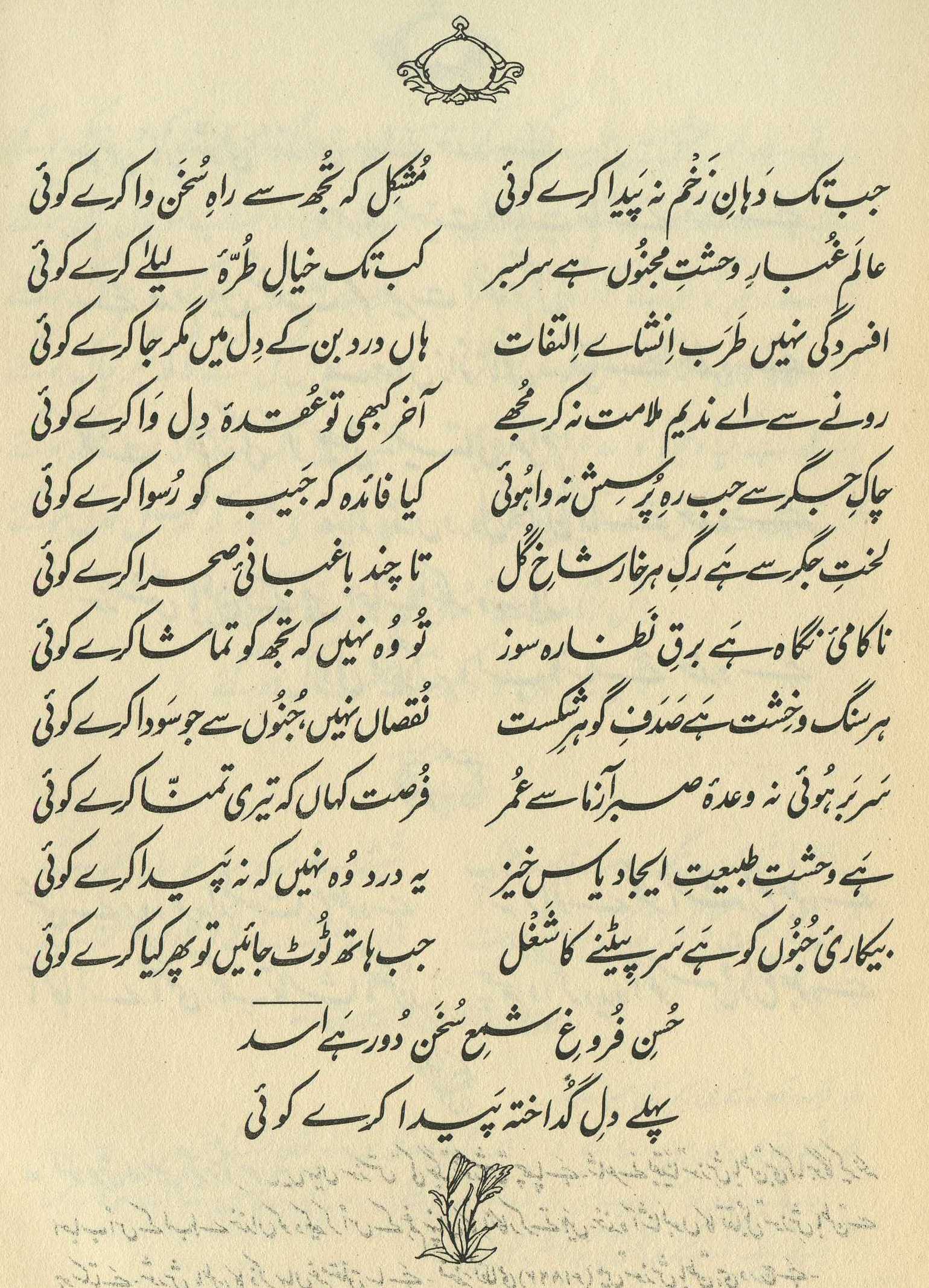
That is, the whole life passed in simply the testing of endurance. Then when would there be time to long for obtaining you?
==Urdu text: Yadgar-e Ghalib , p. 164
That is, we died in the interval of waiting itself; the time of longing didn't manage to come. But it would have been better if he had said that time for the obtaining of longing didn't manage to come, and there was no chance at all of achieving what one longed for; for the ground of the verse didn't give a way toward this meaning. (243)
== Nazm page 243

[Disagreeing with Nazm:] The Lord knows from where Janab the Commentator pulled out this meaning, and how he pulled it out! Because if the time of longing itself never came, then what kind of vow was it, and who made it, and why, and to whom? And from where did the expression of this standard of waiting come? The author is saying in very clear words that he felt longing, and that he also had a chance to express his condition. The beloved too made a vow. But that vow was endurance-testing. The lover wasn't vouchsafed the time to live until the day of [fulfillment of] the vow. (437)
Who actually made the 'endurance-testing' vow or promise, and what kind of a vow was it? Was it made by the lover, or by the beloved? What was the content of the vow? Any close reader can see the care with which all such information has been withheld.
Since we don't know anything at all about the vow (except that it was 'endurance-testing'), we have to decide for ourselves how to connect the two lines. What is the relationship between the 'vow' and the 'longing'? Is the 'longing' for the fulfillment of the vow in particular, or just a general expression of passionate desire? Is the 'vow' completely separate from the 'longing', such that it supplanted the longing in the lover's attention, or is it connected to it? Is the 'longing' a single action that might never happen, or a prolonged action that might never be brought to full completion? Out of all these complexities, here are some of the possible readings that emerge:
='No one's lifetime is enough for the full measure of 'longing' for you-- where is there enough leisure in a mere lifetime for anyone to properly, duly, devotedly, fulfill his vow of longing for you?'
='Who has any leisure?! As if anyone did! Since one's whole life is more than taken up with fulfilling an endurance-testing vow, who has time to even think about longing for you?!'
='The impossible, endurance-testing vow that you required me to take was more than I could bear; it killed me instantly, before I even had a chance to long for you.'
='Your vow of such great joy (of union) after such a long interval (almost a lifetime?) was more than my heart could bear; the combination of ecstasy and wild impatience finished me off at once, before I even had a chance to long for you.'
The use of is also enjoyable, because vows are often taken in a form like 'I swear by your/my head []'; and can mean 'bearing, carrying off' (Platts p.143).
The second line, in its colloquial, possibly petulant, tone, is a charmer-- for discussion, see the similarly structured 214,2 .
graphics/longing.jpg