Verse 111821aakare ko))ii
G3
1
the uselessness/'unemployment' of madness has the employment/pastime of beating the head
2
when the hands would break, then-- then/again, what would/could anyone do?!
'Without work or employment, unemployed, not in office, idle; inoperative, ineffective; without force, invalid; useless, worthless'.
'Business, occupation, employment, labour, study; anything to occupy or divert; diversion, pastime, amusement'.
| References | |
|---|---|
| Arshi, Imtiyaz Ali | Ghazal# 169 |
| Raza, Kalidas Gupta | 347 |
| Nuskhah-e-Hamidiyah | 255-257 |
| Asi, Abdul Bari | 262-263 |
| Gyan Chand | 383-384 |
| Hamid Ali Khan | Open Image |
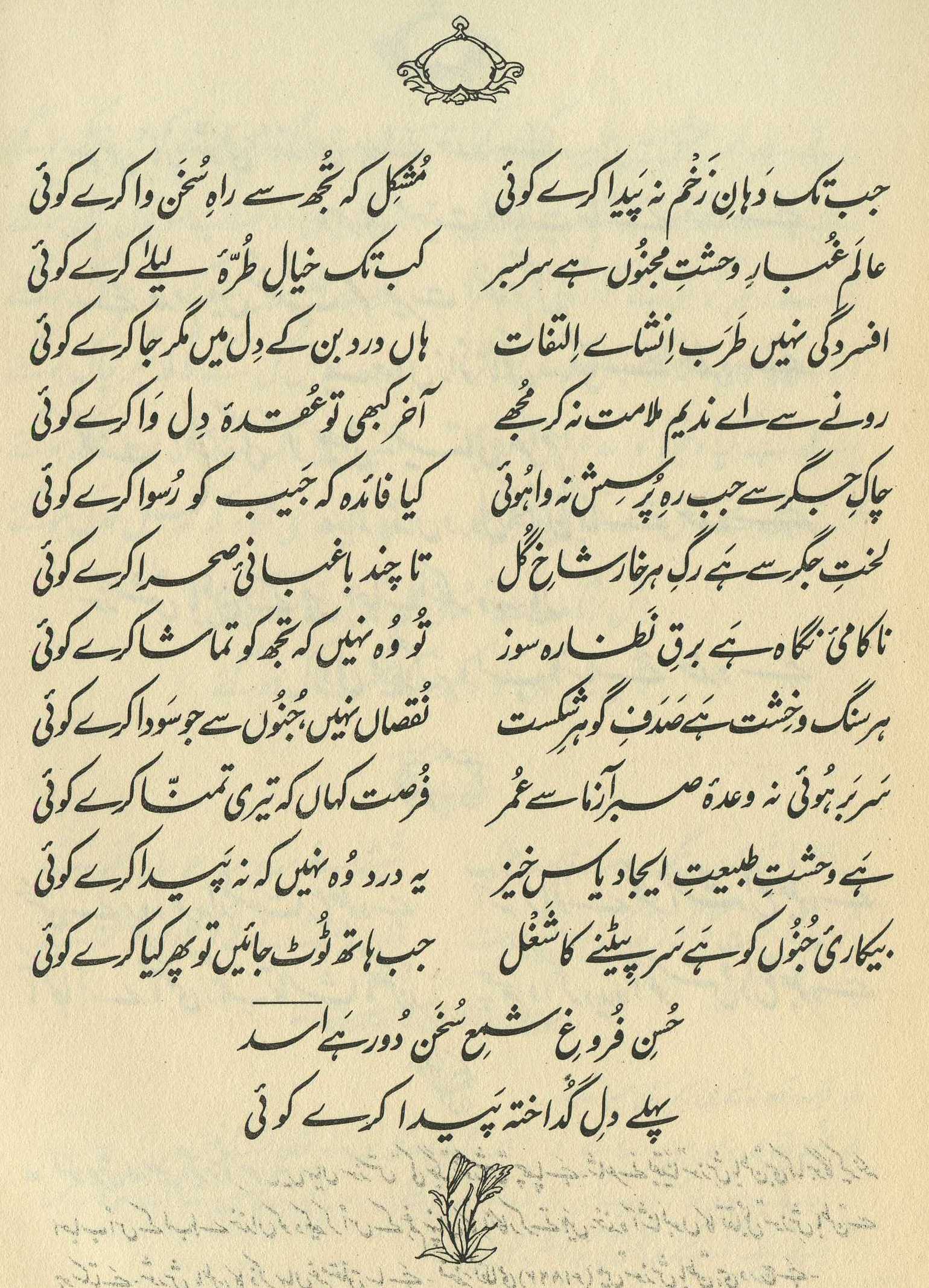
In this verse, would have been better in place of . And from the hands' breaking, to remain useless and to become without occupation is intended. That is, in madness, from constantly sitting useless and without occupation one feels suffocated [and thinks]: 'Come on. let's beat the head!' As long as one would be useless in this way, if he wouldn't beat his head then what would he do? The convention is that when a man becomes fed up, then he beats his head. (243)
== Nazm page 243

He says, for madness, one employment or another is necessary and indispensable. As long as clothing remained on the body, he kept tearing the collar. When every thread had been torn apart, he found the employment of beating the head.... Now the thing to see is that if the hands too would break, then what would he do? (302)
[Disagreeing with Nazm's correction:] From saying , he constructs the 'uselessness of madness' itself as inventing the employment of beating the head. From saying , the possessor of the madness is declared to be the inventor.... If Hazrat the Commentator's revision and correction would be accepted, then the force of the speech would began to lament [over its lessening]. The tells us that the speaker hardly has enough awareness that he would seek out for himself an employment; the 'uselessness of madness' does whatever it wishes. (439)
The first line has an enjoyable feeling of paradox : the uselessness or 'unemployment' of madness has, it seems, an 'employment' after all. Or if we soften the formal force of the paradox, at a minimum the 'idleness' of madness has an 'occupation', or at least something or other that forms a 'pastime': repeatedly striking the head, in despair or sheer craziness.
The second line moves on to consider a future that's certain to come about-- it's not 'if' the hands would break, but 'when'. And then comes the real center of the verse: the double reading of . In normal colloquial speech, this is a general remark expressive of futility or helplessness, like 'what can you do?' or 'what can I say?' in English; it's the verbal equivalent of a shrug of the shoulders. The speaker washes his hands of a hopeless situation that he is powerless to remedy. For another example of this idiomatic expression, see 215,2 .
But in this case it suddenly strikes us that the conventional phrase is to be read literally too: 'then what would anyone do?' is a serious question. When the 'unemployment of madness' loses its employment, how will it react? What will the 'madness' do, and what effect will it have on the mad lover in whom it lives? Will it drive him into the desert? Will he begin to smash his head into a wall, with fatal results? Will he sink into a hopeless inertia? If beating his head with his hands until his hands break is a 'pastime', the loss of it can only result in something even more disastrous. The next stage is sure to end badly; and it's only a matter of time until it occurs.
Moreover, the presence of makes the problem feel very generalized. What would 'someone' or 'anyone' do? The grammar suggests that the problem is one that anyone, or even everyone, might one day have to confront.
graphics/madness.jpg