Verse 121821aakare ko))ii
G3
1
the beauty of the brightness of the candle of poetry/'speech' is far off, Asad
2
first someone would/should create a melted heart
'Illumination, light, brightness, splendour; flame; --glory, fame, honour'.
'Melted, dissolved'.
| References | |
|---|---|
| Arshi, Imtiyaz Ali | Ghazal# 169 |
| Raza, Kalidas Gupta | 347 |
| Nuskhah-e-Hamidiyah | 255-257 |
| Asi, Abdul Bari | 262-263 |
| Gyan Chand | 383-384 |
| Hamid Ali Khan | Open Image |
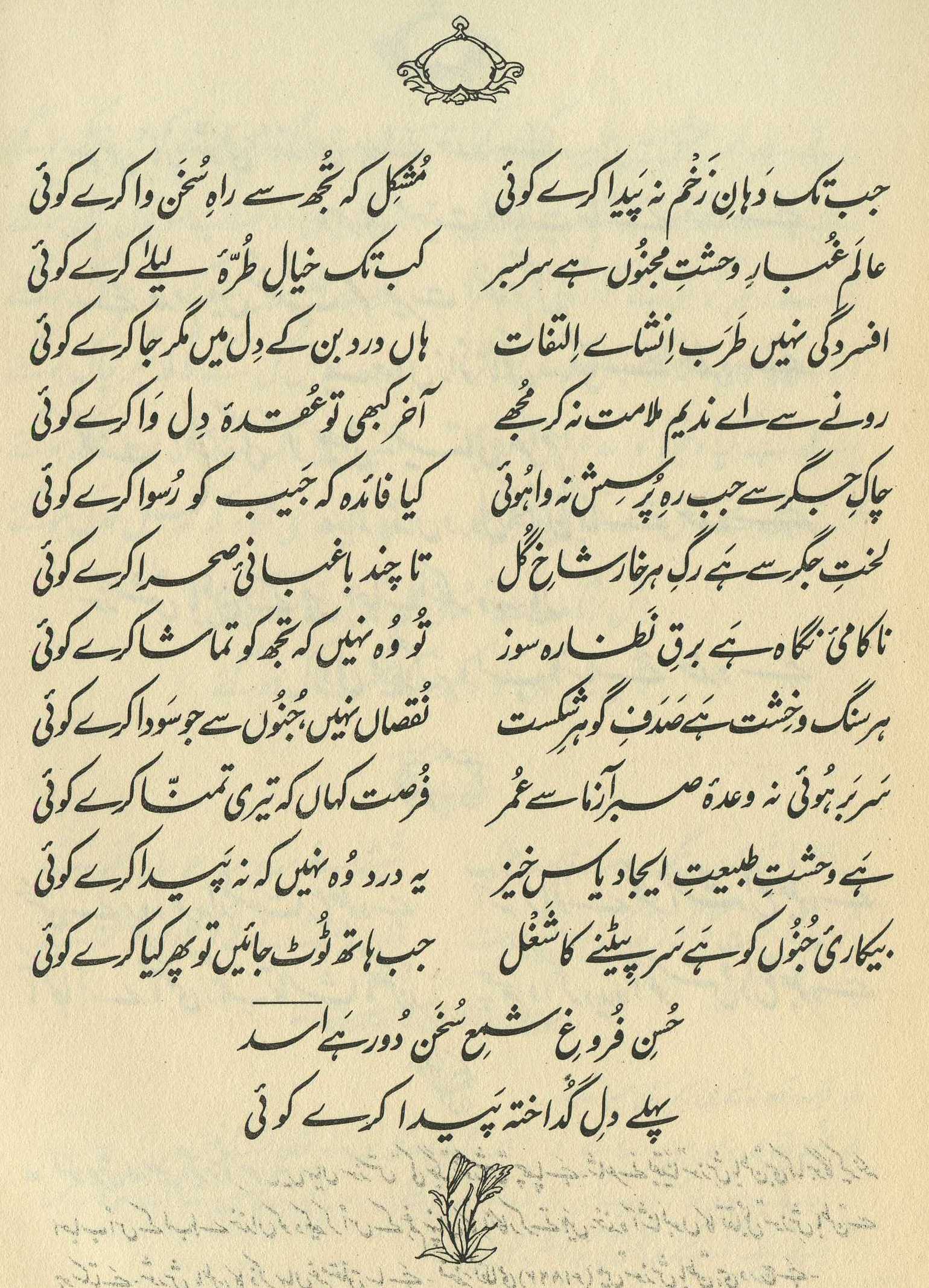
That is, like a candle, first one would create a melted heart; after that, one would long for the brightness of the flame of poetry. (243)
== Nazm page 243

He says, first, like a candle, one would create a melted heart; after that one would long and yearn for the brightness of the flame of poetry. (302)
The one who wishes for there to be pleasure in his speech, ought first to create burning and melting in his heart. (439)
As Faruqi observes, a candle flares up most brightly before dying; this is true frequently in the real world, and always in the ghazal world. When it's on the verge of guttering out, the candle's flaring, radiant 'heart' has become 'melted' into a pool of liquid wax that surrounds it. So it's when one's flame is almost ready to burn itself out that one's true radiance appears; this idea is reminiscent of the folk-etymology of 'ghazal' as derived from the last wild beautiful cry of a dying gazelle.
And if we take the first line in a more literal and careful sense, we have a more piquant subtlety of meaning. What is it that's 'far-off'? It's 'beauty', and the beauty is that of 'brightness', and the brightness is that of a candle-- the candle of poetry (or, literally, 'speech'). In view of the flexibility of the construction, this may be a metaphoric equation (candle=poetry), but it could also refer to a candle that 'belongs to' or 'pertains to' poetry in some other, unspecified sense.
In any case, it appears that one can't have the 'candle of poetry' without either previously, or at the same time, having a candle. Thus the aspiring poet must melt down his heart with suffering, pain, longing, and so on-- all the torments the passionate lover knows so well-- until it is as hotly radiant (and self-consuming) as a candle.
This closing-verse also seems to bring us full circle, for it evokes the opening-verse , 214,1 .
graphics/meltedheart.jpg