Verse 121833aardekh kar
G3
1
that breaking-open [of his] head, by disturbed/mad Ghalib
2
came to my mind/memory, having seen your wall
'To break the head (of), crack or split the skull (of); to wrangle, quarrel, fight; --to rack (one's own) brains, to labour or strive in vain'.
'Disturbed (in mind), distracted, mad, frantic; desperately in love; faint; dejected'.
| References | |
|---|---|
| Arshi, Imtiyaz Ali | Ghazal# 63 |
| Raza, Kalidas Gupta | 380 |
| Hamid Ali Khan | Open Image |
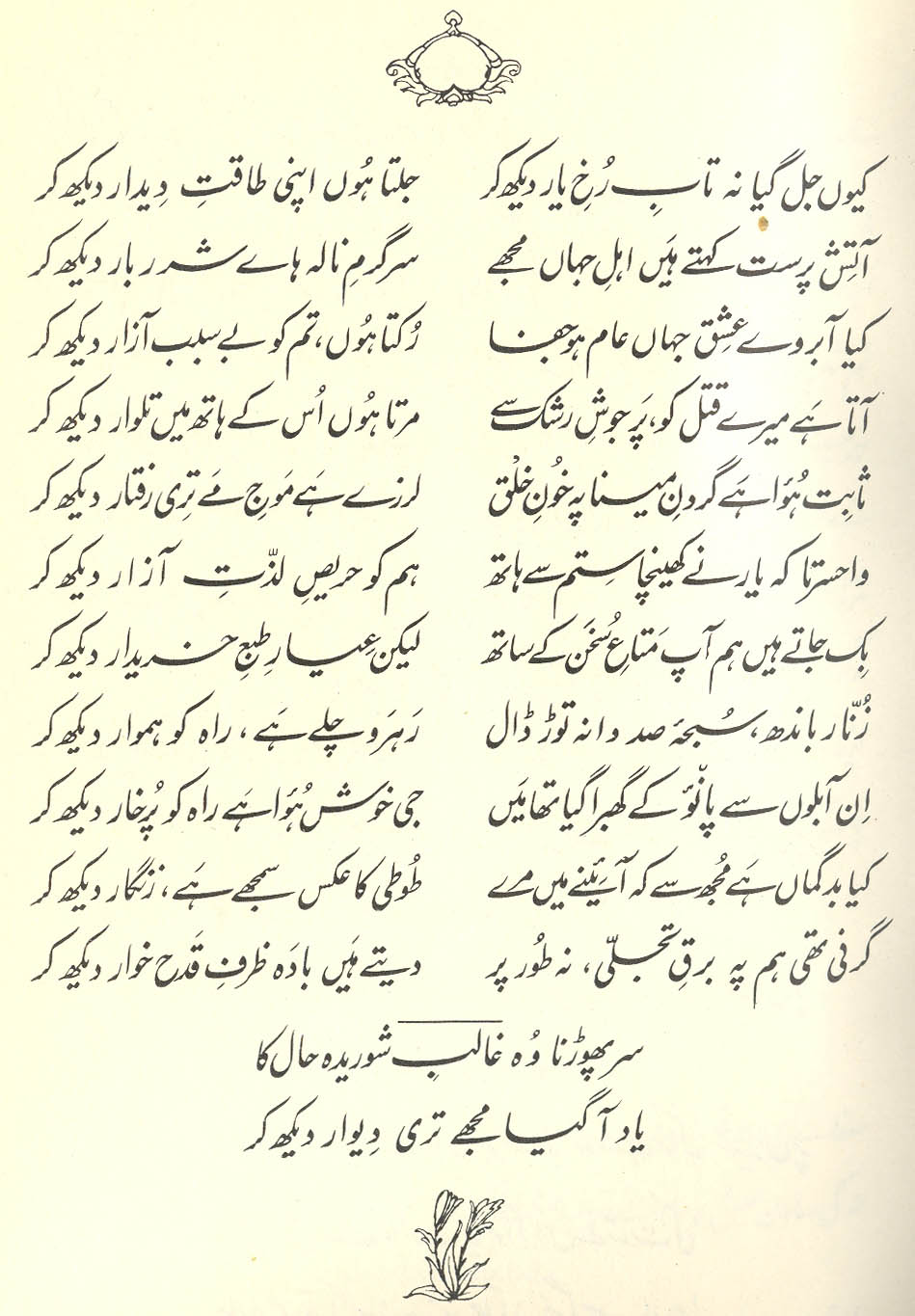
The author has put 'Ghalib' instead of 'lover'-- he has used a proper name instead of a common noun. And for this reason the verse has become more familiar. And the other delightful thing is that the words he has used to fill out the line are very meaningful indeed. For one thing, Ghalib's quality is his being 'disturbed/mad', which makes manifest the cause of his breaking his head. Second, he's used the word 'that' [], which by its meaningfulness raises the beauty of the verse from single-fold to thousand-fold. (60)
== Nazm page 59 ; Nazm page 60


In the first line, Mirza Sahib has created with the word 'that' a picture of his breaking his head before the eyes. The time and occasion of the head-breaking have passed, but seeing her wall, even now that spectacle passes before the eyes, and those who see the door and walls have their memory refreshed. (106)
In the first line, saying 'Ghalib' instead of 'lover'-- that is, a proper noun instead of a common noun-- is also a special part of the beauty of style. (142)
Compare 72,7 (204)
The commentators point to what might be called the intimacy of the verse. Someone speaks to the beloved in the intimate form [], and casually mentions a shared memory. Who is the someone? A new lover? An old friend? There's no way of telling, but certainly someone who shares the kind of closeness to the beloved that the lover could only dream of. The way the speaker uses the 'that' [] does indeed, as Nazm says, make for a sense of assured recognition; the speaker is referring to a well-remembered event, not imparting information about something previously unknown: ('I just was reminded of that day when...').
The memory of the disturbed/mad 'Ghalib' breaking his head in despair came to the speaker when he saw the beloved's wall-- a beautiful example of implication . We immediately understand that Ghalib tormented (or even killed?) himself by beating his head on a wall-- that very wall? or merely a similar one?-- to escape the intolerable suffering of passion. The memory is so vivid that merely the sight of the beloved's wall can trigger it. Perhaps the wall outside her house was the nearest Ghalib ever got to the beloved?
Nazm emphasizes the extra familiarity given by using the name 'Ghalib'. But of course, this is a closing-verse and needed to include the poet's pen-name , so there's an element of convenience as well. And perhaps the strong suggestion of death given by also seemed suitable to a closing-verse.
Arshi is right to suggest for comparison 72,7 , which really is very similar.
graphics/wall.jpg