Verse 51833aardekh kar
G3
1
it has been proved/fixed on the neck of the flagon, [guilt for] the blood of the people/creation
2
the wave of wine trembles/quivers, having seen your gait
'Continuing, subsisting, lasting, enduring, remaining; remaining fixed or stationary, standing, resting; permanent, constant, firm, steady, steadfast, stable, fixed, fast, settled, established, confirmed, proved, ascertained'.
is an archaic form of . ( GRAMMAR )
| References | |
|---|---|
| Arshi, Imtiyaz Ali | Ghazal# 63 |
| Raza, Kalidas Gupta | 380 |
| Hamid Ali Khan | Open Image |
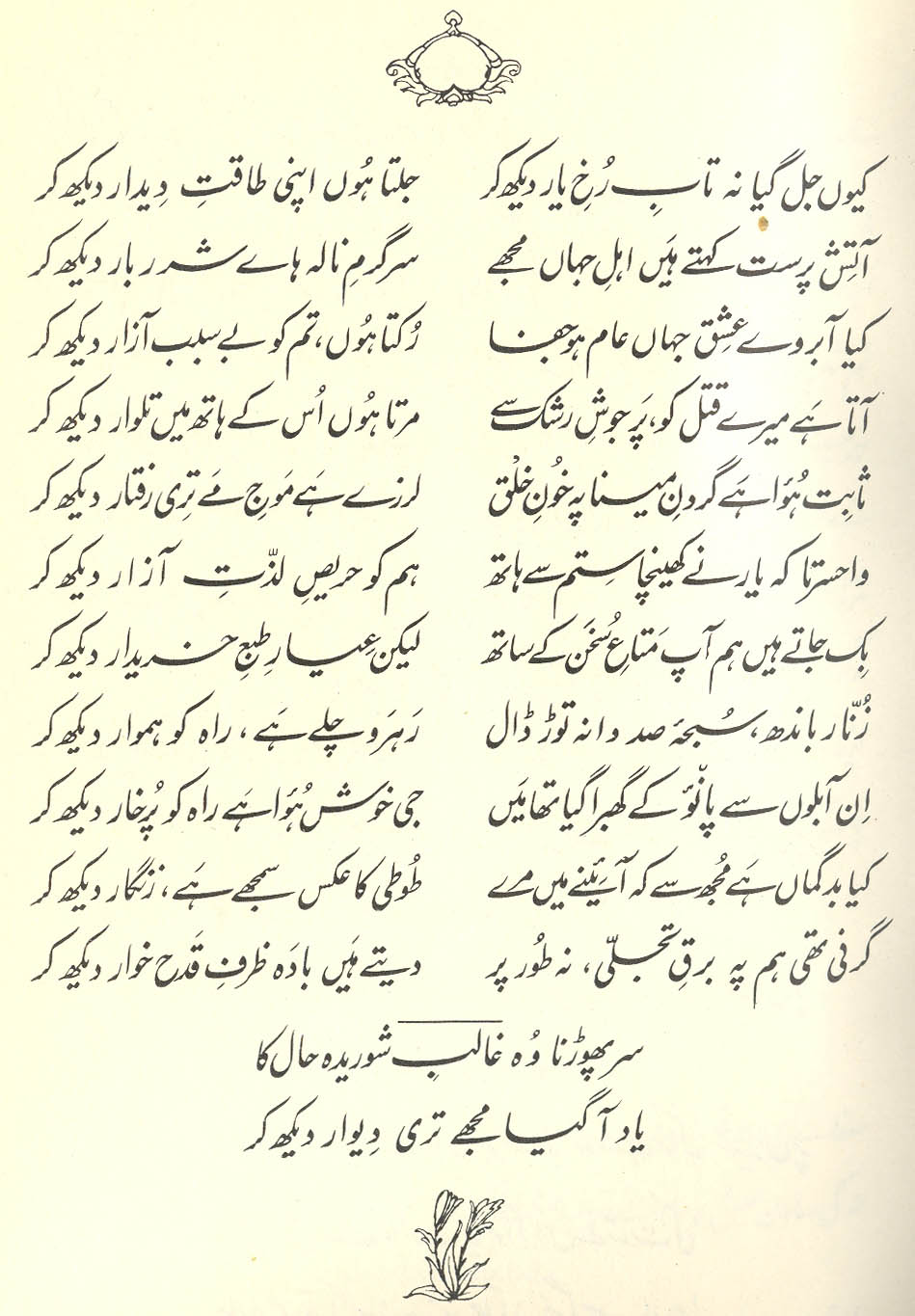
Seeing your intoxicated gait in a state of drunkenness, the wave of wine is trembling, [aware that] this gait will cause the murder of the world. From this we have learned that the cause of the murder of the world is this very glass of wine-- if you had not drunk wine, then your intoxicated gait would not have murdered the world. (58)
== Nazm page 58

He says, on the neck of the wine-flask is proved to lie the blood of the Lord's creatures. For this reason, out of fear the wave of wine, seeing your gait, is trembling. The meaning is that in the state of intoxication your gait has become more intoxicated, and seeing it, the whole age is being slain. (104)
The wave of wine naturally trembles. But Mirza says the reason for this is that since your intoxicated gait has murdered the world, the wave of wine is realizing that if you hadn't drunk wine, then your gait wouldn't have been so intoxicated, nor would the world have been destroyed. The wave of wine considers itself to be the reason for this universal slaughter, and is trembling with fear of Judgment Day. (133)
Bekhud Mohani in effect claims, though without using the term, that this verse is an example of the verbal device called ' elegance in assigning a cause '. Wine tends to show small wave movements in its surface when the flagon or glass that holds it is moved. Now the verse tells us what those movements are: they are caused by the 'trembling' of the wine as it anticipates the punishment it will receive for the murder of those thousands who have been slain by the ravishing loveliness of the way the beloved walks, swaying slightly, when she is intoxicated. Of course, this explanation doesn't account for the trembling of the wine drunk by other people in other gatherings, so the causality is not ideally universal.
Usually murderers are spoken of as having the blood of their victims on their 'neck' [], the way in English murderers have blood on their 'head' or 'hands'. And a wine-flagon too has a thin, elegant 'neck'; if the flagon is held by the neck for pouring, the main body of it will be especially likely to 'tremble'. If the punishment for capital crimes is thought of as loss of one's head (as in 59,4 ), then the flagon's neck, which actually poured out the blood-red, murder-causing wine, is an aptly anthromorphic part of it to mention.
There is also a nice connection between the beloved's 'swaying' gait and the 'trembling' of the wine in the flagon. Even more elegantly, this likeness is made entirely through implication -- there's not a word in the verse that describes the beloved's gait. There's a wordplay connection too, since 'trembling' and 'swaying' contrast so directly with the 'fixed, stationary, standing' (see the definition above) sense of .
graphics/winequiver.jpg
graphics/winewave.jpg