Verse 71833aardekh kar
G3
1
we ourself are sold along with the merchandise/goods of poetry
2
but [only after] having seen the measure/touchstone of quality/temperament/'print' of the buyer
'A standard (of measure, weight, or fineness); mark, proof, test, touchstone, assay'.
tab((a>> : 'Stamping, printing; print, impression, edition (of a book, &c.); --nature, innate or natural disposition; genius; natural temper, temperament; idiosyncrasy; quality'.
| References | |
|---|---|
| Arshi, Imtiyaz Ali | Ghazal# 63 |
| Raza, Kalidas Gupta | 380 |
| Hamid Ali Khan | Open Image |
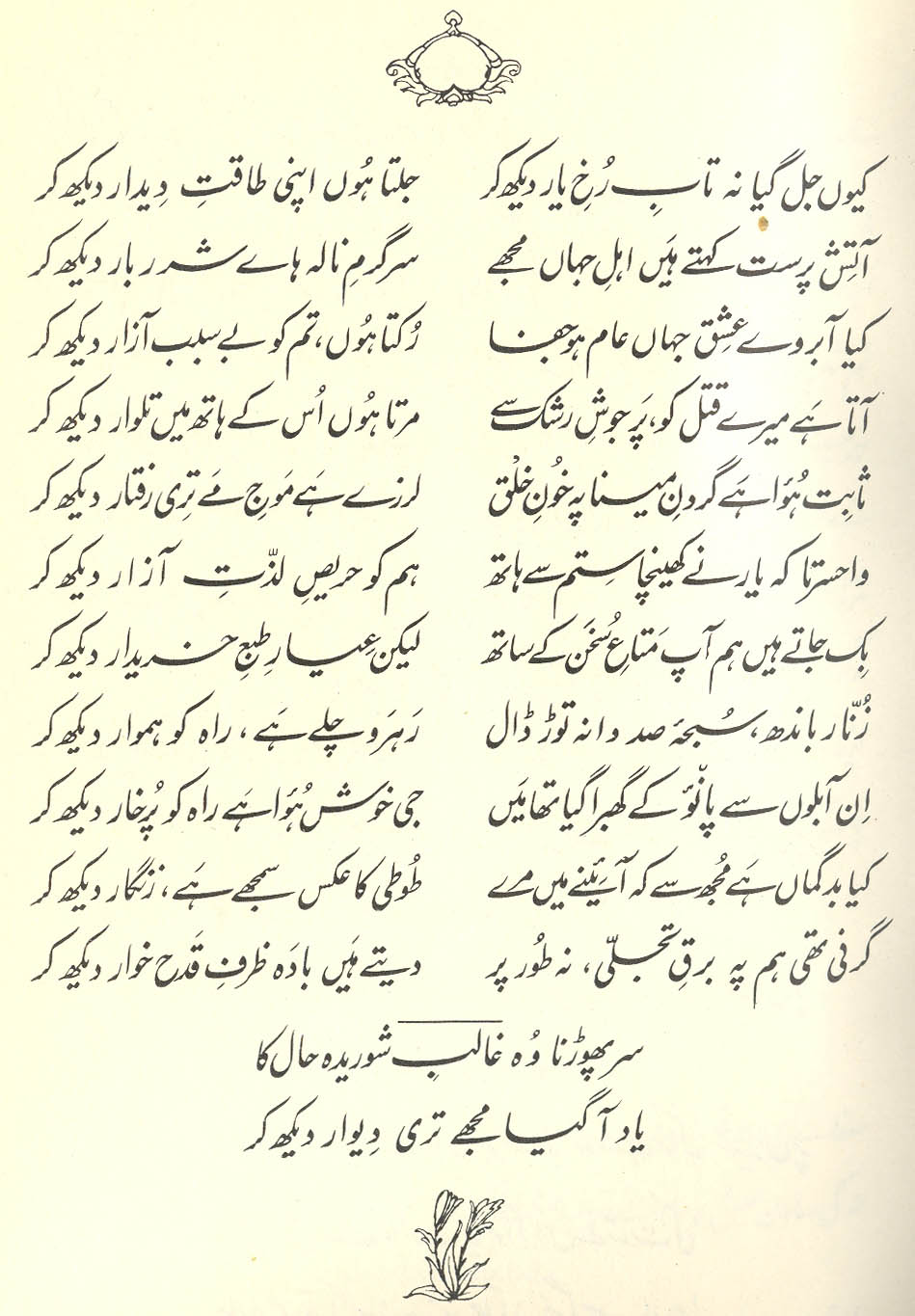
The meaning of the first line is that I myself am sold along with my poetry, and the second line implies that having a correct taste for my poetry is a proof that that person is a person of accomplishment, and this is the reason that I myself am sold into his hands. (59)
== Nazm page 59

We first test the judge of our poetry, and see whether to what extent he can understand our poetry. After that, we ourselves become a judge of his worth. The truth is that to understand Mirza's poetry requires an uncommon mind. In the depth of his ordinary verses too, something is hidden that can only be understood with great difficulty. (105)
Somebody has said,'People have the opinion that you're very arrogant about your poetry, and you don't even recite your poetry to anyone'. In answer to this he says, 'No, Hazrat, such is not the case. Not to speak of reciting verses, I myself am sold into the hands of listeners.' (134)
The second line of this witty little verse depicts the caution and careful scrutiny exercised by a prudent buyer-- the kind who is proud of his ability to detect inferior goods, the kind who never buys a car until he has checked out the transmission and kicked the tires.
But all this caution and prudence are attributed not to the buyer, but to the seller. Why would the seller be so careful about the qualities of the buyer? The first line tells us why: because the poet himself is somehow sold as part of the transaction. (The intransitive verb leaves no agent or seller lurking in the background.) He is passed on along with the creations of his heart and mind, his verses, because he can't easily let them go. Their quality is so high, and so much of himself is invested in them! Would he let his treasures go to an inferior home, where they wouldn't be properly valued or cherished? Naturally he has to be very particular about such things, so he uses a touchstone .
Ghalib's imagining the transfer of verses as a commercial transaction is striking in itself. Usually, it seems, he thinks of commercial transactions only in a way that subverts them. See for example 3,3 , in which 'my Thought's dealings with you' take place only in a dream; or 58,5 , in which the lover's doors and walls become a 'shop' of gazing, for the 'trade' in waiting. Is this verse too, with its seller/buyer role reversal, of the same kind?
If we wanted to interpret the imagery more literally, we could consider it in the light of the new print technology through which Ghalib disseminated his divan . After all, there's the arresting wordplay created by the various meanings of (see the definition above). Ghalib supervised (through intermediaries) the printing of his divan four times in the course of his life (in 1841, 1847, 1861, and 1862), and his letters make clear how he agonized over misprints, typos, and other errors that he was not always able to arrange to have corrected. How different was this kind of dissemination from the traditional oral recitation in an elite, sophisticated mushairah !
And yet, ultimately, how different was it? We know from his letters that Ghalib found his service at the Court irksome and unworthy of his talents. He complained at intervals throughout his life of not having the audience his genius deserved, and of not receiving the patronage that was his due. Perhaps the impersonal vexations of printed books merely replaced the personal vexations of the traditional patronage system. (Compare the generalized 'commercial' frustration expressed in 323x,6 .)
Ultimately, this verse is not about print versus oral recitation, but about the uneasy relationship between the power of the poet (with his enviable, unique brilliance) and the power of the patron (with his indispensable, influential money). How to negotiate a mutually tolerable exchange between them? In his life, Ghalib never found a really satisfactory solution to the problem.
graphics/touchstone.jpg