Verse 31833aardekh kar
G3
1
what honor of/for passion, where cruelty/oppression would be general?
2
I pause/halt, having seen you [to be] {afflicting / an affliction} without cause
'Oppression, violence, cruelty, injury, injustice, hardship'.
'Sickness, disorder, disease, infirmity; trouble, affliction; injury, outrage'.
'Trouble, disorder, affliction, sickness, disease, grief, vexation, molestation, injury, outrage; importunity; (in comp.) tormenting, reproaching, teasing, affronting, as , Tormenting the soul; cruel, brutal'. (Steingass p.42)
| References | |
|---|---|
| Arshi, Imtiyaz Ali | Ghazal# 63 |
| Raza, Kalidas Gupta | 380 |
| Hamid Ali Khan | Open Image |
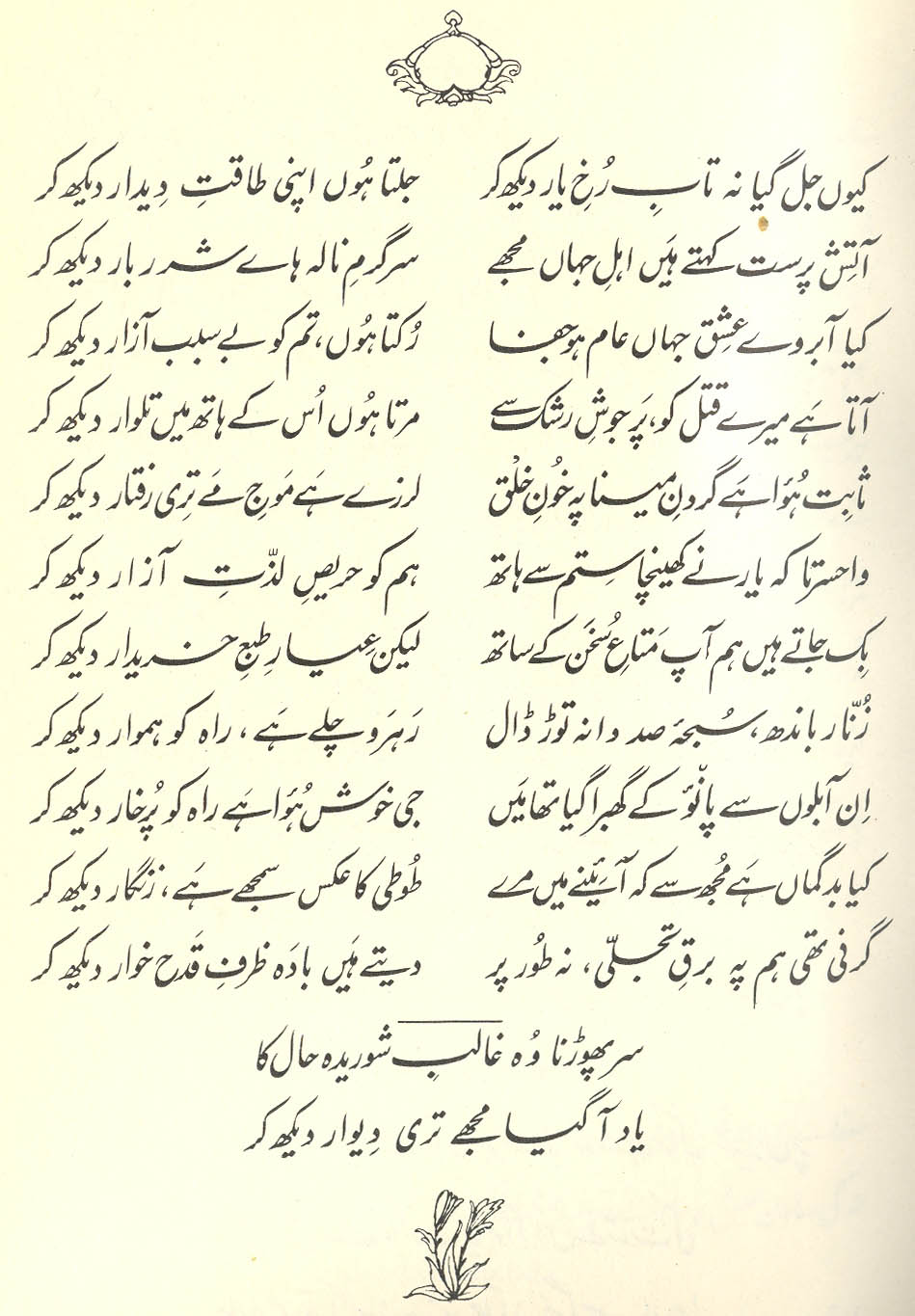
The construction is Persian.... Indeed, freshness in words and in poetic structure gives rise to great beauty, but it ought to be understood that when one does not have very good command of another language, not everybody has the right to make changes in usage. Here, by cruelty being universal is meant that the Rival, in whom the cause for cruelty (that is, passion) is not found-- even at him you get angry in a beloved-like way, as you do at me. (56)
== Nazm page 56

He says, you have made cruelty universal, no kind of discrimination remains. And this deed of yours has stained the honor of love. That is, enduring cruelty is always the lover's essence. You show cruelty to the Rival as well; in the Rival's heart there is no passion for you. Seeing your cruelties to him, I can say that you are angry without reason, and this very thought is the reason that I pause. (104)
One excellence of the verse is its universality and widespread applicability. That is, the theme is not limited simply to ordinary passion; rather, it can be used naturally in politics as well. And this too is a special distinction of many of Mirza's verses. (212)
At first glance, the second line is so reassuringly commonsensical-- the lover tells the beloved, it gives me pause to see you be cruel without reason. So it should! What more ominous alarm signal could there be, than to see a show of wanton cruelty in someone you love? Naturally it would give you pause-- and maybe cause you to turn on your heel and make a quick escape.
But needless to say, the commonsense reading has to be stood on its head. What gives the lover pause is not the sight of serious flaws in the beloved's character, or the fear of falling victim to unjust cruelty. On the contrary in fact-- what gives the lover pause is a fear of losing his precious monopoly rights over the beloved's cruelty. If she is cruel to everyone, causelessly, indiscriminately, how can her cruelty remain a special bond between lover and beloved? Her cruelty should not be lavished upon undeserving others (if it's considered a privilege), nor should it be inflicted upon helpless others (if it's considered a torment).
Like her kindness, her cruelty should be a mark of favor reserved for the true lover alone. (See 38,1 for the limit case of inappropriateness: the beloved is cruel to others, and pointedly not cruel to the lover.) The situation is serious: the very 'honor of passion' can't be maintained unless the beloved does her part, and channels her cruelty as she should. The honorable lover is as jealous of the beloved's cruelty as a lesser, worldly lover would be of her favors. (Since, of course, her cruelty is her favor, or at least as much favor as the lover is likely ever to get from her.)
In Urdu, is just a noun meaning 'trouble, affliction', etc.; in Persian, as Nazm notes, it can be used as the last member of a compound, in a participial way, like , 'scattering', and so on. Steingass gives an example (see the definitions above). The Persian-style reading is, on the face of it, more suitable: 'having seen you to be tormenting without cause'. Normally in such a usage the word must be the last member of a compound ('life-tormenting' or the like), but Ghalib is quite capable of warping Persian grammar as well as Urdu grammar; see 71,7 for a very apposite example.
Still, since we have to do something irregular anyway (by using in isolation a form that should be the last member of a compound), we might as well consider the the literal Urdu too: on that reading, the beloved herself is a causeless 'sickness, affliction, torment, trouble', etc. This makes her sound like an infectious disease, or like a , something that just drops down from the heavens, for no reason whatsoever, to make our lives wretched. And in this verse, that's exactly what she is: she's an affliction that's not only dire and widespread, but also, and most pointedly, .
This is a tarot card, the 'Queen of Swords':
graphics/cruelty.jpg