Verse 91833aardekh kar
G3
1
from these blisters on my feet, I had become anxious/dismayed
2
my inner-self has become happy, having seen the road [to be] full of thorns
'To be confused, confounded, flurried, or flustered (by, or in consequence of, - ); to be perplexed, bewildered, or embarrassed (by); to be perturbed, disturbed in mind, agitated, disquieted, distracted; to be alarmed, scared, dismayed'.
| References | |
|---|---|
| Arshi, Imtiyaz Ali | Ghazal# 63 |
| Raza, Kalidas Gupta | 380 |
| Hamid Ali Khan | Open Image |
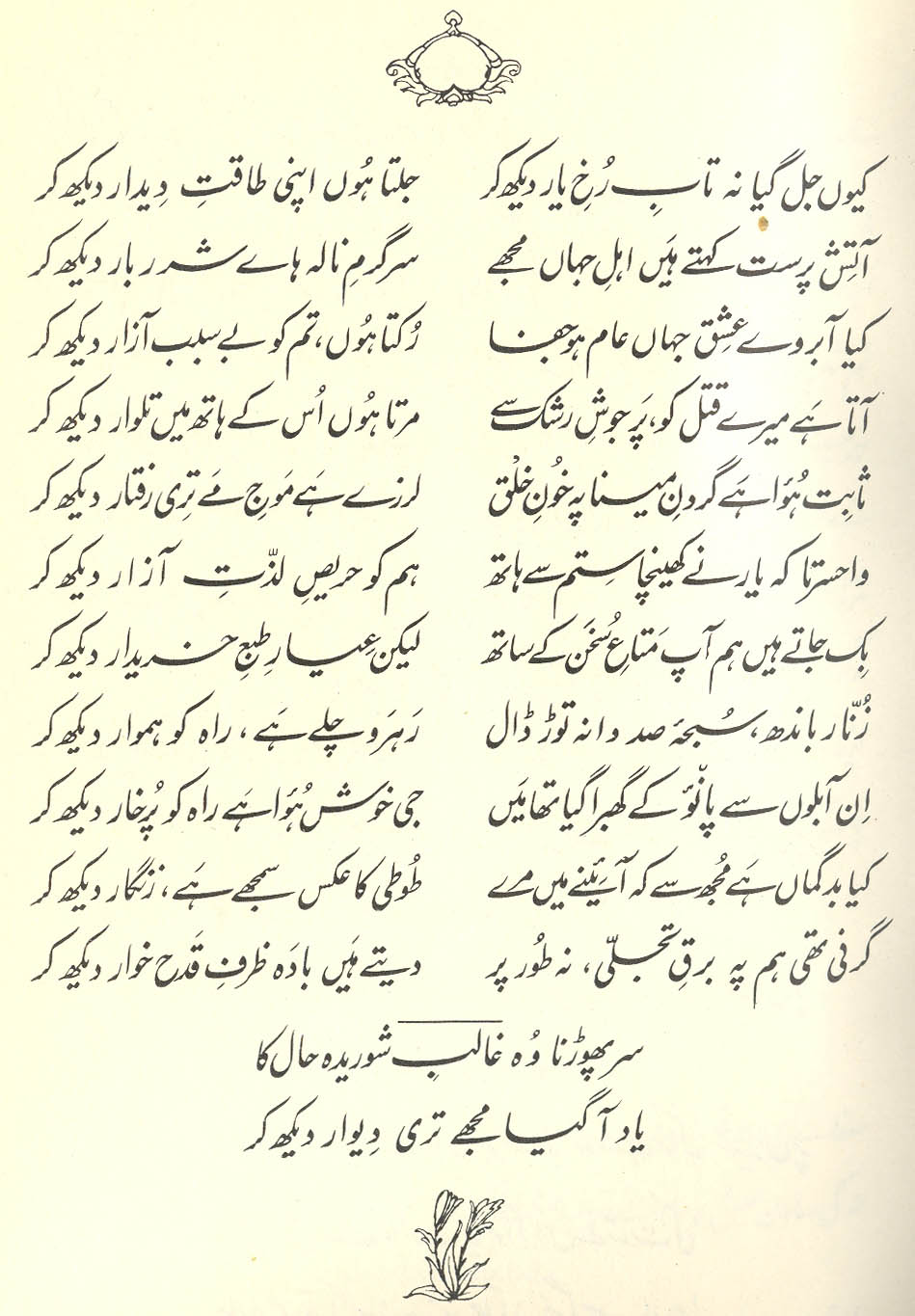
In this verse the author has indicated the blisters, and thus given more attention to the speaker. If instead of 'these' there were 'what' [], then this pleasure would not have been obtained. (59)
== Nazm page 59

He says he had been very anxious about these blisters, but seeing the wilderness full of thorns, his heart rejoiced. The meaning is that when the human heart is cracked open by passion, then no matter how many troubles it has to confront, it doesn't lose courage. (105)
He expresses his worship of suffering, his love of difficulty [], his ardor for the destination-- I had become anxious over the blisters on my feet, but now that I see the road ahead to be full of thorns, my heart is gladdened. Blisters didn't let me walk; now the thorns will burst the blisters and I will quickly reach the desired destination. (134)
[He also makes a point about this verse in his discussion of 87,9 .]
The blisters on the feet are due to the hardships of wandering, but they also symbolize the first stage of the poet's passion. These blisters have appeared not because of the hardship of the love but because of the hardship of the road. His feet were not accustomed to the torture. These blisters only show the immaturity of his love. Now the thorns have appeared on the road. They will rid the poet of these blisters which are beneath his dignity as a lover-poet. The path of love has become more torturous, and consequently the more pleasing for the lover. (24-25)
I remember how the first time I read this verse, I just had to laugh; it was so over the top that I felt sure that it had been intended for humorous effect. But when I discussed it with S. R. Faruqi, he said that to him it was no different from any other verse; so perhaps my reaction was just American, or just personal.
Still, this verse is an example of what I call grotesquerie; for more on this concept, see 39,3 . To me it makes sense for the lover to have blistered feet, after wandering over hot desert rocks and sands; and it makes sense for the path of passion to be thorny, both metaphorically and even literally. But when these two images are brought together as they are in this verse, the effect is what as a kid I would have called 'gross'. We are forced to envision the blistered feet walking along the thorny path, as the blisters burst excruciatingly on the thorns (are there audible little pops?) and leak fluid and pus and bits of dead skin all along the ground. It's perhaps a bit more than we care to know about the lover's state.
Vasmi Abidi suggests that our minds are meant not to explore the imagery so literally, but instead to move at once into the realm of abstraction, and to perceive this verse as a cousin of 48,1 or 111,15 . I see the force of the argument, but after all, if we don't take Ghalib's imagery seriously, we weaken the force of the verse in a different way, one that risks making it tedious and facile.
Literarily speaking, the first line is cleverly framed for ambiguity. The verb with its wide range of meanings can well suggest the dismay of someone in pain, all alone, with blistered feet, driven to keep walking yet unable to walk. The lover's anxiety may involve, we expect, the question of where to find bandages or soothing ointments for his poor tormented feet.
Then in the second line we are startled to learn that indeed the lover has come up with a solution-- and apparently a perfectly delightful and complete one, too. He can keep right on walking as he wants to do anyway, and as a by-product, his blisters will be lanced by the thorns in the road ahead. What could be better! For the lover disdains all rest anyway (see 56,3 for an illustration of his attitude), and welcomes all suffering incurred on the road of passion. What could be more emblematic of the proper loverly attitude than this verse? The lover's cult of eagerly-sought (or even masochistic?) suffering makes mere stoicism look self-indulgent.
graphics/thorns.jpg