Verse 21833aardekh kar
G3
1
the people of the world call me a fire-worshipper
2
having seen me eager/inflamed/'hot-headed' for/from spark-scattering laments
'Inflamed with love; enthusiastic, ardent, zealous, eager, earnest, intent (on); assiduous, diligent, attentive'.
| References | |
|---|---|
| Arshi, Imtiyaz Ali | Ghazal# 63 |
| Raza, Kalidas Gupta | 380 |
| Hamid Ali Khan | Open Image |
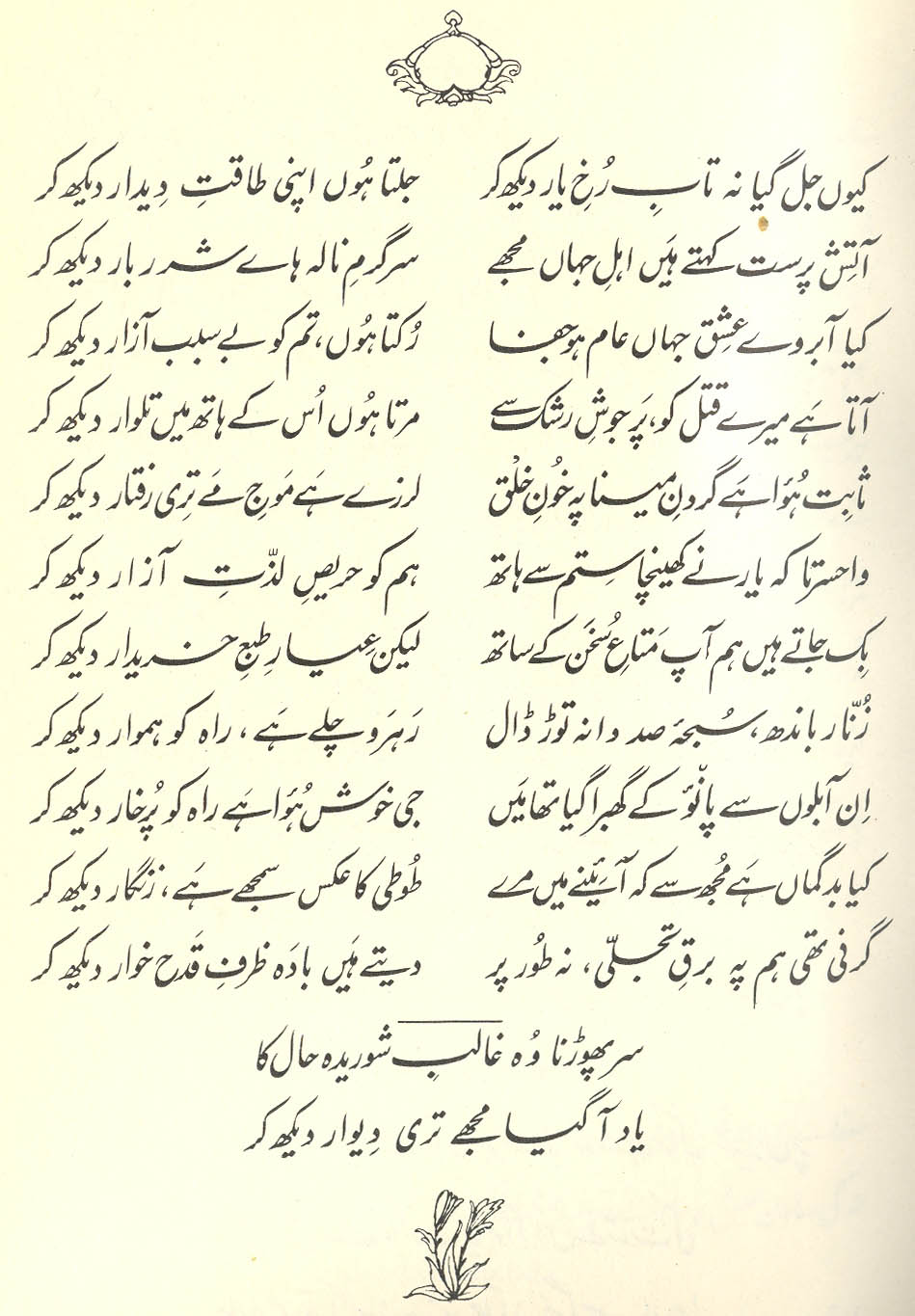
That is, the way in which people devote themselves to worshipping fire-- with that same relish and ardor I am always hot-headedly eager to make fiery laments. (56)
== Nazm page 56

He says, the intention with which fire-worshippers worship fire-- in that same relish and ardor I remain hot-headed in heaving spark-scattering sighs. Seeing this condition of mine, the people of the world call me a 'fire-worshipper'. (103)
This is a proud boast that is being expressed. (132)
In general, Ghalib's references to other religions are very sympathetic; he establishes a kind of mystical parallelism that unites them all under the great banner of passion and faithfulness. And when he speaks more skeptically about religions, as in the unpublished 93,3x , then too he sees them as a group with shared qualities and roles.
In 59,5 , the lover accepted the likelihood that people would abuse him with the general term 'infidel' because of his 'worship' of an 'infidel idol'. In the present verse, people call him a 'fire-worshipper', as though he had abandoned Islam for the Zoroastrian creed of the Parsis . Only the 'people of the world' do this, of course, and we in the ghazal world know their limitations all too well; see 5,6 for a scathing indictment of them that also turns on imagery of fire.
The verse is built on the wordplay of fire: 'fire-worshipper', 'hot-headed', 'spark-scattering'. But of course, if the lover's burning hot sighs scatter sparks in all directions, the source of the fire must be an inward one. And since the lover eagerly pursues his 'worship' of this inner fire, he must be absorbed in cultivating the fiery wounds of passion in his heart; in 19,1 , he actually uses his fingernails to claw these wounds open and keep them from healing. So behind the wordplay there's even a literal sense in which the lover can rightly be described as a 'fire-worshipper'. For after all, the verse never claims that in this particular case the 'people of the world' are wrong.
graphics/fire.jpg