Verse 1after 1821aave;Ngekyaa
G1
1 a
what help, in {my affliction / sympathy with me}, will friends attempt to bestow?
1 b
will friends attempt to bestow help, in {my affliction / sympathy with me}?
1 c
as if friends will attempt to bestow help, in {my affliction / sympathy with me}!
2 a
by the time the wound fills up, won't the fingernails grow?
2 b
as if, by the time the wound fills up, the fingernails won't grow!
'Affliction, sorrow; --sympathy, commiseration, condolence, comfort; real or true friendship'.
'Endeavour, attempt; exertion, effort; enterprise, essay; purpose'.
is an archaic form of ; GRAMMAR .
| References | |
|---|---|
| Arshi, Imtiyaz Ali | Ghazal# 35 |
| Raza, Kalidas Gupta | 354-355 |
| Hamid Ali Khan | Open Image |
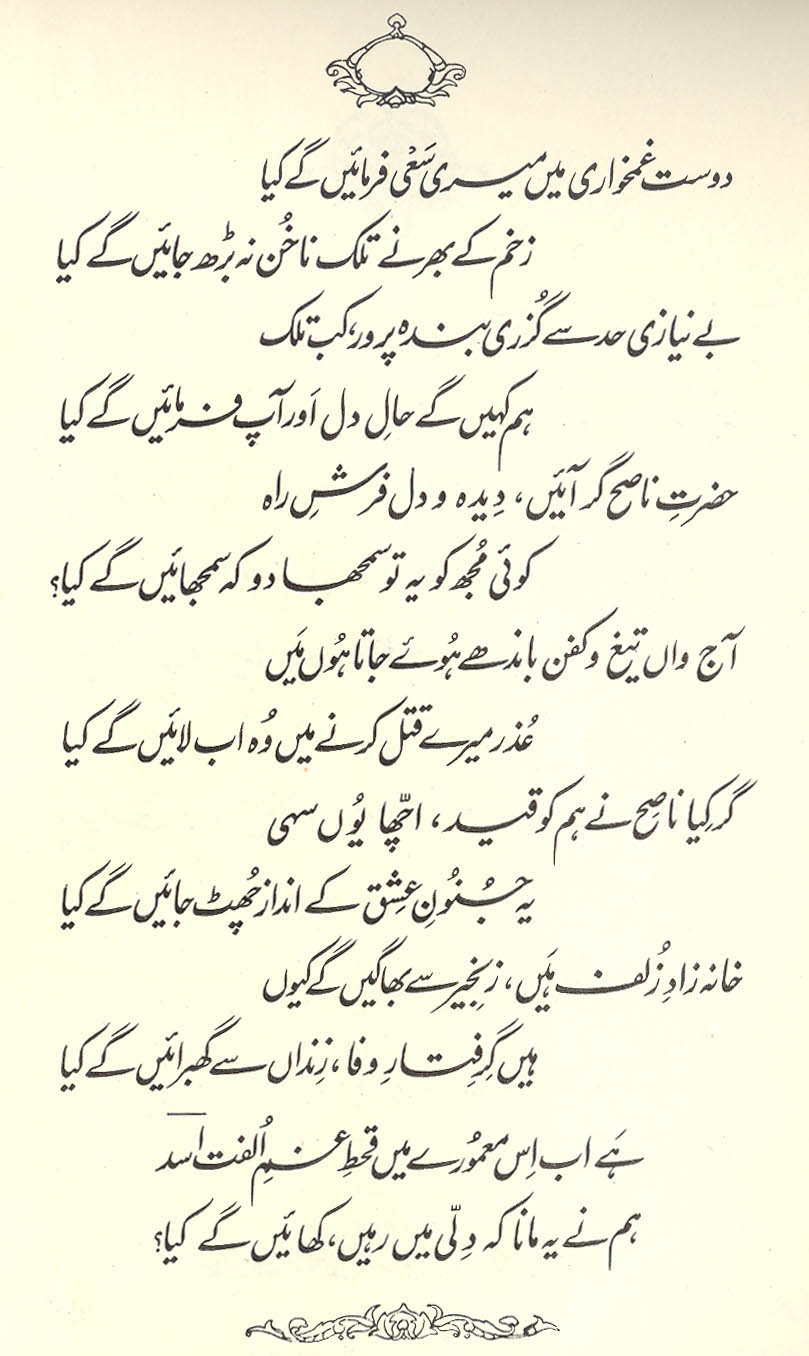
In the first line is for contempt, and in the second line, for a negative question. That is, what's the good of cutting my nails-- won't they grow again? (19)
== Nazm page 19

How excellently he has presented the meaning that my friends, in sympathy-- what more can they do than having my nails cut? In the state of madness, I keep scratching the wound and don't let it heal. After the nails are cut, it's hoped that the wound will quickly heal. In opposition to my friends, I'm thinking, by the time the wound heals, my cut nails too will grow, and all their efforts will become useless in a single moment, because I will again deepen the wound. (40)
Janab Zauq too has composed [] this theme very well:
[after hearing some mentions of sewing the rip in my liver
having controlled my laughter, I look at my nails]. (46)
[See his discussion of Mir's M 318,2 .]
The ending is an archaic form of the modern Urdu ; some divan s update the spelling, but I follow Arshi in retaining the original; GRAMMAR .
The use with of , 'to command', rather than , 'to do', suggests respect and formality: the friends would 'command the doing of' an attempt. 'Bestow' doesn't quite capture it, but it's the best I could come up with. Of course, the use of the language of respect also opens the clear possibility of a sarcastic or ironic reading as well.
In this whole ghazal, because of the refrain , the emphasis on speech is unusually pronounced. The real pleasure of it is the multivalent readings not only offered but even enforced, since both lines can be read in different tones, with different emotions, to greatly different rhetorical effect. When the possibilities of (1) are multiplied by those of (2), a veritable tree of readings fans out from the original lines. For discussion of the priceless multivalence of , see 15,10 .
The present verse thus can offer a kind of encyclopedia of the lover's relationship with his friends. He wants to know whether they will help at all, he wants to know how they will help, he scorns the usefulness of their help; he finds it obvious that their help is in vain, he is indignant at the futility of their efforts. To add to the complexity, , literally 'grief-eating', is both the suffering that the grief-stricken person himself undergoes, and the compassion that his sympathetic friends feel when they share his pain (see the definition above). The work done here by is that of 'my', and also that of 'with me'; for more on this see 41,6 .
Compare Mir's treatment of a similar theme, the absurd naivete of the friends who expect to be able to 'cure' the lover [M 40,5 ]:
((ilaaj karte hai;N saudaa-e ((ishq kaa mere
;xalal-pa;ziir hu))aa hai dimaa;G yaaro;N kaa
[they 'cure' me of the madness of passion--
it's become unsound, the mind of my friends!]
In Mir's verse the lover ends up, most wittily, with the suspicion that the friends are the ones who are crazy-- by believing that they can 'cure' him, his friends have shown that their minds are more unbalanced than his own.
The present verse also works by implication , leaving a great deal unstated. We have to know, or deduce, the connection between the fingernails, the cutting of the fingernails by the helpful friends, the healing of the wound, and the use of the regrown fingernails to reopen the wound. We have to already know, or deduce, the lover's radical intransigence, without which the verse would make no sense at all.
graphics/fingernails.jpg