Verse 3after 1821aave;Ngekyaa
G1
1
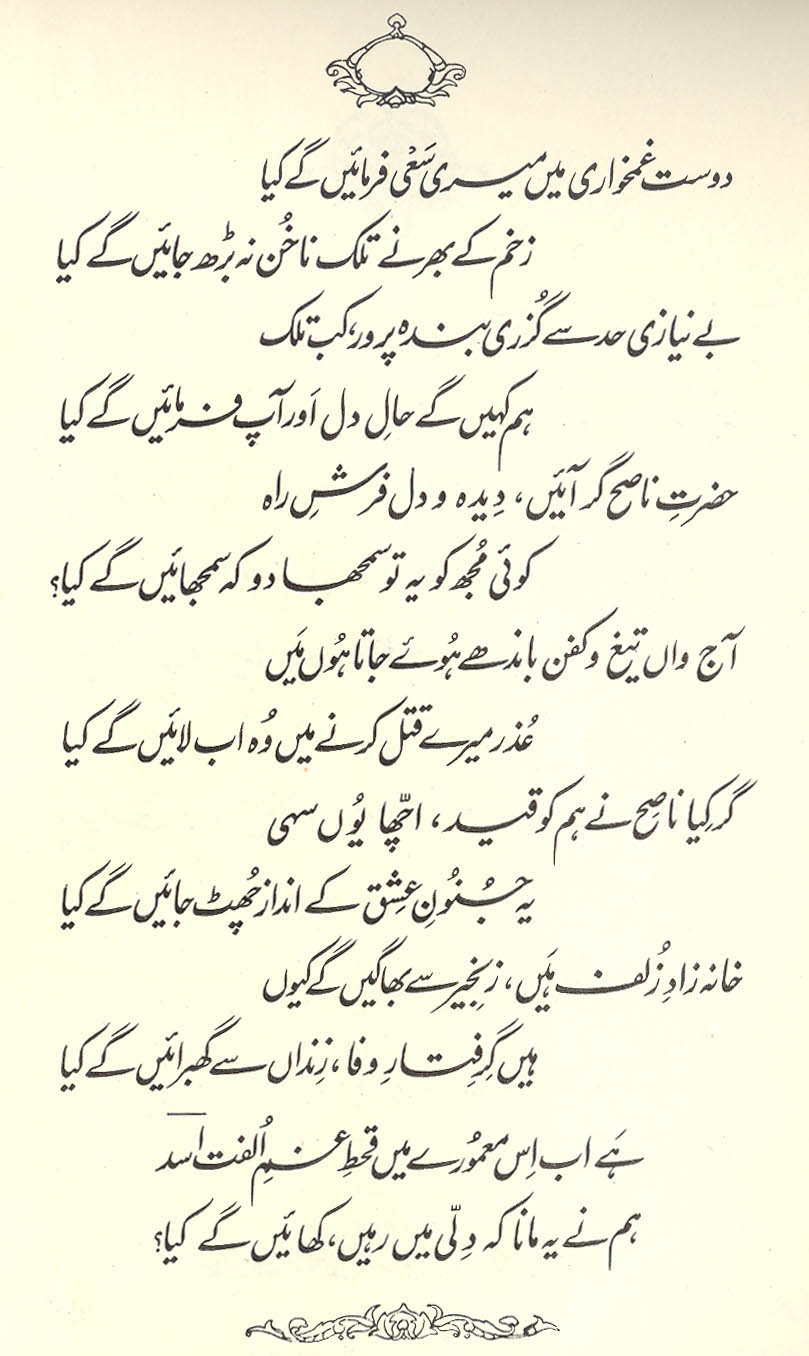
if his Lordship the Advisor would come, my eyes and heart [would be] a carpet for his path
2
let somebody then explain this to me-- how/what will he explain/persuade?
>> 'To cause to know, or understand, or comprehend; to give to understand, to inform, to explain (to), to describe, to account for; to give or render (an account); to impress (on the mind of), to remind; to convince, satisfy; to undeceive; to apologize; to instruct, to advise, to reason with, to remonstrate or expostulate with, to admonish, to warn; to correct, punish, chastise'.
| References | |
|---|---|
| Arshi, Imtiyaz Ali | Ghazal# 35 |
| Raza, Kalidas Gupta | 354-355 |
| Hamid Ali Khan | Open Image |
The excellence of it is that he has expressed it in such a way that it becomes a picture of madness. (20)
== Nazm page 20

Urdu text: Vajid 1902 {19}
In one line he has made clear the honor and respect paid to his Lordship the Advisor... and in the second line he has conveyed so much contempt for his understanding: What can he explain to me? Who is he anyway? (40-41)
I will never in any way be ready to renounce passion. So then, what will he explain to me? He'll come, and beat his head [in frustration], and go away again. (47)
One manuscript source has instead of in the first line; Arshi discusses this variant in his introduction, pp. 105-106.
The idea of a is that a particularly honored guest is provided with a special, temporary walkway of valuable carpets, so that upon arrival his or her precious feet won't even be allowed to touch the dirty, common, rough street or entry-way. Mir offers a less sarcastic example of such 'red-carpet' hospitality: M 268,1 .
What a wonderful verb is , with the full range of meanings set forth by Platts (see the definition above). It can be used for almost any form of hortatory or persuasive rhetorical performance, from the rational to the emotional, from the reproachful to the apologetic.
Is the lover asking an insane question, as Nazm supposes-- since everybody knows what the Advisor is bound to say to the mad lover? Or is it a sarcastic question, as Bekhud Dihlavi believes-- since the wretched Advisor's efforts are known to be futile even before they are made? Or is it a sincere question, as Bekhud Mohani implies-- since undoubtedly the Advisor will face great difficulties?
And of course, why is 'somebody' enjoined to explain beforehand what the Advisor will then come and explain? Again, is it madness, sarcasm, or straightforward inquiry? Similarly, when the lover speaks of the Advisor as his Lordshop and promises, through a stylized phrase of reverent salutation, an elaborately respectful welcome-- is that madness, sarcasm, or courteous respect?
One more verse, one more set of -generated questions.
graphics/redcarpet.jpg