Verse 6after 1821aave;Ngekyaa
G1
1
[we] are a hereditary/'house-born' slave of curls, why will we flee from chains?
2 a
[we] are a captive of faithfulness; will we be flustered by a prison cell?
2 b
[we] are a captive of faithfulness-- as if we will be flustered by a prison cell!
''Born in the house'; child of a slave, a slave'.
'To be confused, confounded, flurried, or flustered (by, or in consequence of, -se); to be perplexed, bewildered, or embarrassed (by); to be perturbed, disturbed in mind, agitated, disquieted, distracted; to be alarmed, scared, dismayed'.
| References | |
|---|---|
| Arshi, Imtiyaz Ali | Ghazal# 35 |
| Raza, Kalidas Gupta | 354-355 |
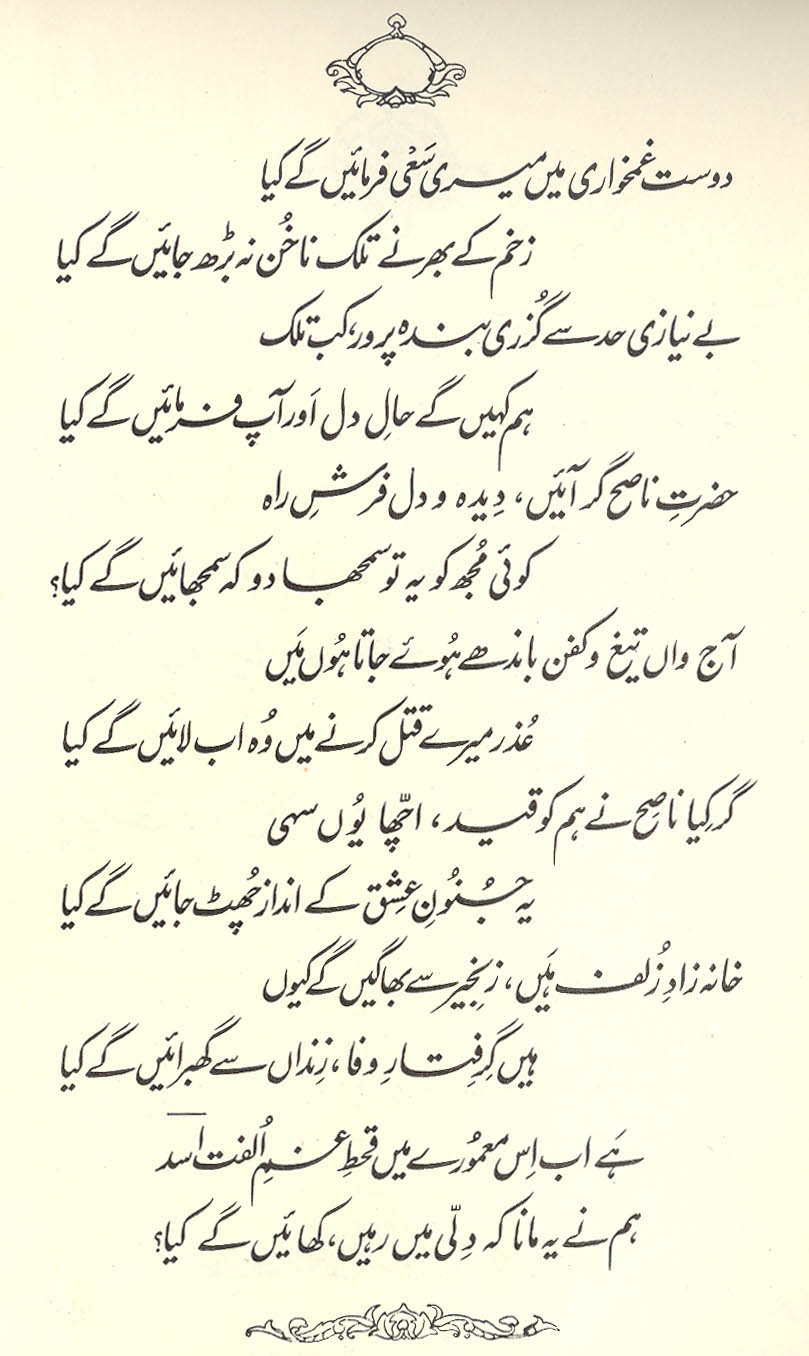
| Hamid Ali Khan | Open Image |
The subject-- that is, the word 'we'-- is omitted . (20)
== Nazm page 20

The verse is a two-part one; both lines have been arranged as equals. (41)
That is, captives of faithfulness and prisoners of curls neither fear a prison cell nor flee from chains, because in passion, these things are constant occurrences. (48)
As Nazm notes, the subject, 'we' has been omitted, though it's clearly implied (since the verse really makes sense only if said by a 'we', so there's no ambiguity. The essential, default voice in the ghazal world is that of the lover.
This verse follows nicely from 19,5 right before it. If the lover is a hereditary slave of curls, why would he flee from chains? He would not, of course, for at least two possible reasons: (1) the chains resemble curls, and thus remind him of the beloved, so that he welcome them; and (2) the beloved's curls confine him much more tightly and cruelly than any chains, so he will hardly even notice the chains. For another example of curls/chain imagery, see 36,4 .
Similarly, he who is a captive of faithfulness would never be anxious about a prison cell, because (1) the cell reminds him of the familiar bondage of faithfulness in which he has lived so long, so he can't fear it; and (2) the bondage of faithfulness is much more narrow and straitened than any cell, so he will hardly even notice one more layer of confinement.
In short, chains and cells are like his present state of passion, but are also laughably feeble and trivial by comparison. And the lover either asks rhetorically why he would flee from them, or denies indignantly that he would. Just the usual language. And as usual, how well it works.
graphics/darkcurlsmet.jpg
graphics/chains.jpg