Verse 7after 1821aave;Ngekyaa
G1
1
there is now in this city a dearth/scarcity of the grief of love, Asad
2
we agreed to this: that we would remain/live in Delhi-- what will we eat?
>> 'An inhabited, or a well-peopled place; --a cultivated spot, or a well-cultivated, or delightful, spot'.
t :>>'Drought, scarcity, dearth; failure of the crops or harvest; famine; want, penury, hunger, starvation:
| References | |
|---|---|
| Arshi, Imtiyaz Ali | Ghazal# 35 |
| Raza, Kalidas Gupta | 354-355 |
| Hamid Ali Khan | Open Image |
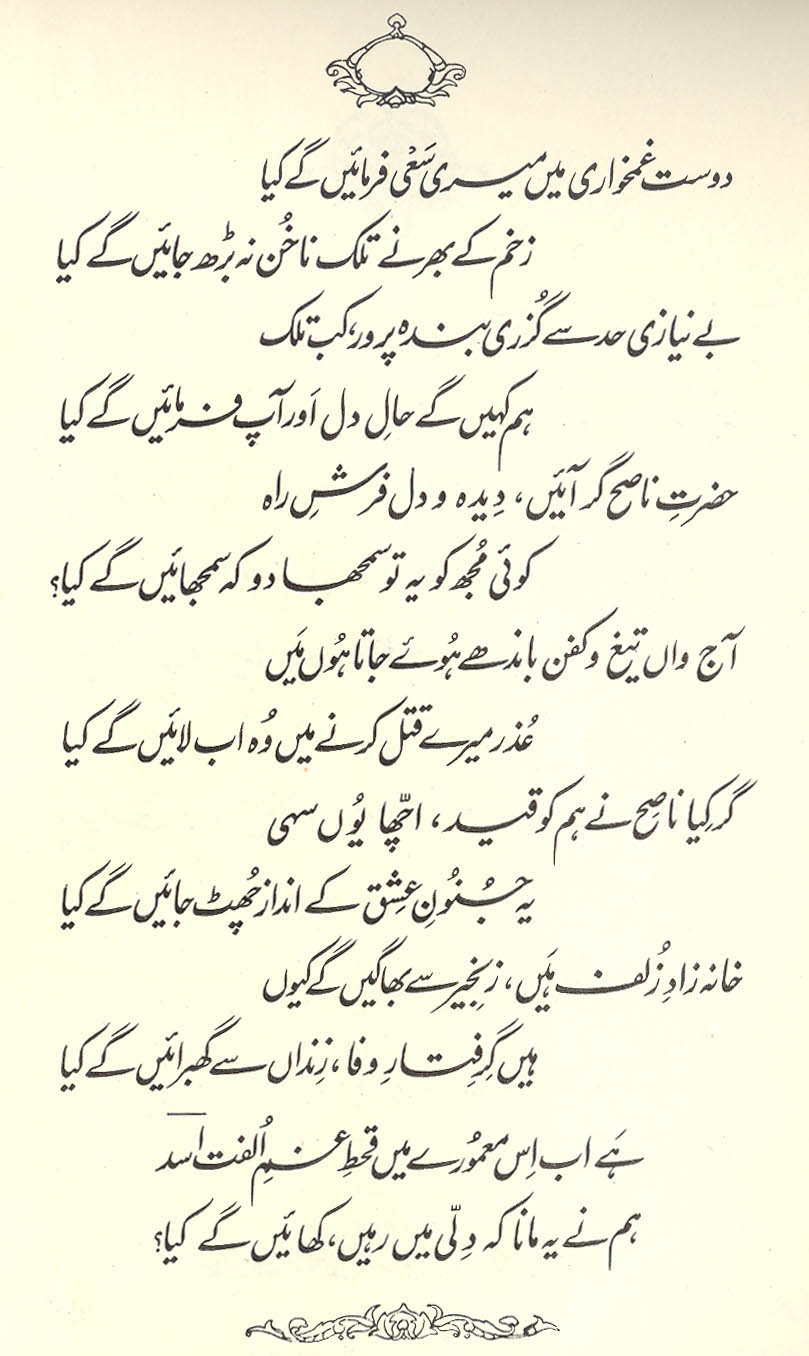
We have learned to experience the relish of 'eating' grief, and that is not available here; that is, in this city there are no beloveds for whom passion would be felt. (20)
== Nazm page 20

He says, our food is the grief of love. And the grief of love falls to one's lot when a person falls in love with someone. In Delhi, there's a famine of the grief of love. That is, here there are now no such beloveds whom one could love. (41)
Since to 'eat' grief is an idiom of the language, this rhyme is a gift bestowed by this idiom of the language. The interpretation is that the city which has become a stranger to love-- how would we who have given our hearts manage to live in it, how would we survive? (77)
Some manuscripts, and some modern editions, have instead of in the second line. As always, I follow Arshi. See his discussion in his introduction, p. 123. (The grammar shows the idiomatic use of the perfect instead of the subjunctive.)
The first line sets up a strange and piquant situation-- a drought, a scarcity, a crop failure, of the 'grief of love'? And located in a particular area, just like a real drought? It's tempting to guess, because of the abstractness of the 'grief of love', that the should be read in only a very general sense-- a scarcity, a shortage, a lack. How will the second line resolve the situation? Under mushairah performance conditions, of course, we'd have to wait as long as conveniently possible before we'd be allowed to find out.
The second line remains notably uninformative for as long as it possibly can. 'We agreed that we'd stay in Delhi'-- how does that help? Then in classic mushairah-verse style, at the last possible moment the punch-word is finally vouchsafed to us-- that excellent . When the original audience heard , surely they must have burst out laughing. Because of course the connection suddenly is made in the hearer's mind, with a shower of sparks-- that in Urdu one literally 'eats' grief []. So to the mad lover, a drought or scarcity or shortage of grief is just as dire as a real lack of food, and the is in fact a real famine.
When it comes to food, the verse sets up an implicit contrast between the city and the desert, the usual haunt of wild lovers and madmen. Hunger in the desert is almost de rigeur (think of the skeletal Majnun); in the desert there's a famine of food to eat, while in this well-peopled, pleasant city (see the definition above) there's a famine of grief to 'eat'.
The first part of the second line [] suggests that the speaker has been (reluctantly?) persuaded to remain in Delhi, at least half against his will, and feels inclined to be perverse about it. He thus raises practical objections. For having a steady diet of grief to eat is obviously as important to the lover as having a steady diet of food to eat would be to anybody else. How can he live in a place where he can't 'eat'?
Thus we're led to ask ourselves whether the big city and the desert are more similar (both lack the wherewithal for 'eating') or more different (a famine of grief amidst a crowd, versus a famine of food in solitude).
It's rare for Ghalib to mention anything as specific, as 'real', as a city in the world, and that too the one he actually lives in. Of course, he doesn't go so far as to give us any genuine information about it-- it becomes a ghazal city, distinguished only by its temporary ('now') grief-famine. The fact that even something as minimal as a place name stands out so vividly shows how deep in the realm of stylization and abstraction the ghazal itself lives.
And for a more extravagant foray into the wordplay of 'eating' grief, compare Mir's M 608,5 :
[except for wounds, except for grief, and except for anger
our 'eating' is religiously prohibited]
graphics/delhi.jpg