Verse 2after 1821aave;Ngekyaa
G1
1
inattention/independence passed beyond the limit-- Protector of Servants, for how long
2 a
will we say the state of our heart and you will command, 'What [did you say]?'
2 b
will we say the state of our heart, and you will command, 'What [-- how dare you]!'
2 c
will we say the state of our heart-- and what will you command?
2 d
will we say the state of our heart, and you will command-- what?!
'Freedom from want, ability to dispense (with), independence'.
is an archaic form of ; GRAMMAR .
'To order, command; (in polite or respectful speech with reference to superiors, &c.) to say, affirm, declare'.
| References | |
|---|---|
| Arshi, Imtiyaz Ali | Ghazal# 35 |
| Raza, Kalidas Gupta | 354-355 |
| Hamid Ali Khan | Open Image |
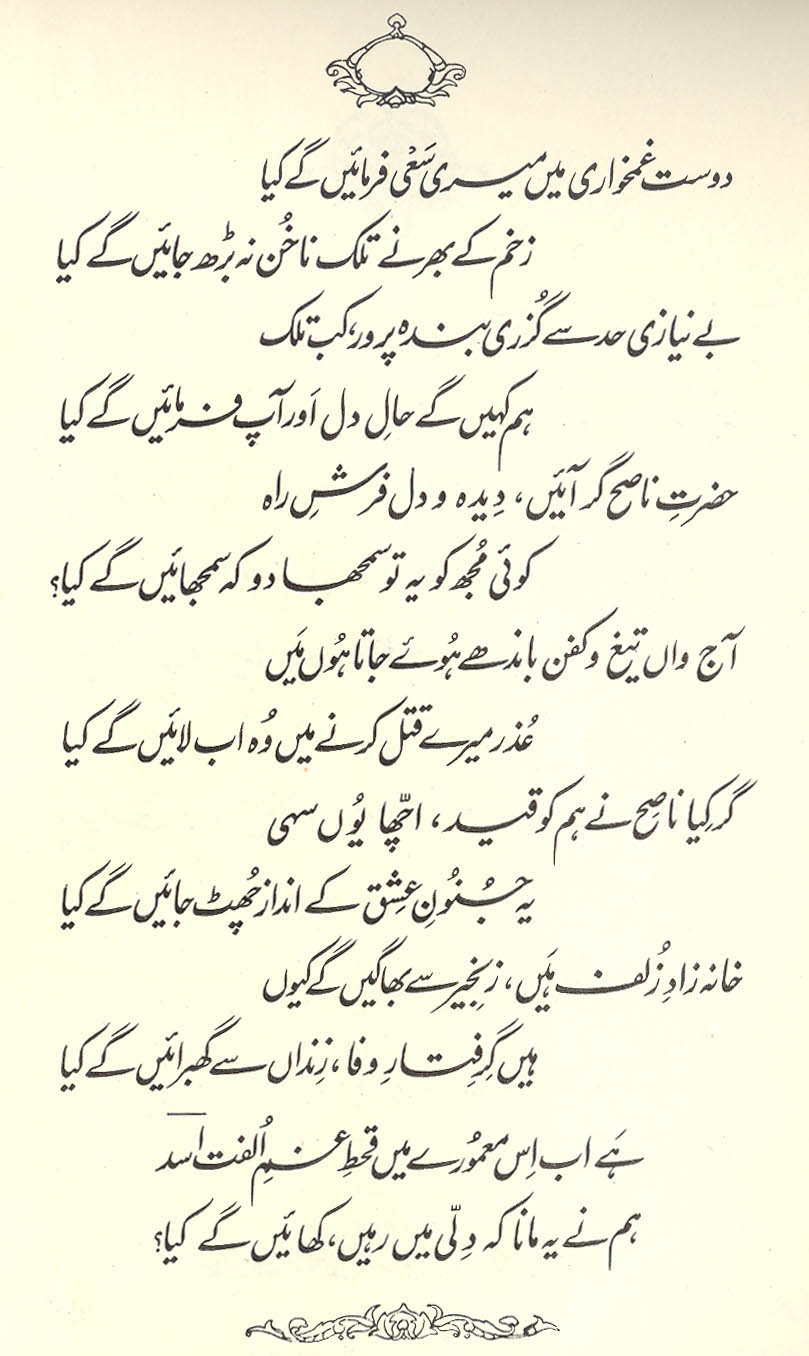
He says, your inattention has passed beyond all limits: you ignore my state and don't listen to me, and constantly say negligently, 'What did you say?'. In this verse is in a narrative mode, the way the author has later said: 21,2 . (20)
== Nazm page 20

From the second aspect of the word a meaning of sarcasm emerges: that is, whatever you said, it's a lie! (40)
In this verse he's shown the limit of the lover's restlessness and the beloved's indifference. When the hearer doesn't listen to the speaker's words, it very much displeases the speaker.
Note: If anybody else besides the beloved would be the addressee, then the verse can also be read in a tone of challenge. (47)
[See his comments on Mir's M 921,5 .]
In the second line, the verse offers another remarkable example of the versatility of . The lover makes his plaint to the beloved, who is (with either irony or naive hope) addressed as 'Protector of Servants,' a title fit for saints or virtuous kings. Her reply, fittingly, takes the form of a 'command'.
Perhaps her reply takes the form of a languid 'What?' of total negligence (2a), since she hasn't been listening; or perhaps she responds with a 'What!' of indignation and anger at his presumptuousness (2b). Or else the lover simply wonders what she will in fact finally say (2c). Or else she says something so outrageous that the lover himself exclaims in disbelief at it (2d), as Bekhud Dihlavi suggests.
graphics/saywhat.jpg