Verse 81833aardekh kar
G3
1 a
tie on a sacred-thread, rip apart the hundred-beaded prayer-beads!
1 b
having tied on a sacred-thread, having ripped apart the hundred-beaded prayer-beads
2
the traveler moves along, having seen the road [to be] smooth
'Waist-cord, belt (particularly a cord worn round the middle by the Eastern Christians and Jews, and also by the Persian Magi); the Brahmanical or sacred thread'.
is an archaic form of ( GRAMMAR )
| References | |
|---|---|
| Arshi, Imtiyaz Ali | Ghazal# 63 |
| Raza, Kalidas Gupta | 380 |
| Hamid Ali Khan | Open Image |
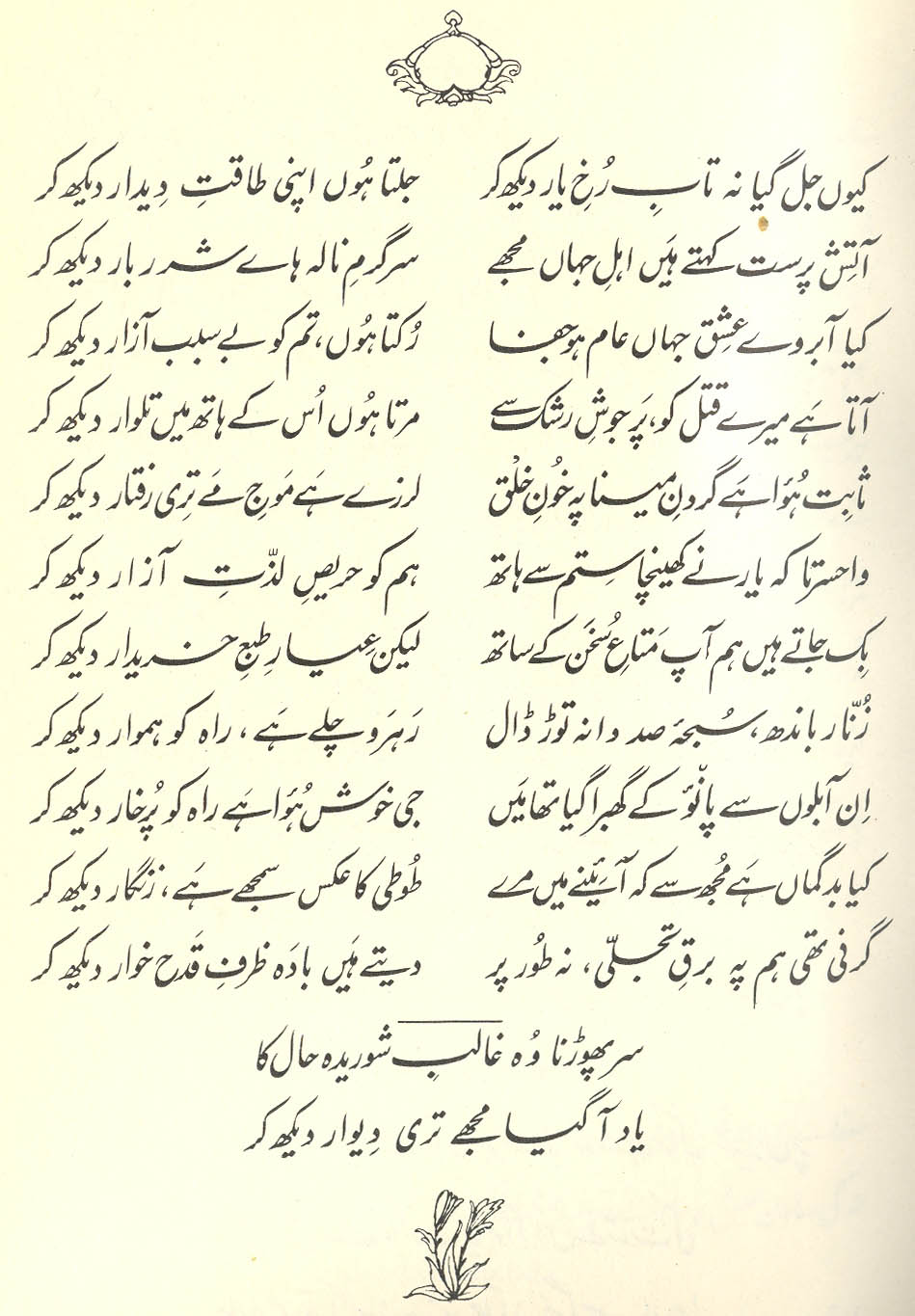
The relationship between the prayer-beads and sacred thread is that both are roads, but the difference is that the sacred thread is smooth and the prayer-beads are a road in which it's necessary to face bumps. Poets always give preference to idol-houses, Brahmins, and sacred thread over Sufi hospices [] and Preacher s and Shaikh s and holy men and prayer-beads. And the intention is a taunt-- that is, what does the knower of mystical knowledge need with prayer-beads and holy men? (59)
== Nazm page 59

He says, the sacred thread and the prayer-beads are a kind of string; that is, in the eyes of the knower of mystical knowledge, they are both paths. In reaching the desired destination, he has constructed the sacred thread as smooth, because it is clear. And because of the rise and fall of the beads of the prayer-beads, he has declared it to be an uphill-downhill path, on which it's necessary to endure a hundred shocks on the way to the goal. (105)
This verse is in a rakish [] style. (134)
To have the rakish, wine-drinking poets remain opposed to the Shaikh and Preacher and Advisor is a perpetual assumption of the poets. (215)
ABOUT the , and STYLIZATION: In the ghazal world the word refers to a Brahminical sacred thread. But see the definition above, which makes clear that its earlier meaning was something quite different (a waist-cord or belt) from an entirely different cultural context (Eastern Christians, Jews, Magi). In 109,5x , the is equated with (Islamic) religious smugness or pride. In 112,1 , it's unfortunately been torn away by the lover in his madness. By contrast, 117,4x and 145,7x feature the , a line that appears in a wine-flagon. In 143,7x the becomes a street or lane, just as in the present verse.
The extreme stylization of the ghazal world makes this kind of semantic repurposing easy and convenient (and usually even invisible). Another such example: 39,5x and 298x,4 with their (repurposed from a Christian gong to a Hindu conch-shell). On the idea that 'Hindu' means 'black', see 138,6 . Then there's 118,1 with its , a word for a wide variety of non-Islamic holy places from which only context enables us to select a Hindu temple. Another very broad term is , as in 93,3x and 115,2 ; Mir 's usage makes it clear that a Hindu temple is meant (as in M 7,15 ). There are also cases of shifting reference with no religious implications, such as the identity of the Nightingale, with its varying ornithological possibilities; for discussion see 33,3 . And there's also the case of the , a tulip that readily morphs in India into a red poppy (see 33,1 ). And for the repurposing of the Persian into the Urdu 'dust-bin', see 68,5 . Finally, the ubiquitous season of 'springtime' presents special problems of its own; for discussion, see 49,4 . An example from Mir: M 1746,1 .
Other highly stylized concepts, which may have been unknown to the poets and their audiences except through earlier ghazal verses, include: the 'paper robes' in 1,1 ; in 5,5 ; the 'blood-price' in 21,9 ; metal mirrors in 34,2 ; the 'wine-duck' in 49,1 ; in 67,2 ; in 71,6 ; the 'line of the glass' in 81,6x . There's also the petrified image of the beloved, with her nonexistent mouth ( 91,4 ), her vanishingly small waist ( 99,4 ), her awesomely tall stature ( 38,4 ), and her all-enveloping black curls ( 14,6 ).
The present verse is indeed a 'rakish' one; as Bekhud Mohani points out; Nazm observes that such a stance is the fundamental attitude of the ghazal. The ghazal poet disdains the guardians of ostentatious religiosity (the Preacher , the Shaikh , sometimes the Brahmin ), and their ostentatious religious paraphernalia (the prayer beads, the sacred thread) as well.
The true seeker of the divine Beloved is carried along on a tide of passion, committed to following his quest to the point of death-- and beyond. Minor external tokens like sacred threads or prayer beads are useless, ludicrous, even contemptible in their pretentiousness. Thus the injunction (addressed intimately to a who might be the speaker himself) to remove the 'bumpy' prayer-beads and replace them with the 'smooth' sacred thread. (Alternatively, the verbs in the first line may be read as constructions with the colloquially omitted; for more on this see 58,7 .)
After all, everybody knows that travelers prefer a level road to a rough one. And why shouldn't they? The traveler-- literally, 'road-goer' []-- is rightly interested in the road as a means, not an end. Traditional religions may offer different paths, but they're all branches of the same road. It's moving along on the road that is the traveler's one real obsession. What better vision of the mystic's path can there be?
I can't resist including this equally enjoyable treatment of the subject by Mir Dard , which construes the thread on which prayer beads are strung as the Brahminical sacred thread:
[Oh Ascetic , just also pay a bit of attention to 'hidden idolatry'!
with every bead of the prayer-beads there's a sacred thread too]
graphics/bayard1869.jpg