Verse 6after 1816aanhai
G3
1
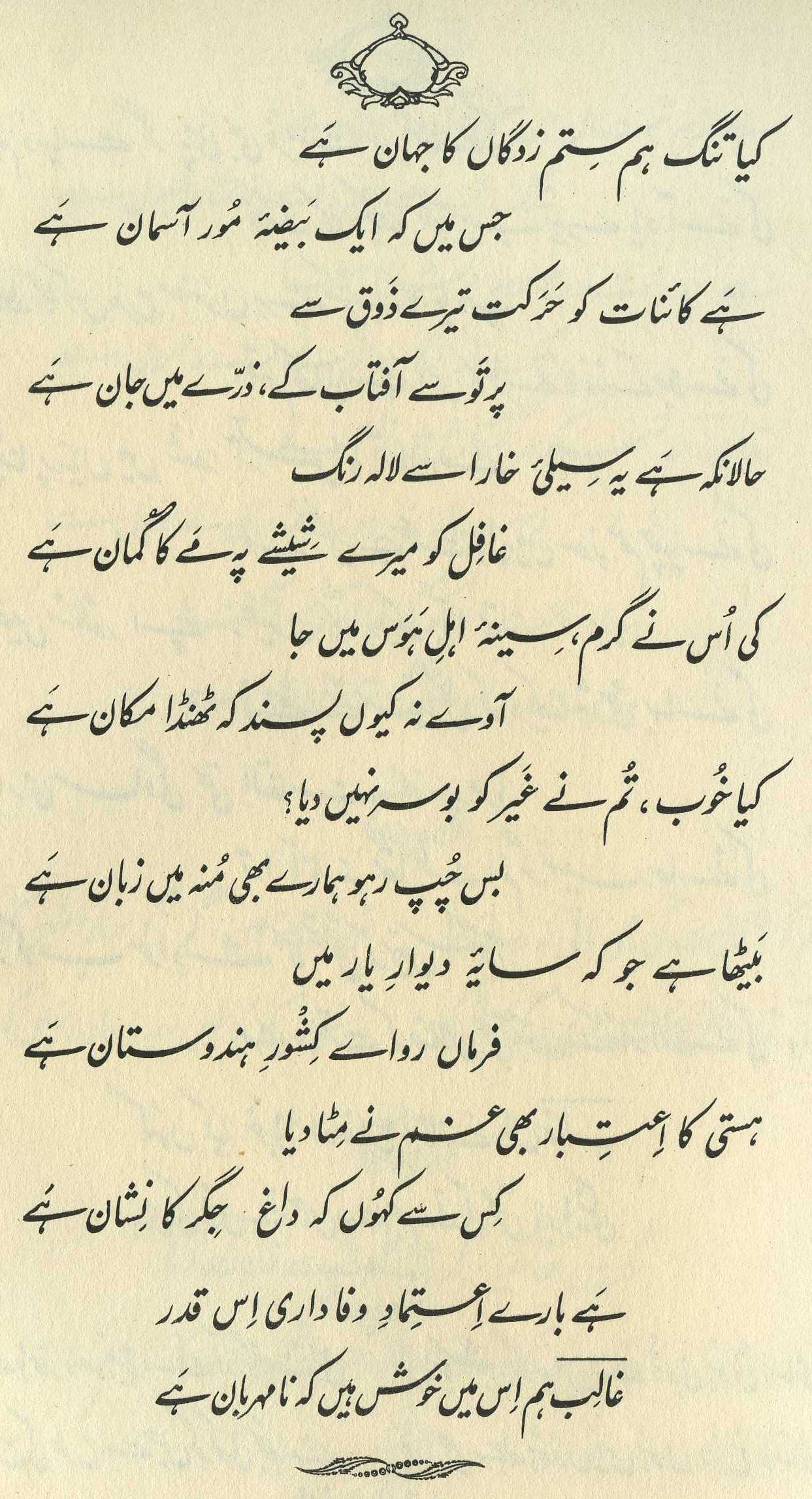
the one who is seated in the shadow/shade/shelter of the beloved's wall
2
is the decree-issuer of the realm of Hindustan
'Shadow, shade; shelter, protection; apparition, spectre; influence (of an evil spirit)'.
'An Indian; black; a servant; a slave; a robber; an infidel; a watchman; a mole on the cheek of a mistress'. (Steingass p.1514)
| References | |
|---|---|
| Arshi, Imtiyaz Ali | Ghazal# 135 |
| Raza, Kalidas Gupta | 297 |
| Nuskhah-e-Hamidiyah | 186-187 |
| Asi, Abdul Bari | 218 |
| Gyan Chand | 334 |
| Hamid Ali Khan | Open Image |
The special feature of Hindustan is that in the shadow of a wall there is darkness, and Hindustan too is a black [] country. (148)
== Nazm page 148

To sit in the shadow of the beloved's wall is equal to being the emperor of Hindustan.... Since they say 'realm of Iran' [], etc., the pleasure of this is increased. Because the verse has been composed in Hindustan, and will also be recited right here. This reason too can be cited for using Hindustan: that there is an affinity between 'shadow' and 'Hindustan', because the color of the people here is black. (270)
(1) That person who would get the chance to sit in the shadow of the beloved's wall is so fortunate and triumphantly lucky that he is the king of Hindustan.
(2) When they become lovers, the king and the beggar all become alike. That person who is seated in the shadow of the beloved's wall is in truth the King of Hindustan. Passion has taught him humility and submission.
(3) That person who has ever sat in the shadow of the beloved's wall has the rank of the king of Hindustan.....
Durga Parshad 'Nadir' Dihlavi, pupil of Hilm Dihlavi, has said an excellent thing: that there is an affinity between 'shadow of the wall' and 'Hindustan, because both are black' ( meaning 'black' [in Persian]). Look how the affinity-seekers see affinity in so many places. It's true, as Hasrat Mohani has said, that affinity of words is a thing of great accomplishment.
== (1989: 260-61) 2006: 284-85
ABOUT 'Hindu' as 'black': In the philological sense 'Hindu' (together with 'Hindustan', 'Hinduism', and all the 'Hind'-based words) has nothing to do with color; the ultimate derivation is from the Sanskrit , 'river', which became the Latinized 'Indus' and was misunderstood by incoming western travelers as the name of a particular river, so that 'India' came to refer to the land beyond (that is, to the east of) the 'Indus' River. In Persian the same word became . The association in Persian of the adjectival form with blackness may have come about because most Indians are darker in complexion than most Persians (and than most British officers, which gave rise to a Ghalibian anecdote ), and/or because from an Islamic point of view India is full of the moral darkness of idol-worship.
But then came the classical Persian and Urdu ghazal, with its wild transgressiveness. As any ghazal reader knows, the ghazal world is made from a radical inversion of conventional values: the Advisor , the Ascetic , the Shaikh appear as villains or fools, the Ka'bah itself is often denigrated-- while the Brahmin and the and the practices of 'idol-worship' come off much better (especially since the beloved herself is an 'infidel' [] or an ' idol '). Similarly, the ghazal world practices a good deal of color-inversion, in which (virtuous, clear) whiteness is challenged by (potent, irresistible) blackness-- the blackness of the lover's nights of suffering, the blackness of the beloved's curls, the blackness of the suvaida in the lover's heart and the beauty-spot on the beloved's cheek.
In short, the untroubled enjoyment shown by the commentators-- who are Indians all, from 'Hind', and thus in a strong sense themselves-- confirms the basic truth that the ghazal world has many fine metaphorical uses for Hindustan, and for its darkness or blackness. Only someone who knew very little about the classical ghazal would take the idea of the 'blackness' of Hindustan in a 'natural poetry' way, as an expression of real-world racism or disdain.
The first line of the present verse offers a lovely picture of humility, confiding submission, and contented simplicity-- for the lover seated in the shadow of the beloved's wall is receiving both (literal) shade from the sun, and (metaphorical) shelter and protection accorded by the wall-owner. What more could the true lover desire?
So it is both a surprise, and then not a surprise, to find in the second line that the lover is also (in pointedly Persianized royal vocabulary) the 'decree-issuer of the realm of Hindustan'. The second line thus equips the same submissive lover with the highest degree of rank and power obtainable in the realm.
As Faruqi points out, there are three ways that this attribution of grandeur can be read: (1) the one who is seated there is so ecstatically happy that he feels himself to rule the realm ('as happy as a king'); or (2) that one in some sense actually is, by virtue of his (mystical) rank as a lover, the 'real' king of the realm; or (3) most literally, the one who is so humbly seated there happens to be the actual king in person, struck by the same irresistible arrows of passion that afflict everyone else.
No matter how we read it, the lovely paradox of submission and exaltation remains. The verse is grounded on the invocation of 'symmetry'-- the assertion 'A is B' (the lover is a king), with its grammatically unavoidable corollary 'B is A' (the king is a lover). It's this very simplicity that gives it an open-ended dignity and charm.
An excellent verse for comparison is 129,4x .
graphics/nizamuddin1890s.jpg