Verse 8after 1816aanhai
G3
1
once/suddenly/finally, there's confidence in/of faithfulness to this extent!
2
Ghalib, we're happy in this, that [she] is unkind/ungracious
'Once, one time, all at once; at last, at length'.
'Reliance, dependence, trust, confidence, faith'.
'Loving, affectionate, friendly, kind, benevolent, beneficent, favouring, indulgent, gracious, propitious; compassionate, merciful'.
| References | |
|---|---|
| Arshi, Imtiyaz Ali | Ghazal# 135 |
| Raza, Kalidas Gupta | 297 |
| Nuskhah-e-Hamidiyah | 186-187 |
| Asi, Abdul Bari | 218 |
| Gyan Chand | 334 |
| Hamid Ali Khan | Open Image |
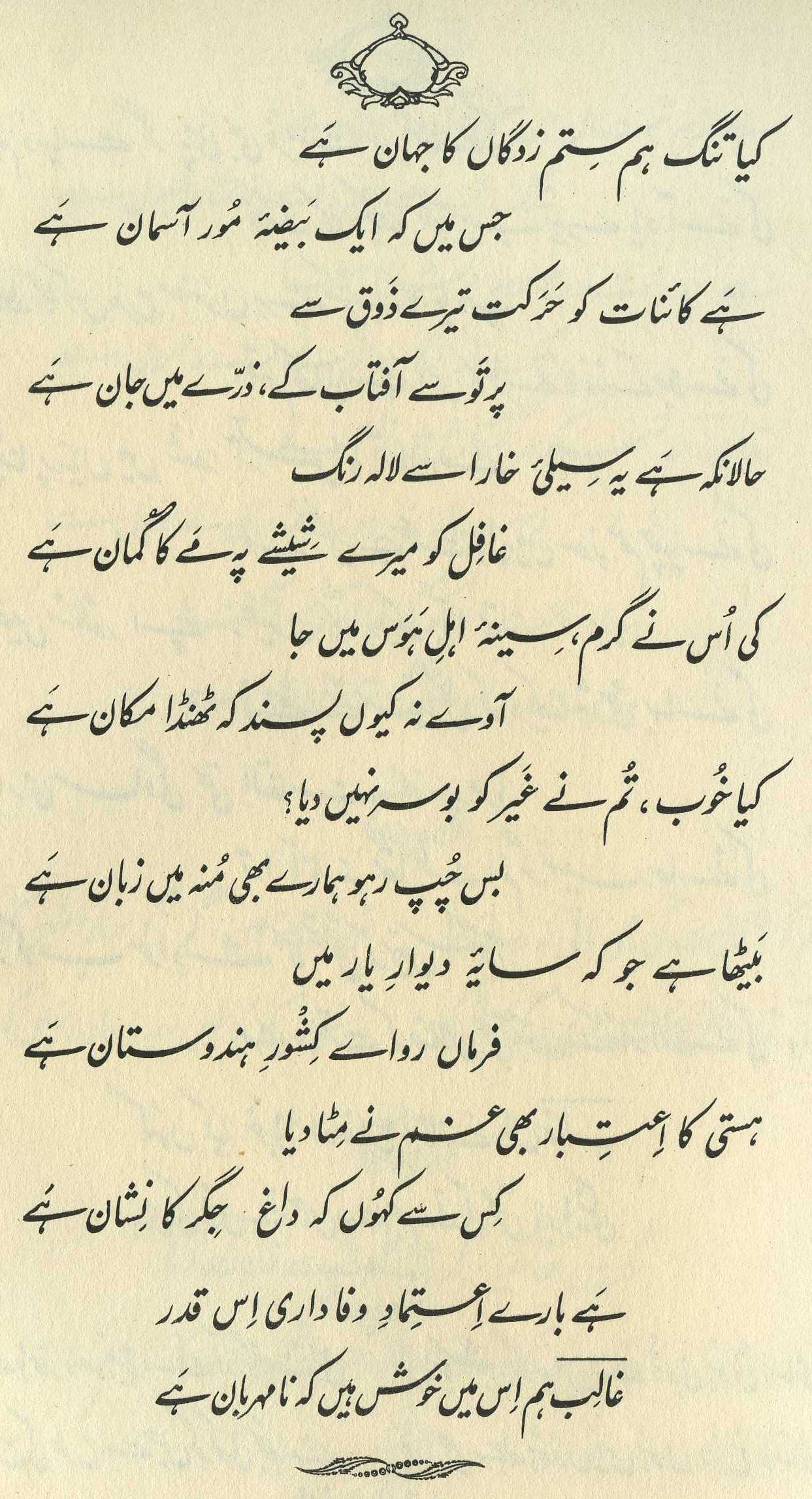
That is, we are happy at the beloved's being unkind, since she has confidence in our faithfulness. She considers that even at her ill-treatment, I will not renounce love. (148)
== Nazm page 148

The theme of this verse is a fine one, but in the second line, without 'she' [] or some word of similar meaning there is no eloquence []. (111)
He says, she has such trust and complete belief in our faithfulness that despite her being unkind and practicing tyranny, she doesn't have even a suspicion that because of her ill-treatment Ghalib would renounce love. (204-05)
The beloved is not kind to us. We are happy with this very thing; we are happy in considering that she has so much trust in our faithfulness that she thinks that no matter how much cruelty she shows toward us, we will remain faithful. (271)
The commentators agree on the most obvious reading, but they don't do justice to the carefully framed ambiguity of the first line. Just as in the previous verse, 138,7 , the first line gives no information whatsoever as to who has trust or confidence in whose faithfulness. That alone should alert us-- since this is Ghalib, after all-- to the need to scrutinize the second line with care.
And when we do, we easily notice a second reading: that the lover is finally at least somewhat ('to this extent') satisfied and confident in his own faithfulness-- so much so that he's quite content, even happy, when she's unkind to him. The first line, in short, may be smugly (or wryly) reporting not on her great faith in his loyalty, but on his own great (and hard-won) faith in his loyalty: he now is able unhesitatingly to accept, with perfect good cheer, whatever she dishes out. (On this reading we take is me;N to mean not 'because of this' but 'in this situation'.)
Then, of course, the whole verse is excellently suited to being read sarcastically: 'Oh sure, aren't we fortunate! After all this time, we're so lucky-- she now trusts us! Such happiness-- she now kindly deigns to be unkind!'
For an even more complex look at the subtleties of kindness and unkindness, see 91,3 .
Note for grammar fans: Hasrat's complaint raises an interesting issue. Normally the subject can be omitted if it is clearly indicated from the prior context. Here, the omitted subject is understood only by being dragged in from our knowledge of the ghazal universe. It does seem a bit dicey, doesn't it? But only when you think about it. Because while you're reading the verse, it feels rock-solid. It shows how excellently Ghalib can control the ambiguities of his verses when he wants to.
graphics/disdain.jpg