Verse 11855ishtko
G3
1
if I went and stayed in the Ka'bah , then don't taunt me! --in any way, ever
2
have I forgotten the right/claim/truth of the companionship of the people of the (idol-)temple?!
ta((nah>> : 'Blame, reproach, chiding, taunting, taunt, reviling, ridicule, scoff, gibe, derision; ignominy, disgrace; aspersion'. (Platts 752)
'Right, title, privilege, claim, due, lot, portion, share, proprietorship;—duty, obligation;—behalf, benefit, interest; —the Truth, the true God'.
'A temple of idolaters, or fire-worshippers; a Christian church; a Jewish synagogue'.
| References | |
|---|---|
| Arshi, Imtiyaz Ali | Ghazal# 124 |
| Raza, Kalidas Gupta | 459 |
| Hamid Ali Khan | Open Image |
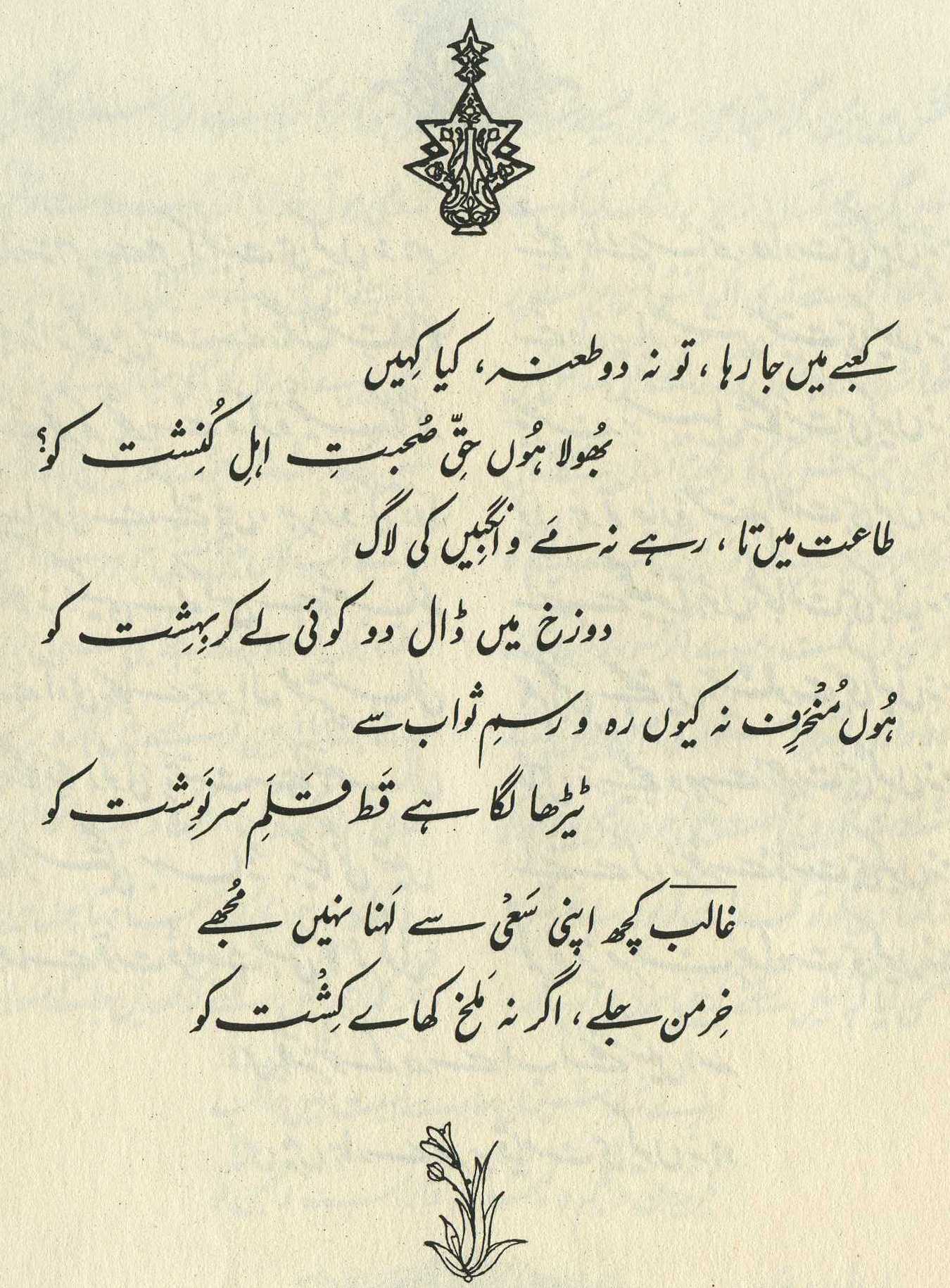
If I went to the Ka'bah, then so what? Am I one ever to forget the idol-temple []? (126)
== Nazm page 126

He says, if I went from Hindustan to make the Hijrah, and remained at the Ka'bah, then why do you taunt me? I am not a man to forget the companioniships of the idol-temple []. (179)
So what if I'm staying here? Have I forgotten the right to companionship of those who stay in idol-temples []? That is, no difference has been made in my and your relationships. (238)
This is an energetic, aggrieved, yet defensive, utterance. It has the form of an indignant, challenging rhetorical question ('Have I ever done so? Of course I haven't! You know very well that I haven't!').
The speaker insists, in the face of 'taunts' that are probably (but not necessarily) from his former (and present?) companions, that his staying in the Ka'bah had no effect at all on his former allegiances-- it just didn't make any difference. This is a piquant notion in its own right-- that someone would not only semi-apologize for staying in the Ka'bah, but would also insist that it really didn't make any difference at all! (In this connection, consider 124,5 .) And by no coincidence, the word for 'right/claim' [] is also, in a mischievous kind of wordplay, one of the names for the 'True God' (see the definition above).
But the 'taunts' add another dimension as well. The 'taunts' might be accusations that the speaker had lowered himself by leaving a higher, more exacting allegiance (to the code of the passionate lover) for an inferior, commonplace, more expedient one: 'He's gone all smug and 'orthodox' on us, he's narrowed his worldview into that of the Shaikh '. Or the taunts might accuse him of sheer fickleness: 'He doesn't know his own mind, he's shallow and idle, he's just in search of novelty and fresh thrills'.
The commentators tend to read unselfconsciously as 'idol-temple', which seems an understandable South Asian interpretation. But in fact the term is remarkably general, and applies to a variety of non-Islamic places of worship (see the definition above); for more on this, see 60,8 .
Do the old companions have a 'right to companionship', or a 'right given by companionship'? The can easily go both ways. Either way, the right belongs not to the , but to the 'people' of it. Perhaps the are simply the visible representatives of the itself, and have their right in that capacity. But the verse feels more personal: it feels as though it is about the privileging of friendship and personal loyalty above outward religious affiliations. Moreover, the grammar of the first line presents the speaker's stay in the Ka'bah as something that occurred in the past ( ), rather than something ongoing, while his loyalty to his companions is presented as continuing into the present ( ). So perhaps even he himself may now recognize his foray into the Ka'bah as a mistake (a youthful folly? a mid-life-crisis? a religious fling?)-- something he plans to live down.
Note for meter fans: Here is scanned with a on the , in the proper Arabic spelling. Verses like 26,7 and 56,5 suggest that Ghalib normally used what Platts calls the 'vulgar' spelling, with no .
graphics/kabah1908.jpg
