Verse 21855ishtko
G3
1
so that, in obedience, the laag of wine and honey would not remain
2
let someone, having taken Paradise, fling/place/involve/produce it in Hell
ta((at>> : 'Obedience, submission, submissiveness; devotion'.
'Honey'.
'Attachment, affection, love; —an application, or a direction (of the mind), aiming; aim; attention; exertion, endeavour, attempt; —touching, reaching, attaining (to), approach; cost, expenditure; —hitting, striking; fixing; —an attack of ill-fortune, a calamitous occurrence, a blow, stroke; enmity, animosity, hostility, rancour, spite, grudge; rivalry, competition; —narcotic quality (of a substance); —intrigue, plot; a secret; —trick, legerdemain, sleight of hand, jugglery; a charm, spell, fascination; —catch, hold, support, basis, ground; a prop'.
'Hell; --(met.) the belly; -- : to fill the belly'.
'To throw, fling, cast, hurl, drop; ... to place or lay (before), to submit, to present; to lay (on), to put or throw (on, as a garment, &c.); to keep (as a mistress), to put aside; to push; to set; ... to thrust; ... to involve; to cause, occasion, produce, excite'.
| References | |
|---|---|
| Arshi, Imtiyaz Ali | Ghazal# 124 |
| Raza, Kalidas Gupta | 459 |
| Hamid Ali Khan | Open Image |
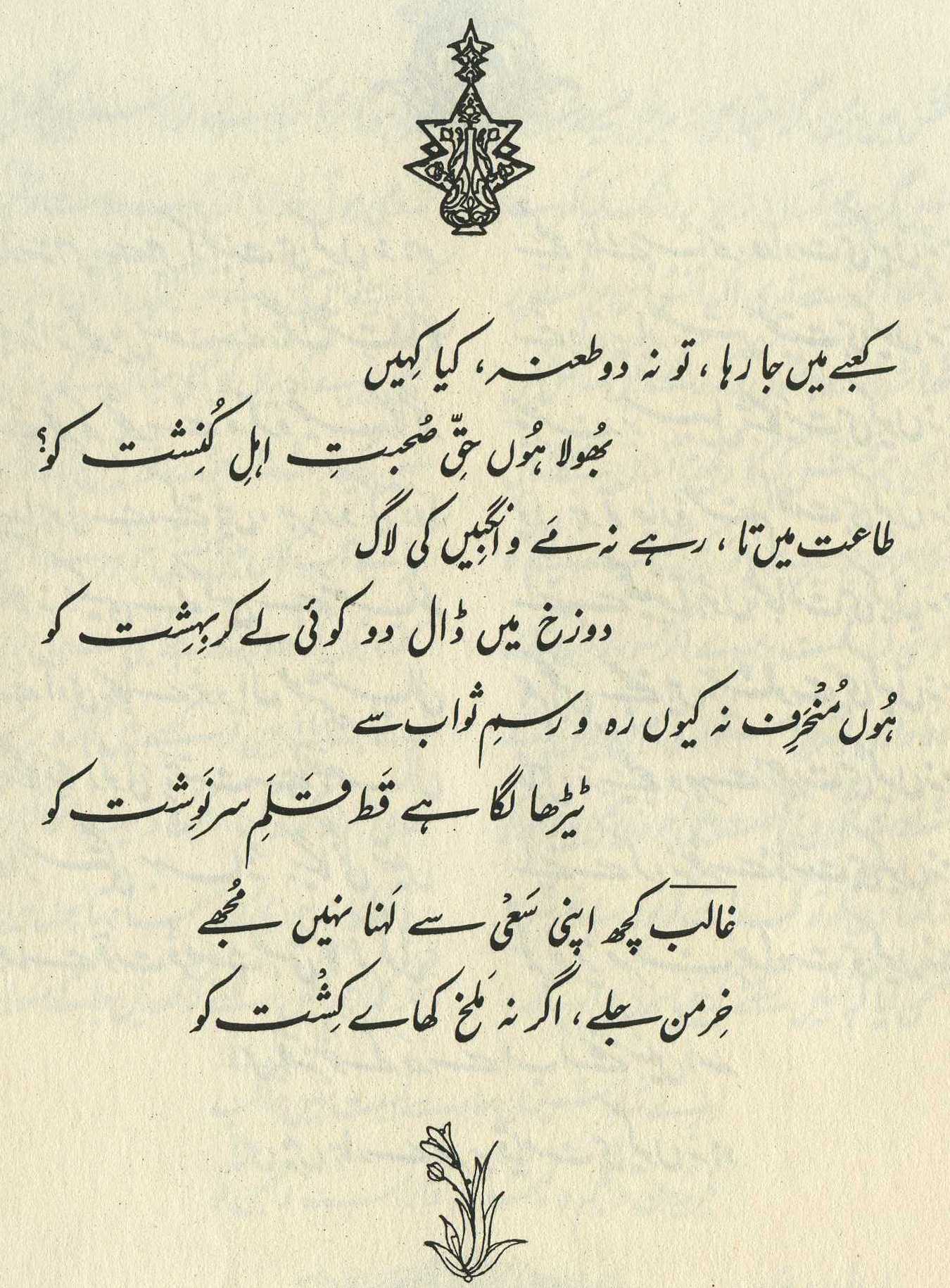
That is, as long as Paradise is in existence, people worship in hopes of receiving honey and heavenly wine, etc. Thus Paradise ought to be flung into Hell, so that this greed would not remain, and people would worship God purely.
==Urdu text: Yadgar-e Ghalib , p. 125
That is, the streams of honey and wine that are available in Paradise-- in coveting them, where is the obedience? Throw such a Paradise into Hell! (126)
== Nazm page 126

If somebody would put Paradise in Hell, it would be a good thing. Then the Lord would be worshipped with a true heart, and the greed for wine and honey would diminish. (238)
Compare 232,4 . (248, 327)
The key word, and a rather troublesome one, is , which primarily means 'enmity; conflict; antagonism', but which can also mean 'longing; lust'. In either case, however, the notion of a conflict remains....
Paradise has never been of much interest to the poet-lover-sufi anyway; he seeks a more intimate relationship. Paradise is for the Mullah, who threatens others with the tortures of Hell but himself drools over the promised delights of Paradise. Thus, the bravado of the poet is essentially a sly attack on the Mullah. He, in fact, does not have any doubt about the sincerity of his own obedience and love.
== Naim 1970, pp. 37-38
[See his discussion of Mir's M 1202,1 .]
Well, this one certainly seems to belong in the 'snide remarks about Paradise' category; for more on this set, see 35,9 . It's not just that Paradise is something that could be casually picked up and flung around. It's also that Hell is apparently so much bigger and more spacious than Paradise, that Paradise could readily be inserted into it, with no further ado. And apparently this deed could be done by 'someone', some member of a (large?) group, rather than only by God.
This one would also be a grand, resonant, melodramatic mushairah verse. The first line is of course uninterpretable until we hear the second. And then the first half of the second sounds like a typical 'let it go to hell!' remark. Only at the very last moment do we finally get to hear what is being so casually consigned to Hell-- and we learn that it's Paradise itself. This verse must have been a delight to hear for the first time, under mushairah performance conditions. What 'mischievousness', and what fun!
This is the consensus reading propounded by the commentators, and it's certainly a legitimate one. But Naim shows some uneasiness about the word , rightly noting that its primary and usual meaning is 'enmity'. And to back him up we have 46,3 , in which such a meaning is clearly at the forefront (though not to the complete exclusion of others). Moreover, if we look at the full range of meanings for (see the definition above), the kind of uneasiness expressed by Naim can only grow.
For after all, just look at the possibilities! Not only the meaning of 'enmity' or 'hostility' that's so prominent in colloquial usage, but so many others as well: an 'aim, attempt', a 'reaching, attainment', a 'cost, expenditure', a 'blow, stroke', a 'spite, grudge', a 'rivalry, competition', a 'narcotic quality', an 'intrigue, plot', a 'secret', a 'trick', a 'charm, spell, fascination', a 'support, basis'.
So for the first line, there are at least three basic readings. The first is the one proposed by the commentators: 'So that, in obedience, the love of (metaphorical or heavenly) wine and honey would not remain'-- that is, so that people would not continue to show obedience in hopes of divine reward.
But the second reading is fully as persuasive: 'So that, in obedience, the enmity toward wine and (metaphorical) honey would not remain'-- that is, so that people would not continue, in obedience to religious injunctions, to force themselves to practice asceticism and self-denial.
And the third reading takes advantage of the versatility of that little : 'So that, in obedience, the calamity/narcotic/trick/spell (etc.) of wine and honey would not remain'-- that is, so that the (variously interpretable) distorting effects of wine and honey on people's obedience would no longer be present. On this reading, the people in question are not active agents who themselves feel love or hatred toward wine and honey, but passive victims who are manipulated by the various dire or sneaky effects of wine and honey.
For after all, in the second line we can see that the idea of moving Paradise into Hell doesn't necessarily mean throwing it away; if Ghalib had intended only an act of violent rejection, he could always have used . Rather, we see that when scrutinized, in the usual Ghalibian way the line is able to rise-- or perhaps expand-- to the occasion, spinning itself out to meet a range of possibilities. For what it actually urges is that someone should pick up Paradise and either 'fling' or 'place' or 'put' or 'involve' or 'produce' [] it in Hell (see the definition above).
So what would it mean to (re)establish Paradise, or a Paradise, or some form of Paradise, in Hell? Would it mean that those dwelling in Paradise would find themselves surrounded by, or implicated in, various sinful activities? Would it mean that the denizens of Hell would have access to at least some of the joys of Paradise? Would Paradise and Hell become so intertwined that the distinction between them would become meaningless? After all, by mentioning both the definitely forbidden 'wine' and the definitely permitted 'honey', the first line has already made a point of opening up possibilities of both licit and illicit satisfaction.
And would all these possibilities suggest that obedience motivated by greed and self-interest is really a Hell-tending activity? And/or that the desire for wine and honey is really legitimate, not contemptible, and so ought to be satisfied even in Hell? And/or that the distinction between forbidden wine and permitted honey isn't really very significant? And/or that the whole process of agonizing over desires, sins, austerities, self-denial, etc. is futile and should just be dropped? Should 'obedience' be purified and thus made loftier, or should it just fade into irrelevance?
Of course, we can't answer these questions. But once we've seen them, we can't ignore them either, and it's hard to stop thinking about them.
The metaphorical sense of as 'stomach' also makes for splendid wordplay-- and meaning-play as well.
Compare 413x,7 for a snidely witty take on the opposite possibility: incorporating Hell into Paradise.
graphics/honeywine.jpg