Verse 31854aa))e;Nkyaa
G14
1
if there would be 'laag', then we would consider it affection
2 a
when there would be nothing at all, then-- as if we would be deceived!
2 b
when there would be nothing at all, then-- would we be deceived?
'Attachment, affection, love; —an application, or a direction (of the mind), aiming; aim; attention; exertion, endeavour, attempt; —touching, reaching, attaining (to), approach; cost, expenditure; —hitting, striking; fixing; —an attack of ill-fortune, a calamitous occurrence, a blow, stroke; enmity, animosity, hostility, rancour, spite, grudge; rivalry, competition; —narcotic quality (of a substance); —intrigue, plot; a secret; —trick, legerdemain, sleight of hand, jugglery; a charm, spell, fascination; —catch, hold, support, basis, ground; a prop'.
'Attachment, connexion; bond, link; ...inclination, propensity'.
'Deceit, deception, delusion; blunder, mistake; ... anything that may deceive or mislead'.
| References | |
|---|---|
| Arshi, Imtiyaz Ali | Ghazal# 46 |
| Raza, Kalidas Gupta | 448-449 |
| Hamid Ali Khan | Open Image |
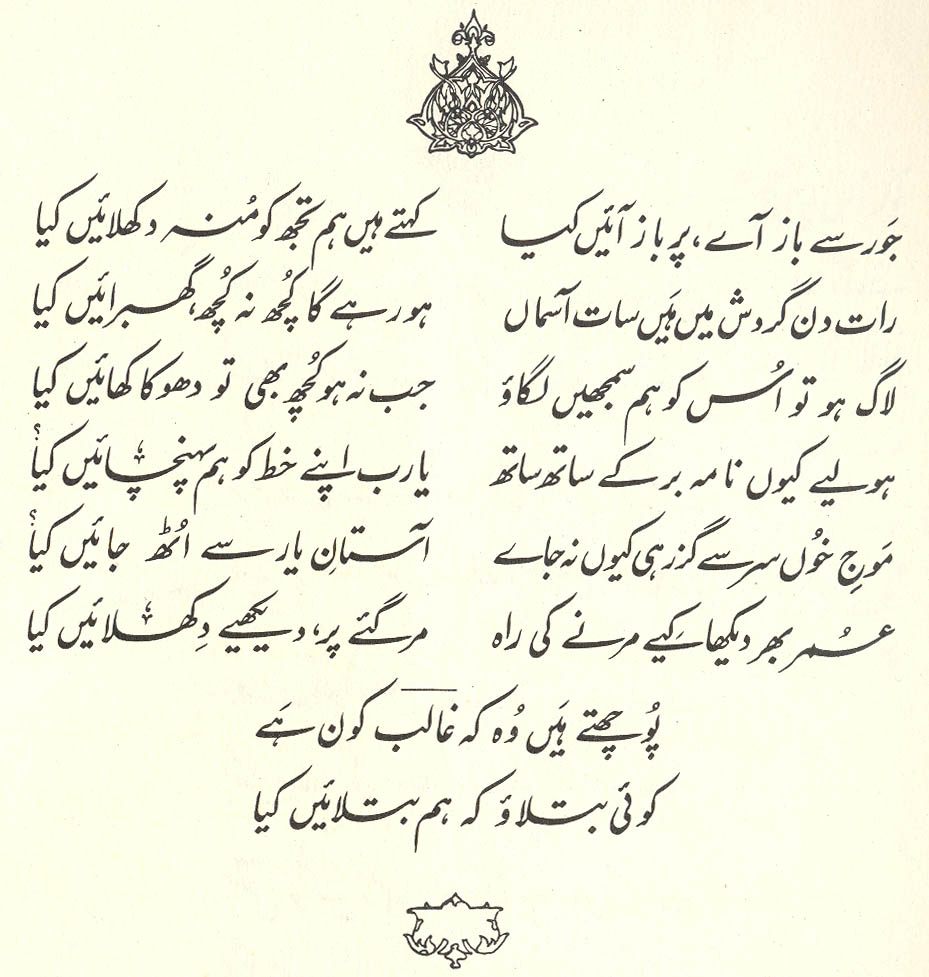
is enmity; and , love. It would not be strange if someone else too had used this theme , but to this day I haven't seen it. Even if somebody had used it, he would definitely not have used it with this excellence and refinement. The meaning is that the beloved feels toward us neither enmity nor friendship; even if there were enmity, then because in it too is a kind of relationship, we would consider it friendship. But when there is neither friendship nor enmity, then what is there to be deceived about?
Leaving aside the fineness and crowningness of the thought, two words like and have been brought together, that have a single source and discordant meanings. And this is an extraordinary coincidence that has multiplied the excellence of the thought many-fold.
==Urdu text: Yadgar-e Ghalib , pp. 121-22
That is, even if she showed hatred, we would consider it love. (42)
== Nazm page 42

Urdu text: Vajid 1902 {46}
Compare 123,4 . (104)
It's a peerless and immortal verse.... He has searched out two words that are entirely different and are derived from the same root and are opposite in meaning. He has thus doubled the loftiness of thought and the excellence of the theme . A theme of this type is to be found in one more place in Mirza's work: he says, 148,2 . (116)
[Compare his commentary on Mir's M 144,5 .]
The commentators stress the elegant wordplay, which is rendered even more spectacular by the fact that is so versatile. Most obviously, it can be either an antonym or a synonym for (though the synonymous usage is rarer). The lover isn't entirely sure he can tell the difference between and ; in fact, he'd be likely to (haplessly? deliberately?) identify the former as the latter. If he did so, he might be wrong-- or he might not. For not only do both nouns come from the same root, but has an extraordinary range of meanings that do indeed include both hatred and love.
And so much more besides! For what the lover might consider to be affection might really be an 'aim, attempt', a 'reaching, attainment', a 'blow, stroke', a 'spite, grudge', a 'narcotic quality', an 'intrigue, plot', a 'secret', a 'trick', a 'charm, spell, fascination', and so on (see the definition above). Any of these possibilities could be mistaken for, or induce a false show of, affection. These complexities of hover as a kind of penumbra, adding to the effect of confusion in the mind of the perhaps deluded lover.
So if the presence of one or another kind of strong emotion can confuse the lover, then might its absence not also prove bewildering, as in (2b)? Or would the lover go on loudly whistling in the dark, as in (2a)?
The desperate lover has thus sought to turn every possible attitude of the beloved's to good account. If she shows love, what could be better? If she shows hatred (or almost any other 'reaching out' emotion), he'll consider it love. And if she shows nothing at all, then he'll console himself with the thought that he's now safe from any deceit and disappointment. None of this really seems very comforting. But then, it may be all the comfort the lover has.
As Josh suggests, compare 148,2 , for a cut-to-the-chase summary of the situation. For other complex deployments of the possibilities of , see 118,2 and 323x,5 .
On as 'to consider', see 90,3 .
Compare Mir's treatment of the complexities of : M 817,1 .
graphics/laag.jpg