Verse 61854aa))e;Nkyaa
G14
1
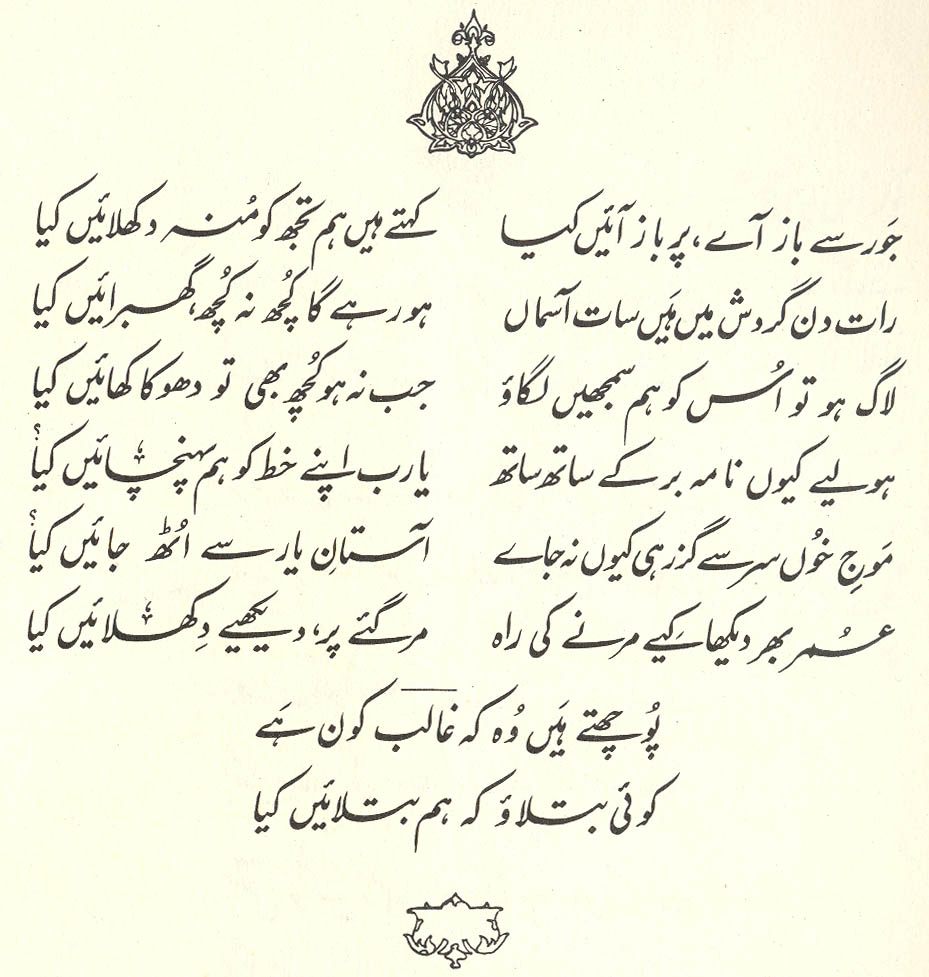
for our whole lifetime we always awaited/'watched the road of' death
2 a
upon dying, let's see what [they] would show!
2 b
we died, but let's see what [they] would show!
| References | |
|---|---|
| Arshi, Imtiyaz Ali | Ghazal# 46 |
| Raza, Kalidas Gupta | 448-449 |
| Hamid Ali Khan | Open Image |
[1855, to Haqir:] There's no breath I take that I'm not mindful of the last breath. I'm already sixty years old. Now how long will I live? The ghazal , the ode , the verse-set , the quatrain , Persian, Urdu-- I've composed ten thousand verses, now how long will I go on composing? I got through the good and bad of life as best I could. Now my thought is, let's see what death is like, and what happens after death: {46,6} [text has ]
==Urdu text: Khaliq Anjum vol. 3, p. 1167
==another trans: Russell and Islam p. 78
[February 1857, to Qadar Bilgrami:] From the age of twelve years I have been blackening the paper with poetry and prose as if it were the record of my deeds. I've reached my sixty-second year-- fifty years have passed in the exercise of this pursuit. Now there's no strength or endurance in body or spirit. I've entirely given up writing Persian prose; in Urdu too I've renounced all ornamentation-- whatever comes to my tongue, emerges from my pen. My foot is in the stirrup and hand on the reins-- what would I write, and what would I do? I constantly recite this verse of mine: {46,6} [text has ]. ==Urdu text: Khaliq Anjum vol. 4, p. 1415
[1859, to Surur:] Now, night and day, I'm wondering-- life has passed like this, now let's see how death will be: {46,6} [text has ] ==Urdu text: Khaliq Anjum vol. 2, p. 604
[c.1859:] [See the mention along with 46,2 .] [text has ]
[1861, to Shafiq:] Neither can you take care of me, nor can I give you any help. God, God, God! I've swum the whole sea. The shore is near. With two more strokes, I'm across: {46,6} [text has ] ==Urdu text: Khaliq Anjum vol. 3, p. 996 ==another trans.: Russell and Islam p. 264; Daud Rahbar p. 182
[1867:] Seventy-one years of age, crippled in the legs, deaf in the ears. Day and night I lie prostrate, if I write two lines, my body trembles, the words don't come to me. My powers are failing, my senses disordered, my diet is limited or rather minimal: {46,6} [text has ] ==Urdu text: Khaliq Anjum vol. 4, p. 1442
[February 1857, to Qadar Bilgrami:] From the age of twelve years I have been blackening the paper with poetry and prose as if it were the record of my deeds. I've reached my sixty-second year-- fifty years have passed in the exercise of this pursuit. Now there's no strength or endurance in body or spirit. I've entirely given up writing Persian prose; in Urdu too I've renounced all ornamentation-- whatever comes to my tongue, emerges from my pen. My foot is in the stirrup and hand on the reins-- what would I write, and what would I do? I constantly recite this verse of mine: {46,6} [text has ]. ==Urdu text: Khaliq Anjum vol. 4, p. 1415
[1859, to Surur:] Now, night and day, I'm wondering-- life has passed like this, now let's see how death will be: {46,6} [text has ] ==Urdu text: Khaliq Anjum vol. 2, p. 604
[c.1859:] [See the mention along with 46,2 .] [text has ]
[1861, to Shafiq:] Neither can you take care of me, nor can I give you any help. God, God, God! I've swum the whole sea. The shore is near. With two more strokes, I'm across: {46,6} [text has ] ==Urdu text: Khaliq Anjum vol. 3, p. 996 ==another trans.: Russell and Islam p. 264; Daud Rahbar p. 182
[1867:] Seventy-one years of age, crippled in the legs, deaf in the ears. Day and night I lie prostrate, if I write two lines, my body trembles, the words don't come to me. My powers are failing, my senses disordered, my diet is limited or rather minimal: {46,6} [text has ] ==Urdu text: Khaliq Anjum vol. 4, p. 1442
One day when Mirza was absorbed in chess, the late Munshi Ghulam Ali Khan recited this verse [of Zauq 's] to somebody else:
[now, in distress, we say this: that 'we will die'
if even/also having died, we wouldn't find peace, then where will we go?]
The late Khan used to say that the sound of this fell on Mirza's ear also. At once he abandoned his chess game and asked me, 'Brother, what did you recite?' I again recited that verse. He asked, 'Whose verse is it?' I said, 'Zauq's'. Hearing this, he was extremely surprised, and made me recite it again and again, and slapped his head. I too notice that Mirza, in his Urdu letters, has mentioned this verse repeatedly. Where he has praised an excellent verse, there he has certainly written down this verse.
==Urdu text: Yadgar-e Ghalib , pp. 82-83
The reference in 'would show' is to the Lord. He says that his whole life he has been waiting for death, since it will certainly be better than the state of life. Now let's see, after dying let's see what state He would show me that has kept me waiting for a lifetime. ==Urdu text: Yadgar-e Ghalib , p. 143
The reference in 'would show' is to the Lord. He says that his whole life he has been waiting for death, since it will certainly be better than the state of life. Now let's see, after dying let's see what state He would show me that has kept me waiting for a lifetime. ==Urdu text: Yadgar-e Ghalib , p. 143
That is, his whole life he waited for death. When he dies, no telling what death will bring. (42)
== Nazm page 42

Urdu text: Vajid 1902 {46}
In this verse the aspect of complaint against the Lord emerges, and it's clear what a bad life this life is, that a person would at every moment wait for death....
The True Beloved (the Lord) has promised to show Himself on Doomsday. The lover says, with this hope I have spent my whole life in passion and in waiting for death. Now let's see what happens after death, whether the longing for sight is fulfilled or not. (105)
Arshi gives , but then in his footnotes Arshi shows that in letters Ghalib used both and about equally often (as can be seen in the examples above). It seems clear that Ghalib considered both forms grammatically correct and poetically appropriate for that point in that verse. This is surely the reason that he himself couldn't seem to remember which form he had officially chosen.
More than any other verse, this one seems to have often come to Ghalib's mind in his later years, at least when he wrote to his friends. The six instances given above are more than can be found for any other verse. Such quotations in letters are of biographical interest of course, and also illustrate the emotional context in which the verse seemed appropriate to him. I reproduce in this commentary every such reference that I've found, since the instances in which he actually analyzes, or even discusses, his own verses are all too few.
The vocabulary of this verse is utterly simple-- which enables it to be nicely turned out when it comes to visual wordplay. The expression 'X ' is a petrified phrase that means 'to wait for X', but its literal meaning is 'to watch X's road,' to watch for X to arrive. Here the 'watching' in the first line is echoed by the 'let's see' and the 'show' in the next line. The polite imperative , literally 'please look', is colloquially used the way 'let's see' is in English. And , 'to show', literally means 'to cause to see', and is of course derived from , 'to see'. (In fact is just a variant form of ; it has the advantage for this verse of scanning with an initial long syllable instead of a short one.)
In Urdu, 'to see', 'to look', and 'to watch' are all expressed by . The eager spectator waited a lifetime to see what death would show him. Why? Because life in the world proved so unsatisfying in general? Because his particular life was so especially wretched and full of pain? Because he had mystical longings that could only be fulfilled beyond this limited life? Because death had a reputation as a master showman who might offer a fine spectacle?
In the second line, can be read either as an archaic variant of , 'upon dying', or more literally as '[we] died, but'. The former seems to be spoken before death, the latter after death (for more verses in which the dead lover speaks, see 57,1 ). The former is more neutral and hopeful; the 'but' in the latter suggests that what death has to show is very likely to be disappointing.
The most striking bit of grammar in the verse is the plural subjunctive, which requires an implied plural subject. Death seems to be irrevocably singular. So who are the 'they' who would be doing the showing? One might of course argue that the plural ending was required by the rhyme , so that the poet was simply-- and slackly-- yielding to necessity. But Ghalib is too tricky a poet to be so readily constrained. I would argue that it's the same 'they' who appear in the expression 'they say' (in both English and Urdu)-- a wryly observed, vague group defined both by being elusively powerful, and by being not me/us. It could theoretically of course be a respectful reference to God, but it certainly doesn't come across that way; God is in any case almost always addressed more intimately.
Then, of course, the final jewel is the artistic use of the multifaceted ; for more on this see 15,10 . All these readings of are possible:
=let's see what they would show (as translated above)
=let's see-- what would they show?
=let's see-- would they show, or not?
=let's see-- as if they would show!
Ghalib cited this verse in melancholy contexts, including laments about the decline of his powers as a poet. But surely he was also reminding his addressees of what he as a poet had already so richly achieved-- could anything from the next world compare with what he had seen, and shown, already?
Note for grammar fans: On , see 215,1 .
graphics/waiting.jpg