Verse 51821arkhe;Nch
G9
In this meter the next-to-last long syllable may be replaced by two shorts.
1
with a sidelong/'half' glance, {uphold / having upheld} the right/claim of the trust of coquetry
2
from the sheath of the veil of the wound of the liver, {draw / having drawn} the dagger
'A sign with the eye, a wink; an amorous glance, ogling; coquetry, affectation'.
'A deposit, trust, whatever is committed to another's charge'.
'Secrecy, privacy, modesty; seclusion, concealment; secret, mystery, reticence, reserve'.
'Grace, beauty; elegance; graceful manner of carriage; charm, fascination; blandishment; amorous signs and gestures, coquetry: ... , To coquet'.
'To perform; accomplish; fulfill; discharge'.
'To draw, drag, pull; to attract, to draw in, suck in, absorb'.
| References | |
|---|---|
| Arshi, Imtiyaz Ali | Ghazal# 56 |
| Raza, Kalidas Gupta | 329 |
| Nuskhah-e-Hamidiyah | 95-96 |
| Asi, Abdul Bari | 105-106 |
| Gyan Chand | 185-186 |
| Hamid Ali Khan | Open Image |
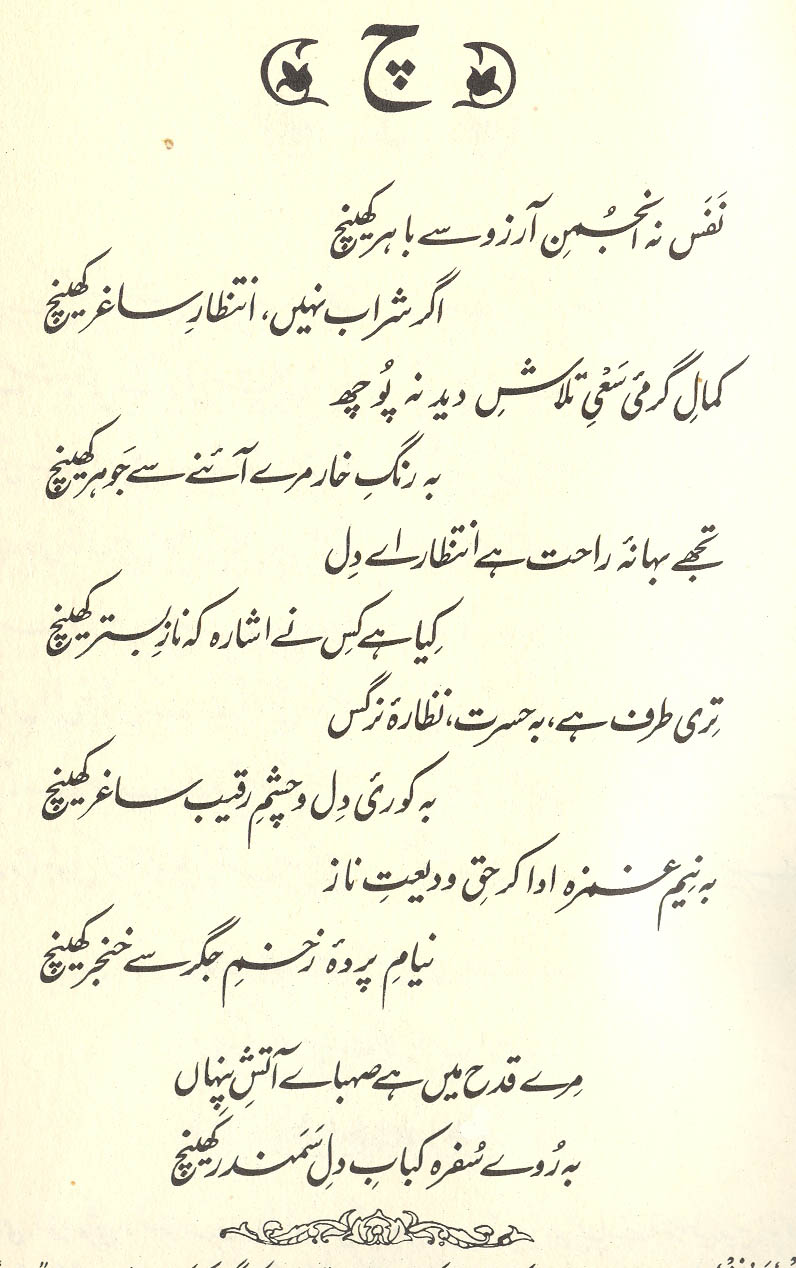
If the dagger-- that is, [a straight vertical line]-- is removed from ['sheath'], then it becomes ['half'], but this dagger has also murdered the meaning. The field of interpretation is very broad. If he has put a meaning in it, it is this: that your airs and graces are a Divine trust; in order to do them justice, show your coquetry, and thus grasp the dagger, so that it can be recognized. Being drawn out, it emerges from the veil of the lover's liver. That is, coquetry is a sword without a sheath; if it has a sheath, then it's the wound in the lover's liver. (51)
== Nazm page 51

I've given your dagger, in the sheath of the veil of the wound of the liver, a trust. Now you too fulfill the right of that confidence, and give recompense for what was entrusted to you, with a half-glance. (54)
He says, The airs and graces that God Most High has bestowed on you are like a trust from Him. Do justice to this trust with a sidelong glance. If you give a full glance, then the lover's life will at once leave him. So it's necessary for you to use a sidelong glance, and an example for that is if after inflicting a wound in the liver, the dagger is left there, then the wounded one is at once on the point of death. And if after the attack the dagger is pulled out, it will certainly take longer for the wounded one to die, and perhaps his life might even be saved. Thus it's better to use a sidelong glance. The other verbal device that has been placed in this verse is that after removing the from , remains. And is exactly what the lover says to use. (96-97)
I have endured tyranny with the hope that sometime you would show me your airs and graces, and give me a sidelong glance. I don't even ask you for a full glance, I seek only a sidelong glance. The word increases the verse's beauty; there is an in it too. This verse also has the pleasing feature that if we remove the from , then remains.... The 'murder of meaning' [alleged by Nazm] has not been proved. (122-23)
[The commentator Sa'id says:] Since you have thrust the dagger into the liver, now fulfill the obligations of coquetry and draw it out in such a way that the wound becomes wider and the wounded one can easily be finished off. (158)
The commentators point out the clever visual 'letter-play' with the dagger-like , between (spelled 'n-y-a-m'), the 'sheath' from which the alif-dagger is to be pulled out, and (spelled 'n-y-m'), the 'half' and sidelong glance that results. Nazm's complaint that this supererogatory wordplay 'murders the meaning' is merely persnickety; the wordplay is enjoyable in itself, and it's not obliged also to work on every possible semantic level. As Nazm himself points out, the range of possible interpretations is very broad in any case.
Bekhud Mohani points out that the word constitutes an . What this means is that in the context of 'sidelong glance,' we think of in its sense of 'to coquet', to display flirtatious airs and graces. Only in retrospect does it become clear that meaning 'to perform' is what is required for the meaning of the verse (see the definitions above). This is a classic form of : a misdirection that requires the hearer to backtrack and reinterpret on the fly; in the present case, it also leaves an enjoyable touch of the earlier meaning hovering above the verse. The loses some of its effectiveness, however, because the information needed for the correct reading is provided at once, right after the misdirection has occurred, so the hearer hardly has time to establish the misreading before it's instantly changed into the right one. If the correction had been provided only after a delay-- ideally, late in the second line-- then the enjoyment would have been considerably greater.
To the set of , , and in the first line is juxtaposed in the second line: the beloved's coquettish behavior implies a clever use of concealment or avoidance, alternated with blandishments. The image of the beloved's sidelong glance, or a glance from behind a (literal or metaphorical) , 'veil, curtain', is a perfect example of such coquetry. This coquetry is a 'trust' that has been placed in the beloved's custody (by God? by the lover?), so it's positively the beloved's duty to maintain and display it. Drawing out the dagger from the or seclusion of the lover's liver, and letting it flash coquettishly in full daylight, is surely no more than proper behavior on the beloved's part.
Not surprisingly, the commentators disagree on what it means to pull the dagger from the sheath of the of the liver. (For more on the implications of , see 30,2 .) It could mean: (1) draw the dagger out, to use it for coquetry, from the liver-sheath in which you store it (Nazm); (2) slow the dying of the wounded lover by drawing out the dagger (Bekhud Dihlavi); (3) kill the dying lover quickly by drawing out the dagger (Baqir). There's undoubtedly a connection between the beloved's coquetry and the use of the lover's liver as a sheath for the beloved's dagger-- but it's left up to us to decide what that connection is.
Note for grammar fans: The ambiguity of the 'A,B' structure is increased by the double possibilities of the two verbs and . Both of these can be read as intimate imperatives, thus yielding two independent lines. Or they can be read as and , such that the action of the first line precedes that of the second; or else they can be read as and , such that the action of the second line precedes that of the first. (They can't both be read as -deletion cases, however, since then we'd lack a finite verb.)
graphics/dagger.jpg