Verse 41821arkhe;Nch
G9
In this meter the next-to-last long syllable may be replaced by two shorts.
1
toward you, with longing/sorrow, is the gaze/ogling of the narcissus
2
to/with the blindness of the heart and eye of the Rival , lift/draw a glass
zaarah>> (or ) : 'Sight, view, look, show; inspection; --amorous glance, ogling'.
'To draw, drag, pull; to attract, to draw in, suck in, absorb'.
| References | |
|---|---|
| Arshi, Imtiyaz Ali | Ghazal# 56 |
| Raza, Kalidas Gupta | 329 |
| Nuskhah-e-Hamidiyah | 95-96 |
| Asi, Abdul Bari | 105-106 |
| Gyan Chand | 185-186 |
| Hamid Ali Khan | Open Image |
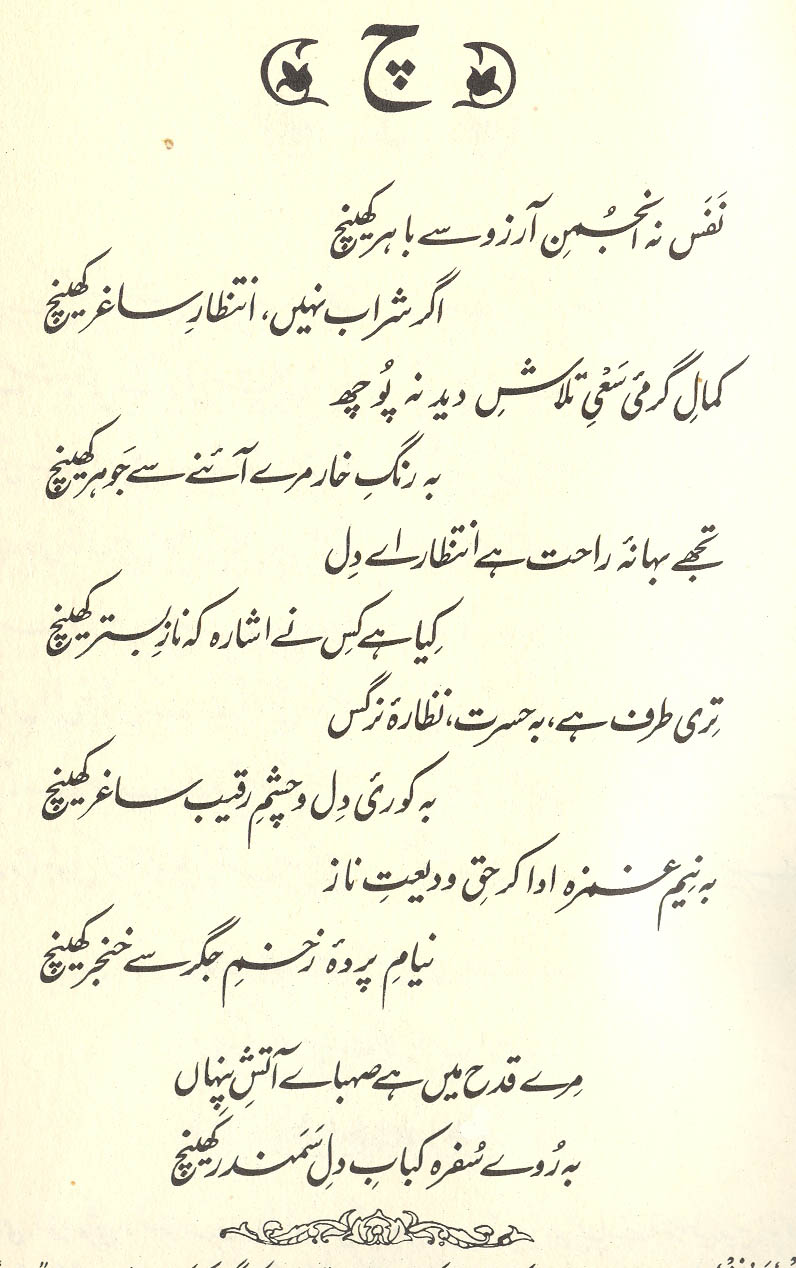
That is, [the Rival is] the narcissus, who is looking toward you with longing. It means, why don't you go ahead and drink wine? Why do you fear the Rival, who is blind-hearted and blind-eyed? These two things have grown out of the narcissus's qualities-- one, that its eye is lightless; the second, that it is compared to a wine-flagon. (51)
== Nazm page 51

He says, the narcissus is staring fixedly at your face with a look of longing. And for anyone to look at you in my presence is an expression of rivalry. But my Rival-- that is, the narcissus-- is blind both in heart and in eye. On this occasion for joy, you ought to drink wine. (96)
The aspect of the narcissus is similar to that of a flagon, but its eye is lightless. Mentioning it on this occasion is inappropriate; it reduces the effect of the verse. (122)
[The commentator Sa'id says:] The narcissus is looking with great longing toward you, so drink a glass to the blindness of eye and heart of this rival of mine, so that he will become blind and the 'evil eye' will not affect you. (158)
The commentators take the narcissus to be the Rival in this verse. The narcissus is thought to have the ideal shape of an eye; it can be used to describe the beloved's eye. But undoubtedly its eye is blind. So this reading is quite possible. The beloved should drink a glass , 'to/with the blindness of heart and eye of the Rival'. Here the elegant multivalence arises: how to interpret ?
Three readings are presented by various commentators: (1) Joyously drink to the Rival's manifest blindness (Bekhud Dihlavi); (2) Freely drink because of the blindness, since the Rival can't see you (Nazm); or (3) Drink as a form of protective curse, to ward off the evil eye (that might otherwise be invoked through such fixed staring), and to strike the Rival blind (Baqir). These simultaneous possibilities, all of them-- as usual in Ghalibian style-- quite appropriate, are the real heart of the verse.
A further consideration also presents itself: the beloved is to drink to, or in connection with, the 'blindness of heart and eye' of the Rival-- and I'm not aware of any idea in the ghazal world that the narcissus is false, or morally dubious, such that it would be described as 'blind of heart'. In fact by looking toward the beloved with longing, even though blind, the narcissus seems to be showing the behavior of a proper lover. In 181,5 , the narcissus even gets its sight restored. (In 217,6x , it uses its eye to give the hapless lover a hostile glare; in 369x,1 , its blindness is emphasized.)
So the narcissus might also be seen merely as a suggestive evocation of the Rival, who is a real (ghazal-world) human being. When the lover sees the blind eye of the narcissus turned toward the beloved with apparent longing, he's reminded of the Rival, who also stares at her so fixedly. Yet the Rival is blind! He's blind not only of eye, but also of heart, and is thus unworthy of her beauty. Since he's as blind as the narcissus and more so, the lover proposes a toast to the Rival's folly and failure and (moral) blindness.
graphics/narcissus.jpg
