Verse 21821arkhe;Nch
G9
In this meter the next-to-last long syllable may be replaced by two shorts.
1
the perfection of the heat/enthusiasm of the effort of the search of sight/vision-- don't ask!
2
in the aspect/style of thorns, {draw / having drawn} the polish-lines from my mirror
'Seeing, sight, vision; show, spectacle'.
'A gem, jewel; a pearl; essence, matter, substance, constituent, material part (opp. to accident), absolute or essential property; skill, knowledge, accomplishment, art; excellence, worth, merit, virtue; secret nature; defects, vices; --the diversified wavy marks, streaks, or grain of a well-tempered sword'.
'To draw, drag, pull; to attract, to draw in, suck in, absorb'.
| References | |
|---|---|
| Arshi, Imtiyaz Ali | Ghazal# 56 |
| Raza, Kalidas Gupta | 329 |
| Nuskhah-e-Hamidiyah | 95-96 |
| Asi, Abdul Bari | 105-106 |
| Gyan Chand | 185-186 |
| Hamid Ali Khan | Open Image |
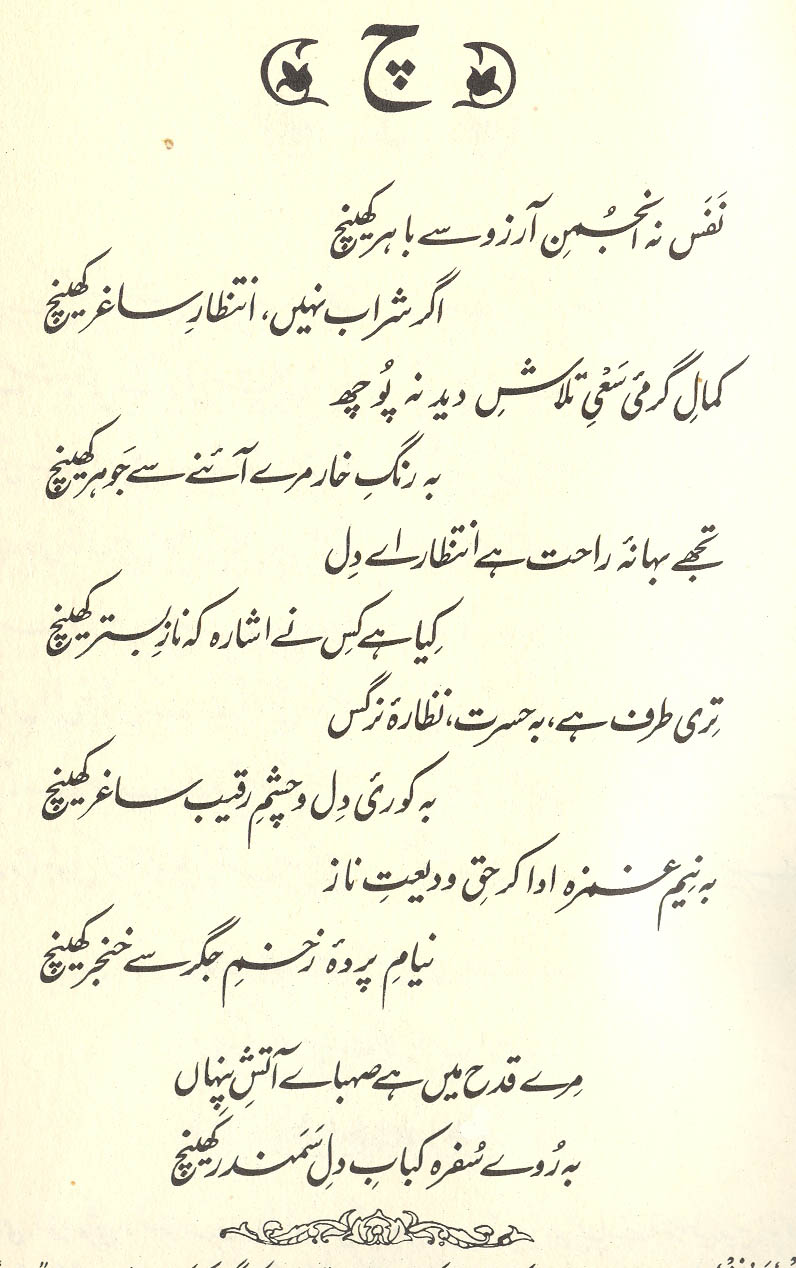
The longing for sight is a mirror, in which instead of polish-lines there are thorns, and during the search for sight these thorns have created scratches. In the first line of this verse there are four 'meaningful' [] [=grammatically necessary] constructions, and the presence of more than three s is a poetic flaw. There's no doubt that if more than one is present, slackness [] develops in the construction-- not to speak of four s, and those too 'meaningful' ones! (50)
== Nazm page 50

The mirror, that is, the mirror of my longing for sight, in which instead of faces there are thorns that ought to be considered the result of the extreme heat of the effort at sight-- just as it commonly happens that those who run around and make excessive efforts have thorns lodge in their feet. (53)
He says, 'Don't ask me about the state of complete heat and effort of my mirror. What difficulties and troubles I've endured in the quest for people of insight and inquiry!-- such that now the polish-lines of my mirror of perfection are pricking in my eyes like thorns. In despair at not finding any accomplished judges of poetry, I only want to find someone who will pull out the polish-lines of perfection from my mirror as though they were thorns.' (95-96)
In the longing for sight, how much effort the mirror of my eyes, or the mirror of my heart, made! Now there's no more time for that question-- don't ask it. Rather, just look at state of the polish-lines of passion and the polish-lines of searching-- they've become like thorns.... Now I wish that somebody would take those polish-lines away from me. (121)
He calls the foot of ardor a mirror, because it has been worn smooth into a mirror. The thorns that have lodged in it he has called the polish-lines of that mirror. Both simile s are very lofty and entirely new. In Mirza's poetry, there's a typhoon of entirely new and entirely untouched similes. (130)
[This unpublished commentary has been provided (Feb. 2015) for the website: Satyanarayana Hegde on {56,2} .]
This is another of Ghalib's 'mirror' verses, which tend to be some of his most abstract. As usual, the mirror is a metal one, with small polish-lines that show how it has been cleaned (by being scraped with something like steel wool).
But four constructions in a row! The is versatile in any case; for more on its possibilities, see 16,1 . Perhaps Nazm is a touch severe, but still, Ghalib is certainly pushing his luck. The Urdu indeed feels almost as clumsy and forced as the four sequential and bumpy 'of' constructions in the translation. That being said, the ambiguity level of the constructions is, by Ghalibian standards, quite restrained. The chief duality that emerges is at the end of the string: is it the 'search of sight' in the sense of a 'search for sight', or is it a 'search made by Sight' for something else?
And the big question-- how to put it all together? It isn't at all clear how we are to find 'objective correlatives' for the images. What is 'my mirror'? Is it my longing for sight (Nazm, Hasrat), my eyes or heart (Bekhud Mohani), or the 'foot of ardor' (Josh)? Except for the heart, all these entities sit awkwardly with the idea of having polish-lines on them. And then, of course, to demand that the polish-lines be pulled out like thorns is itself a large and peculiar leap; why exactly (other than shape) are the polish-lines like thorns, and how are they to be pulled out, and by whom, and from what? Josh's idea that the mirror is really a foot is an attempt to account for the thorns, but of course it has major silliness problems of its own.
If there were a link through the concept of heat, that would help a lot: the first line laments the intense heat of the search for/by sight, and the second would propose a remedy for it. Is it conceivable that the physical polishing of the metal mirror, that creates the polish-marks, generates painfully intense heat? If so, where is the connection to thorns and the removing of thorns, which have nothing to do with heat?
In short, in this verse Ghalib is metaphorically equating abstractions with abstractions. The verse is unrewardingly confusing; its energy spins out into an annoying cloud of uncertainty. I think it's one of his less satisfactory verses. But of course, there could conceivably be some 'key' to it-- some idiom or bit of wordplay now lost to us-- that would resolve these problems and provide the coherence that the verse now lacks.
graphics/mirror.jpg