Verse 7x1821arkhe;Nch
G9
In this meter the next-to-last long syllable may be replaced by two shorts.
1
the madness of the mirror is ardent for a single spectacle
2
on our page, draw ruled-lines with the wing of a Pari
tar>> : 'An instrument with which a book is ruled (made of a piece of pasteboard with strings strained and glued across it, which is laid under the paper; the latter being ruled by being slightly pressed over each string); —a ruled line, a line'.
'To draw, drag, pull; to attract, to draw in, suck in, absorb'.
| References | |
|---|---|
| Arshi, Imtiyaz Ali | Ghazal# 56 |
| Raza, Kalidas Gupta | 329 |
| Nuskhah-e-Hamidiyah | 95-96 |
| Asi, Abdul Bari | 105-106 |
| Gyan Chand | 185-186 |
| Hamid Ali Khan | Open Image |
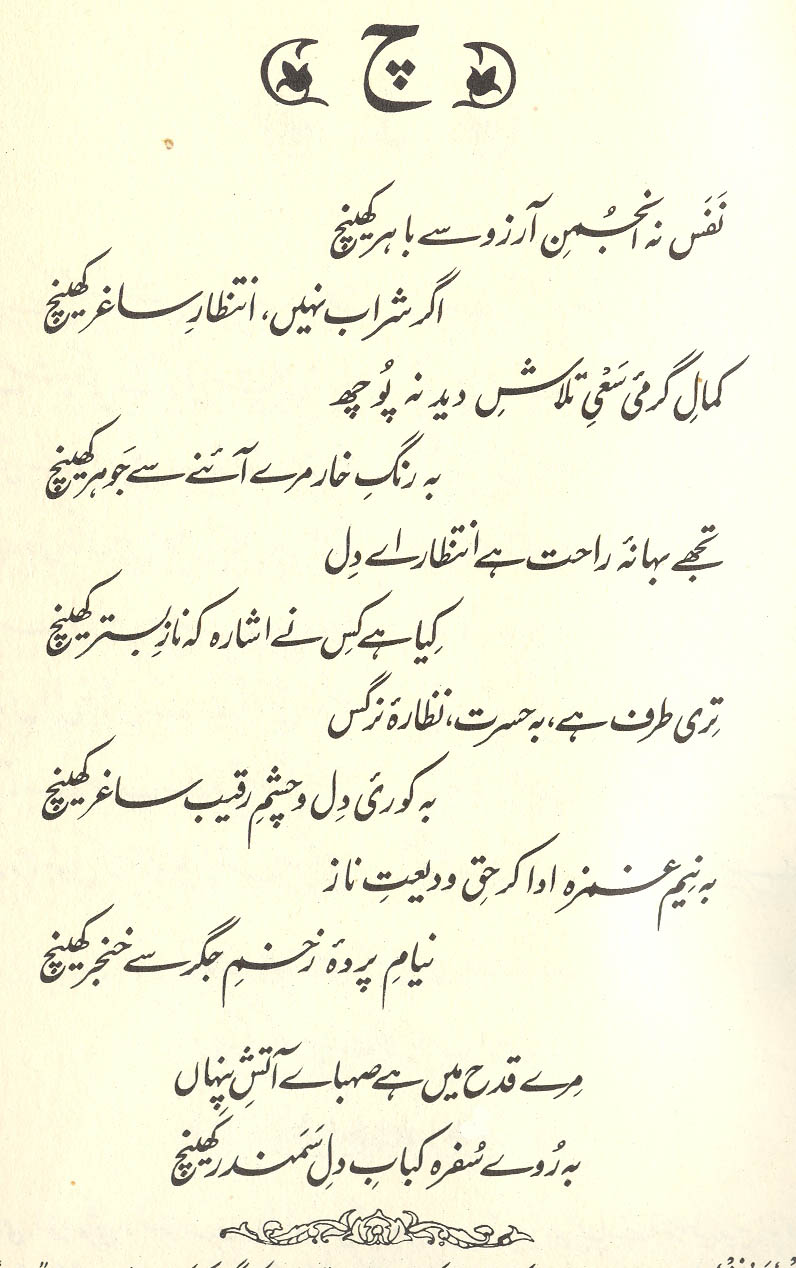
The madness of the mirror wants a single spectacle-- that is, it is eager to have someone see it. Therefore, on our mirror which has the aspect of a blank page, lines ought to be drawn with the wing of a Pari, so that at least it can see that some beautiful one is looking.
== Asi, p. 106
The mirror's madness longs for the amazement of a spectacle. That is, the amazement and simplicity of the mirror is lessened only by the reflection of nearby things falling on it. Our page (the heart) too, since it has the allegory of a mirror, can have its amazement removed by having ruled-lines drawn on it with the hair of a Pari (that is, by being adorned). Or: 'Give peace to our amazement-afflicted heart by showing the flourishingness of your beauty'.
== Zamin, p. 152
= A tool for drawing [] ruled lines.
The first line can have two meanings. [One is that] in the mirror's head there is a mad longing to see a single radiance/appearance of yours. The second meaning is that since you are constantly mad for looking in the mirror, it is ardent to show you a spectacle, to raise a commotion. The first meaning is preferable. In both cases, when the beloved goes before the mirror she will adorn herself, the result of which will be that madness will come upon the speaker.
When a Pari's shadow falls on someone, then madness comes upon him. Thus the meaning of drawing ruled lines on the page with the wing of a Pari is that the decree of madness would be written on the page of our fate/destiny. To draw ruled lines is to prepare for writing. The meaning of the verse is, in brief, that the mirror has a mad longing to see you; if this is the case, then consider us too to be mad.
== Gyan Chand, p. 185
For background see S. R. Faruqi's choices . This verse is NOT one of his choices; I thought it was interesting because of the Pari imagery, and have added it myself. For more on Ghalib's unpublished verses, see the discussion in 4,8x .
As Gyan Chand notes, if a Pari 's shadow falls on you, you will go mad. (By contrast, if the Huma 's shadow falls on you, you'll become a king; on this see 49,3 .)
Not only is this an 'A,B' verse, it's also rather an obscure and unsatisfactory one. In the first line, thanks to the flexibility of the , the 'madness of the mirror' can mean: (1) the madness experienced by the mirror; (2) the madness that is identical with the mirror; (3) the madness that is associated with the mirror in some unspecified way; (4) the madness felt by someone else with regard to the mirror. Then of course, when we look toward the rest of the first line we get no help: 'ardent for a single spectacle' gives us no further information about what the 'madness of the mirror' might be.
Then the second line launches a completely fresh sequence of imagery about the preparation of a page for writing. It is quite possible to see that preparing the ruled lines on a page (of destiny?) with the 'wing of a Pari' can imply some kind of fated, ineluctable madness. But then-- what is the ' connection ' with the first line? The mere presence of 'madness' in both lines doesn't at all suffice. How does the mirror (of the heart?) resonate with the piece of paper (of destiny?)? The 'objective correlative' relationships remain vague and mushy.
graphics/parihair.jpg
graphics/ruledlines.jpg