Verse 11821arkhe;Nch
G9
In this meter the next-to-last long syllable may be replaced by two shorts.
1
don't, outside the gathering of longing/expectation, draw a breath
2
if not wine, then 'draw' a wait for the wine-flagon
'Wish, desire, longing, eagerness; hope; trust; expectation; intention, purpose, object, design. inclination, affection, love'.
'To draw, drag, pull; to attract, to draw in, suck in, absorb'.
| References | |
|---|---|
| Arshi, Imtiyaz Ali | Ghazal# 56 |
| Raza, Kalidas Gupta | 329 |
| Nuskhah-e-Hamidiyah | 95-96 |
| Asi, Abdul Bari | 105-106 |
| Gyan Chand | 185-186 |
| Hamid Ali Khan | Open Image |
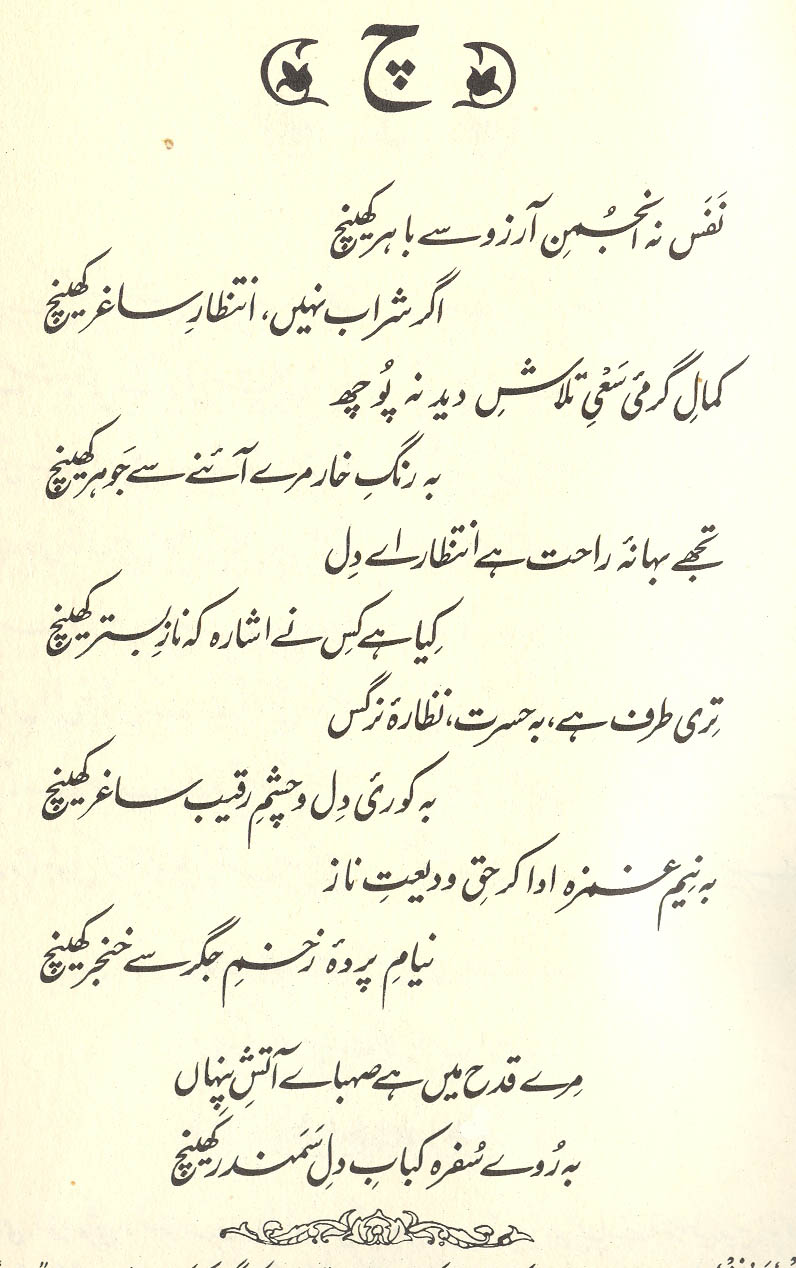
That is, breathe longing with every breath, don't depart from it; if there's no wine, then keep waiting for it. The word is connected with both wine and waiting, but [to pull/draw a wait] is an Urdu idiom too, while [to draw wine] is only a translation from Persian. (50)
== Nazm page 50

He says, even in the event of failure, a person ought not to abandon hope and longing. If there's no wine, then he still ought to wait for the wine-flagon. The meaning is that the hope for success should not be given up in any circumstances. and are both idioms []. (95)
Janab [Nazm] Tabataba'i claims on every occasion that something is a translation of a Persian idiom, and is contrary to Urdu idiom. The first part of this statement is true, the second falls below the level of trustworthiness. What he should have said is that Mirza shaped a Persian idiom in the mould of Urdu. Many Urdu idioms are translations of Persian idioms. To label richness as [heretical innovation] and augmentation as stupidity is to destroy Urdu's progress forever. In all living languages the chain [] of growth and development is continuous. And this is the reason that the final extent of their progress can't even be imagined. The exploration of Persian has produced in the language of Europe such glories that now the world prides itself on them. If we look at the work of Momin among Mirza's contemporaries, and Mir and Sauda among his predecessors, then Mirza can be seen to be following, as a rightly guided pupil, in their footsteps. (121)
This opening-verse , obliged as it is to repeat the refrain at the end of both lines, cleverly uses , 'draw, pull', to unify the domains of three otherwise quite disconnected idioms. In the first line we have , to 'draw' breath; fortunately the same idiom exists in English. In the second line, we have the negated , to 'draw' wine (from a cask?); we can find similar idioms in English (for beer). Then we also have the replacement: we are not to draw wine, but , to wait-- literally to 'draw' a wait.
Bekhud Mohani's vigorous attack on Nazm's position makes a great deal of sense; I applaud both his spirit and his literary judgment.
Other than the wordplay of , there's nothing much going on in this verse, as far as I can see. The prose meaning can easily be reduced to a pious truism about never giving up hope or longing, which is just how Bekhud Dihlavi interprets it. If the wordplay didn't induce a listener to say , surely such a trite sentiment wouldn't be able to. The verse is mostly a riff on three radically different things-- breath, wine, and waiting-- that are all, unexpectedly, 'drawn'. But then, for a brief opening-verse, isn't that enough?
graphics/flagon.jpg