Verse 4x1816aaho
G2
1
the mutual growth of rock and rose of the desert desires/needs this:
2
that even/also the thread of the path would become a 'sacred-thread of the wine-flagon' for the mountain
'To grow, to wax great'. (Steingass p.151)
'(P) A stone; weight'.
'(S) Coming together, joining, uniting, meeting, encountering, concurrence, confluence (of rivers); contact, touch; coherence; union, association, connection, intimacy, friendship, love'.
is an archaic form of ( GRAMMAR )
| References | |
|---|---|
| Arshi, Imtiyaz Ali | Ghazal# 117 |
| Raza, Kalidas Gupta | 218-19 |
| Nuskhah-e-Hamidiyah | 167-168 |
| Asi, Abdul Bari | 193-194 |
| Gyan Chand | 302-304 |
| Hamid Ali Khan | Open Image |
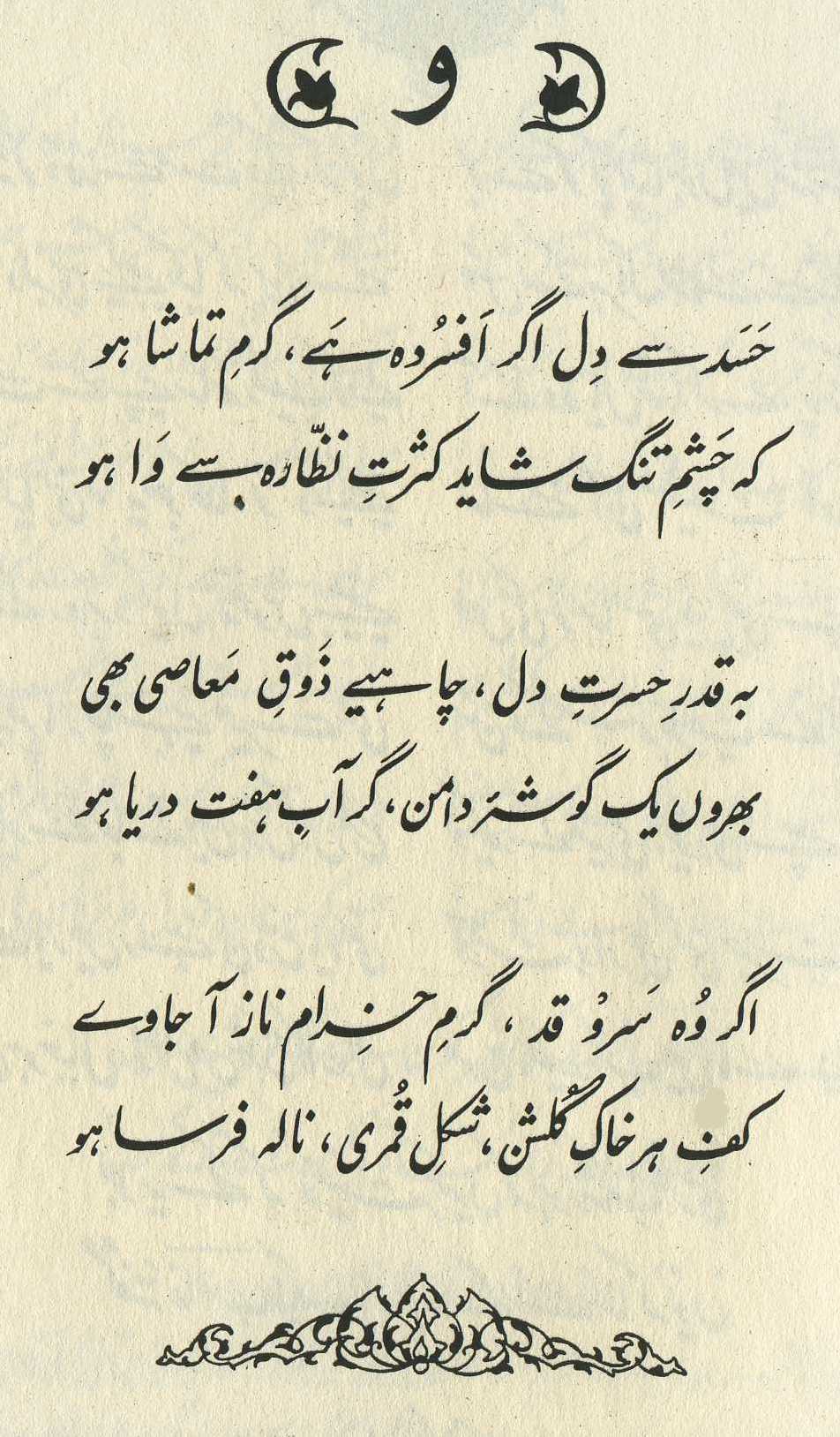
The flourishingness of springtime in the desert increases both stone and rose. To the extent that stone flourishes in the mountain, in the same way there is growth in the flowers. And this growth is in such a condition that the thread of the path of the mountain is going on becoming like the line that appears when a glass of wine would be half-filled. That is, it seems that the forest/jungle is a green wineglass, and the path is a line [] that has occurred [] on the glass.
== Asi, p. 193
In the desert the flowers are increasing, and the stone too. The springtime has caused a fervor of growth to boil up, and everything is moving along on the road of ascendancy. How is it strange if the path in the desert, steadily advancing, would arrive as far as the wine-house and become the line [] of the wine-flagon?! Because springtime is especially the season of wine-drinking, and the glass is made from stone. It is exaggeration , in the praise of the ebullition of the springtime.
== Zamin, p. 287
= If a bottle [] would be half-full, then the line that will become visible between the full and empty parts is called the . On the mountain, in the lower part greenery and wild flowers have burst out. In the upper part, there are rocks. Around the garment-hem of the flower-leaves and the rocks, is a narrow path that is acting as the 'sacred-thread of the glass'.
== Gyan Chand, p. 302
For background see S. R. Faruqi's choices . This verse is NOT one of his choices; I thought it was interesting and have added it myself. For more on Ghalib's unpublished verses, see the discussion in 4,8x .
For further discussion of the , see 145,7x , where it also occurs; on the more generally, see 60,8 .
What intrigues me is the . How to interpret this almost supernaturally weird phrase? It looks as though the applies to the rock, and the 'mutual' [] seems to emphasize this reading (Asi explicitly takes it that way). There's also the wordplay of the Indic , meaning 'coming together' (see the definition above), which works so well with . But what does it mean for rock and rose to 'grow', and to grow 'mutually'? (Though of course in 120,6 , iron has ears, so why shouldn't rock grow?)
And what is the relationship between the 'desert' and the 'mountain'?
Moreover, all the commentators take the verse to be about the ebullition of springtime, but nothing in the verse itself justifies this reading. To me this reading sounds externally imposed, like Zamin's notion that the path would actually propel itself into the wine-house and become the 'line on the flagon'.
It feels as though there ought to be a point of access here somewhere, but I can't find it. And maybe there really isn't one. Maybe the young Ghalib was just rattling our cage (or his own?). Maybe he knew nobody would get it, or could get it. He did, after all, leave it out of his published divan .
graphics/treeline.jpg