Verse 31816aaho
G2
1
if that cypress-statured one would become enthusiastic/'warm' for a stroll/saunter of coquetry
2
every handful of dust in the garden, in the likeness of a Ring-dove , would be lament-wearing-out
'Pace, gait, walk, march; stately gait, graceful walk; strut'.
is an archaic variant of ( GRAMMAR )
'Wearing, rubbing; obliterating, effacing'.
| References | |
|---|---|
| Arshi, Imtiyaz Ali | Ghazal# 117 |
| Raza, Kalidas Gupta | 218-19 |
| Nuskhah-e-Hamidiyah | 167-168 |
| Asi, Abdul Bari | 193-194 |
| Gyan Chand | 302-304 |
| Hamid Ali Khan | Open Image |
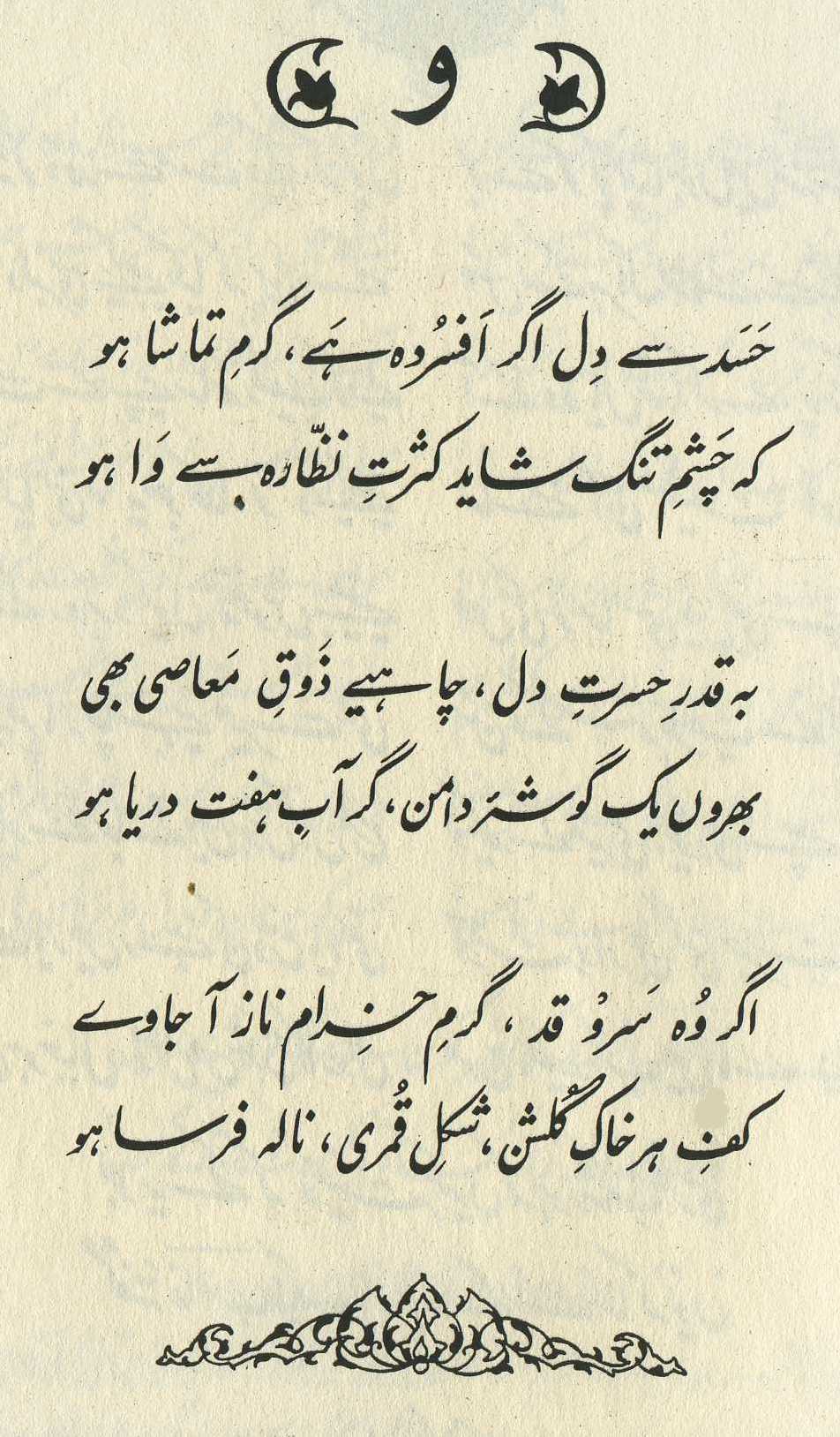
Every handful of dust [] would become a Ring-dove, for the reason that the Ring-dove is ash-colored []. (126)
== Nazm page 126

If the beloved, whose stature is like that of a cypress, would happen, out of coquetry, to pass through the garden, then every handful of dust in the garden would begin to lament like a Ring-dove. That is, the effect of her beauty would make every dust-grain into the hem of a lover's garment. (238)
The interpretation is entirely clear, but some wordplay demands attention. All [the commentators] have said that with respect to 'Ring-dove', 'handful of dust' is fine, because the Ring-dove is considered to be dust-colored. Now look beyond this: (1) is an affinity ; and (2) and (to burn up and become dust), is a . In the light of this, another interpretation arises: that the heat of the beloved's gait will burn up the dust of the garden, and as a result of this a lament will arise from the breast of the dust.
The word is not padding . The point is that when the beloved walks with a 'coquettish gait', only then does the dust of the garden raise a lament like a Ring-dove's. That is, if she walked with an ordinary gait with no coquetry in it, then she wouldn't create this effect. The meaning of can be, in addition to , as well. In this latter case, the heat of the coquettish gait not only affects one garden, but can be seen in all gardens. Consider these other examples of wordplay: (3) (because all forms are made of dust); (4) (because the cyprus is [here] considered to be motionless); (5) the affinity between and is plain.
== (1989: 202) 2006: 224
This is the kind of verse that makes me especially grateful for Faruqi's commentary, which I've translated here in its entirety. The verse shows off Ghalib's power of extravagant wordplay, and Faruqi is especially skilled in recognizing it all, and then laying it all out analytically. It only remains to mention that the Ring-dove is not only dust-colored, but is also, in the ghazal world, considered to be a lover of the cypress tree.
Still, other than major wordplay, there's nothing much going on in this verse, as far as I can tell. It's not the kind of verse (of which there are so many) in which wordplay and meaning-play form an irresistibly enticing network that goes on ramifying forever. And the wordplay itself feels a bit awkward and forced: it's easier even to imagine every dust-grain having a tiny heart tied onto it (as in the equally extravagant 29,1 ) than to imagine the dust as collecting itself into handfuls, then the handfuls all forming themselves into Ring-doves, then the Ring-doves all starting to lament. Where's the real 'objective correlative' for all that?
Ring-dove s seem to bring out the abstraction in Ghalib: for an even more over-the-top example, see 230,5 .
Note for grammar fans: the ordering of the words in , though Hamid complains about it (96)-- and I can certainly sympathize-- is unusual, but apparently not contrary to the rules of usage. For another such instance, see 214,6 , with its . But the present verse seems more egregious: one can easily visualize 'every thorn' and even endow it with a vein, but how does one visualize 'every dust', much less endow it with a 'hand'? However, the word order does have the advantage of letting the second line evoke the idiomatic expression 'to wring the hands of regret' [] (for an example, see 145,4 ).
graphics/turtledove.jpg