Verse 11816aaho
G2
1
if from envy/malice the heart is melancholy/cold, become enthusiastic/'hot' for spectacle
2
for perhaps the narrowed/vexed eye, from abundance of sight, would be open/relieved/cheerful
'Envy, malice; —emulation, ambition'.
'Frozen, frigid, benumbed; withered, faded; dispirited, dejected, low-spirited, melancholy'.
'Contracted, straitened, confined, strait, narrow, tight; wanting, scarce, scanty, stinted, barren; distressed, poor, badly off; distracted, troubled, vexed; dejected, sad, sick (at heart)'.
'To be or become open; to open; to be freed or liberated; to be relieved of sorrow, to become cheerful'.
| References | |
|---|---|
| Arshi, Imtiyaz Ali | Ghazal# 117 |
| Raza, Kalidas Gupta | 218-19 |
| Nuskhah-e-Hamidiyah | 167-168 |
| Asi, Abdul Bari | 193-194 |
| Gyan Chand | 302-304 |
| Hamid Ali Khan | Open Image |
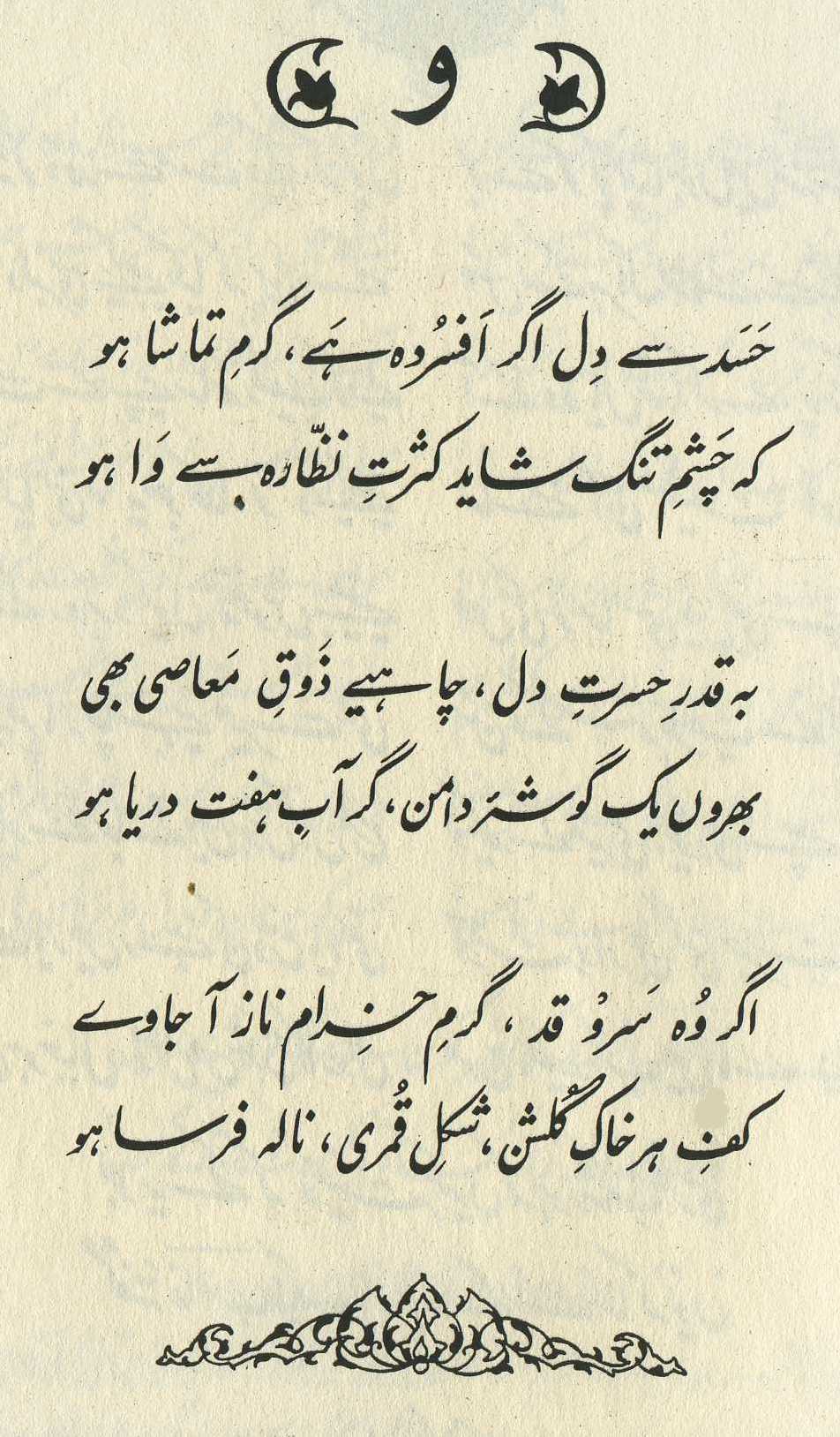
This is not merely an imaginary theme; rather, he has expressed actual reality in an extremely fine form. In fact, when a person is confined within the four walls of a home, unacquainted with the circumstances of the world, and ignorant of the causes of people’s progress or decline, then from his limited range of experience he can't bear to see someone in fine circumstances. But to the extent that his circle of acquaintance keeps widening, he gradually realizes that prosperity of the people he envies is not merely coincidental, but is a result of their labor and planning.
Thus a sense of justice and benevolence is born in his heart, and he himself too is influenced toward effort and planning. And instead of feeling envy and malice, he turns his attention toward following in their footsteps. He [=Ghalib] expresses this wise thought in a sensory example: 'Perhaps the narrow eye, from abundance of seeing, may open wide'. Just as the poet has called the avaricious person’s heart narrow, in the same way he has characterized the envious person’s eye as narrow.
==Urdu text: Yadgar-e Ghalib , p. 153
A narrow eye is among the qualities of envy. And , that is, look at the world. The result is that after experience you'll learn that envy is inappropriate. In the world, no reason for wealth is necessary. Things are like this everywhere. (126)
== Nazm page 126

That is, when you see many well-off people, you won't be able to decide whom to envy. And this bad habit will leave you. Or else you'll also see people who are in a worse state than you, and will be grateful for your situation... [Also compare:] 3,1 . (237)
The commentary that Hali has written about this verse-- nothing could possibly be better. But I will point out some wordplay and points of language to which little attention has been paid. For the sake of its affinity with in its meaning of 'extinguished' and thus 'cold', the phrase has been used. The affinity of 'hot' with the opening of a narrow eye is also fine, because when things get hot they expand-- especially circular things, which seem to expand quickly. For the eye too, the simile of a circle is given.
The affinity of 'heart' with 'eye' is also worthy of note, because the eye is the window of the heart. With 'envy', 'to burn' is also used-- or rather, one meaning of 'to burn' is 'to envy' as well. In this regard to have (to burn, then to be extinguished) because of envy, and then to become , offers a remarkable pleasure. For their affinity with , both 'abundance' and 'sight' are quite superb....
For to have the meaning of 'an eye that sees little', one proof is that the early poets called the beloved and her eye . (See , by Tek Chand Bahar.) The reason is that the beloved, because of her shame or her burden of pride, doesn't even look at anybody. In the verse under discussion, to take as meaning is to fling unnecessary mud-spots on Ghalib's accomplishment. When in the first line he has already mentioned envy and the that results from it, then in the second line to write with the meaning of would be mere repetition. Nor does the interpretation of the verse require it....
A final point is that in Persian also means 'covetousness and desire'-- that is, 'greed', and of course 'miserliness' is already there as well. Thus can also be taken as 'greedy eye', and this interpretation too is very fine in its way, because the envious person's eye is greedy.
== (1989: 200-01) 2006: 222-23
This is a splendid verse for wordplay, and Faruqi has pulled it all together very clearly. Narrow eyes are indeed a sign of envy (or jealousy, as in 3,1 ); but, as Faruqi argues, to think that that's all they are would be to accuse Ghalib of 'mere repetition'. Instead, we need the pairing of the narrow versus the wide-open eyes to add even more enjoyment to the pairing of the cold versus the hot heart. And of course, since the eyes are the window of the heart, narrow vs. wide ones will have no end of metaphorical and mystical resonances.
I would add to Faruqi's inventory one more bit of 'meaning'-play: the contrast between 'envy' and 'spectacle' in the first line. To look with envy is to to look with a cold, narrow eye-- to fixate on a few particular things, to crave to own and monopolize them. To see the world as a is a distancing project-- it requires wide-open eyes, some patience and tolerance, and a kind of detached spectatorship.
But there really isn't a meaningful choice to be made. The eye should, no matter what, become open, as Ghalib has said with somehow an effect of complete straightforwardness in 48,9 .
graphics/eye.jpg