Verse 21816anhanuuz
G3
1
the pride/coquetry of the impoverished is over gone-from-the-hand gold
2
I am a {rose/scar/brand}-{seller/displayer} of the mischievousness of ancient wounds/scars, now/still
'Blandishment, coquetry, playfulness, amorous playfulness, feigned disdain; dalliance, toying; fondling, coaxing, soothing or endearing expression; --pride, conceit, consequential airs, whims'.
'A rose; a flower; a red patch (on anything) ... --a mark made (on the skin) by burning, a brand'.
'To be cauterized; to cauterize oneself (a practice among lovers, who burn themselves with heated pieces of coin, &c., as a proof of their love)'.
'Playfulness, fun, mischief; pertness, sauciness; coquetry, wantonness; forwardness, boldness, insolence, &c.'.
| References | |
|---|---|
| Arshi, Imtiyaz Ali | Ghazal# 67 |
| Raza, Kalidas Gupta | 184-85 |
| Nuskhah-e-Hamidiyah | 110-111 |
| Asi, Abdul Bari | 124-125 |
| Gyan Chand | 211-212 |
| Hamid Ali Khan | Open Image |
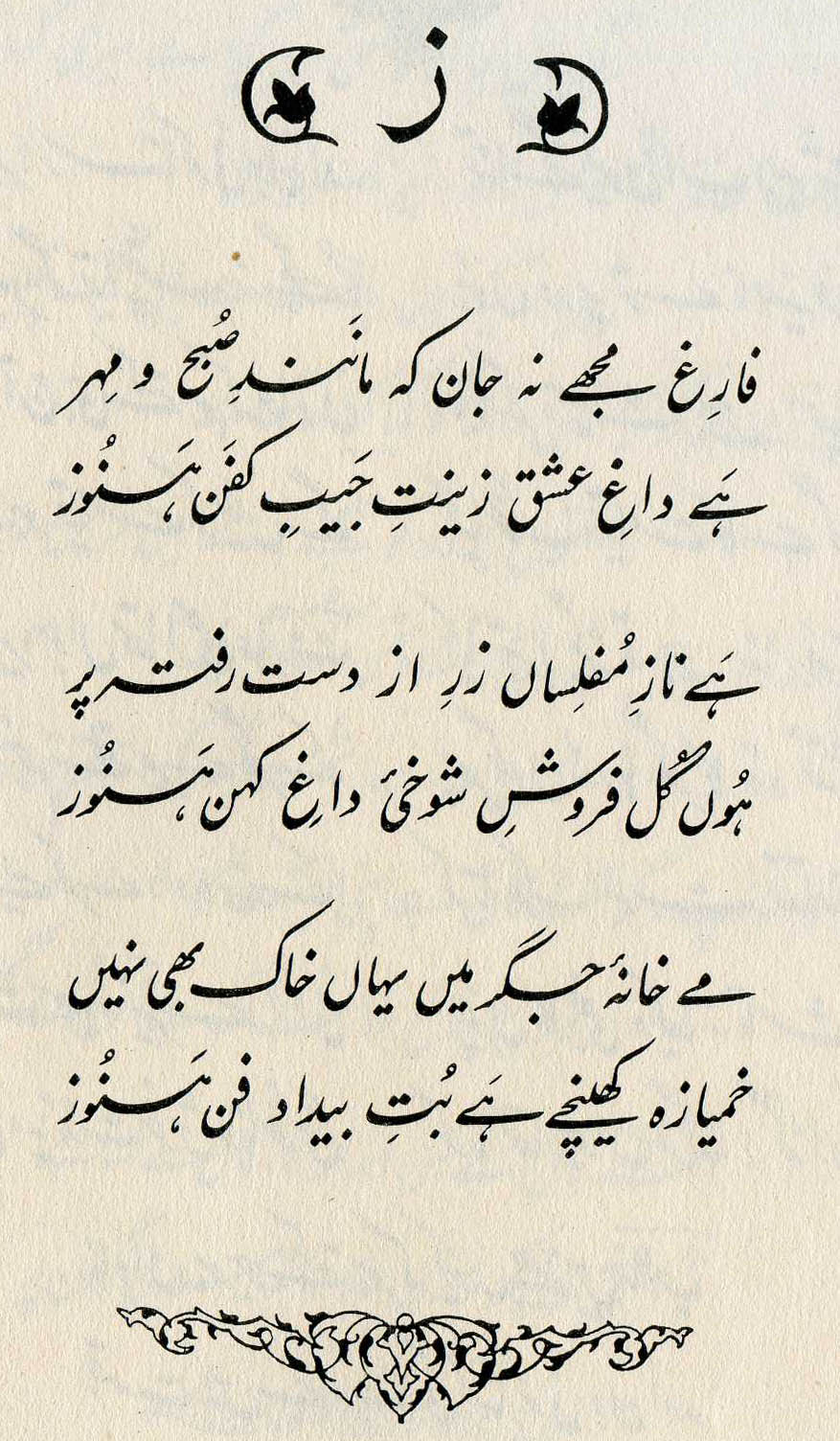
That is, if I don't now have the wound of passion, then I constantly speak about it. He's given for 'wound' the simile of a gold piece, and for the decline of passion, lost wealth. (66)
== Nazm page 66

He says, just as poor people, having lost their wealth, speak with pride about their departed gold, similarly I, having lost my wound of passion, always speak of it. (116)
Our priding ourselves on our ancient wound of passion is as if poor people would pride themselves on their lost wealth. That is, when the wound no longer remained, then we establish our pride by mentioning the wound. (149)
In this verse confusion has been caused by the question of what the word means. [A discussion of how various commentators have had difficulty in dealing with this problem.]
Here the first thing to which the commentators have paid no attention is that one meaning of is also 'to show'. So it's not necessary to establish the meaning of as 'rose/wound seller'. In the [Persian dictionaries] 'Mavarid ul-Masadir' of Ali Hasan Khan Salim, and the 'Bahar-e Ajam' of Tek Chand Bahar, it's clearly written that the meaning of and both, is 'to make apparent' []. Then the 'Mavarid' goes on to say that the meaning of is also 'to show' and 'to introduce'. [Two Persian verses are given as examples of this usage.]
From these proofs it's established that in Ghalib's verse the meaning of is 'rose/wound displayer', and the meaning of is 'displayer of the scars/traces of the beauty of ancient wounds'. The apparent meaning of this is that people used to heat up a ring [] and make wounds/scars here and there on their hands. And through the affinity of color and heat, they [=poets] give for a wound the simile s of flowers and gold coins.
== 2006: 93-95
ABOUT : Faruqi points out that lovers used to show the depth of their passion by using a heated ring-- or a coin (see the definition above)-- to make wounds on their hands. Ghalib doesn't very often invoke this idea explicitly, but it often could be latent in imagery about roses and wounds, as in the present verse. Compare also 81,9x , in which the use of also may evoke this practice. Mir uses the expression more directly: see M 1341,1 for further discussion, along with Mirian examples.
Poor people plume themselves on the memory of the gold they no longer have. The speaker is a 'rose'-seller/displayer of the mischievousness/coquetry of long-ago wounds now/still. (On the clever doubleness of , both senses of which create excellent word-play with 'ancient', see 3,4 .)
So there's a kind of triangular affinity of imagery, among gold pieces, roses, and wounds. Among their common traits are: (1) valuableness, eye-catchingness, desirability (wounds are part of the true lover's indispensable equipment); (2) roundness of shape (if the wound is thought of as resembling a fiery burn-mark or 'brand'); (3) brilliance of color (wounds are full of radiant blood); (4) transitoriness (wounds either kill, or become cured; roses die; gold is spent or lost).
There are also more complex interconnections: brilliant round gold pieces can be used to buy brilliant round roses. Gold pieces can also be sources of coquettish pride, as can wounds, even in retrospect-- or perhaps especially in retrospect: there's always the great fisherman's boast about 'the one that got away', and 'mischievousness' [] as well as 'coquetry' [] would seem to hint in this direction. Both gold and wounds may be offered as currency to buy roses, among whom the beloved is of course the supreme Rose.
As to whether old wounds and scars still work as currency, Faruqi makes it clear that they may be shown or exhibited, rather than 'sold' in any vulgar or commercial sense. But even selling needn't be unworthy: consider its emotionally-framed use in 60,7 . Lost gold pieces are 'gone from the hand'-- and round red burns were sometimes made by lovers with coins, on their hands (see the discussion of above).
graphics/goldcoins.jpg