Verse 11826aarbhii nahii;N
G3
1
from madness, there's not even a sacred-thread on [our] shoulder
2
that is, in our collar there's not even a single thread
'The opening at the neck and bosom (of a shirt, &c.); the breast-collar (of a garment); the heart; the bosom (the Arabs often carry things within the bosom of the shirt, &c.; and hence the word is now applied by them to) 'a pocket'.'
| References | |
|---|---|
| Arshi, Imtiyaz Ali | Ghazal# 100 |
| Raza, Kalidas Gupta | 364-65 |
| Hamid Ali Khan | Open Image |
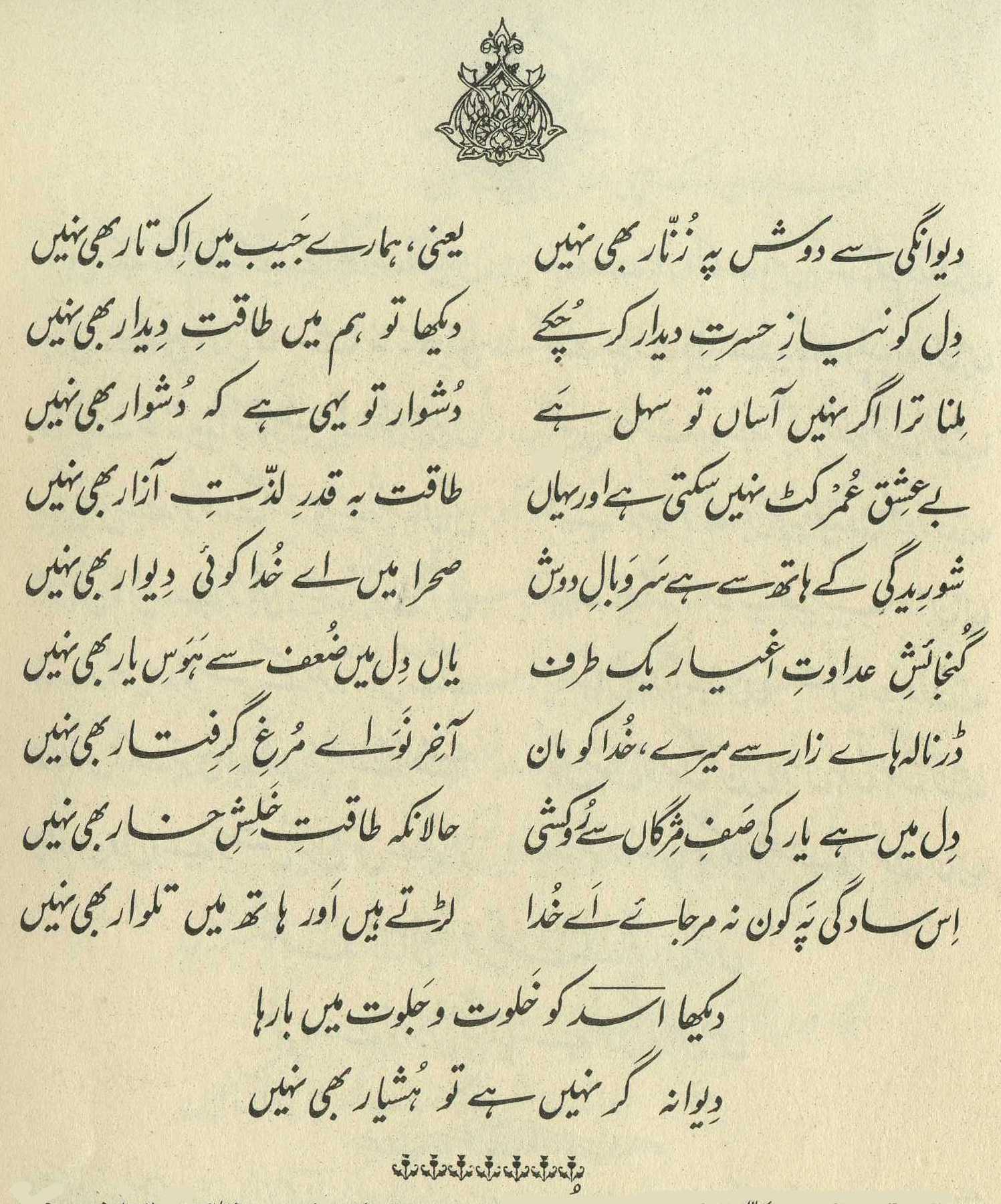
He says, the style of my madness is that I didn't leave even one thread remaining in my collar [], such that it would have been in place of a sacred thread and would not have been contrary to my practice of idol-worship. (120)b
== Nazm page 120

He says, this is a new madness, that has not left a single thread in our collar! If even two or three threads had been spared at the hands of madness, then we would have considered them a sacred thread, because in the religion of idol-worship it was necessary to have a sacred thread. (169)
Is there any limit to this madness? In the collar, not even one thread has remained, which would have been a symbol of idol-worship. That is, in love madness occurred, and reached the limit that not even the signs of idol-worship remained. (225)
The first line is piquant and even a little shocking: because of the speaker's madness, he doesn't even have on his shoulder a 'sacred thread' [] such as Brahmins wear (on this term see 60,8 ). The implication is that if the lover were not so extremely mad, he certainly would have such a sacred thread on his shoulder. Such a thread, of course, would mark him as an infidel, an idolater, a Brahmin. (In the ghazal world, no other Hindu caste groups exist except Brahmins, since they alone are needed for symbolic purposes like this.) Under mushairah performance conditions, the listeners would have to contain their curiosity for a bit before being allowed to hear the second line.
At the beginning of the second line, 'that is' [] makes it clear that the second line is to be taken as a paraphrase or explanation of the first one. 'That is', not a single thread remained in the lover's collar-opening. The word also means 'pocket', as in a slash pocket, but here refers to the vertical 'slash' neckline of a kurta. The lover has done such an exhaustive job of collar-ripping [] that not even a single thread remains. (For more on this concept, and on the word , see 17,9 .)
When the two lines are put together, what is striking is the strength of the equation: the presence (or absence) of a remaining thread or two of the lover's torn collar is completely identified with the presence (or absence) of a sacred thread. If there were even a single thread left of his collar, it would be a Brahminical sacred thread; and its absence seems astonishing-- note the double use of 'even' []. In short, there's no gap at all here between the lover's practice and the Brahminical practice. But, in true mushairah-verse style, we don't learn that until the last possible moment: until we hear the crucial word 'thread' [], we can't make any sense of the verse-- and that word is deferred until the very end, which enhances its 'punch'.
This conflation of the lover's worship of the beloved, the 'idol' [, ], with the worship practices of other and (Islamically speaking) 'idolatrous' religions, is a commonplace of the ghazal world. It can always be taken mystically, as well: it can suggest that the lover's passion transcends the mere external rituals of conventional religious practice, and brings him mystically into the real presence of the one God.
graphics/zunnar.jpg