Verse 81826aarbhii nahii;N
G3
1
in the heart is-- 'face-presenting' toward the beloved's rank of eyelashes
2
although there's not even strength for the irritation/'pricking' of a thorn
'A rank, row, line, file, series, order; a company of men standing in a rank, &c.'.
'The being externally one thing and internally another'.
'Pricking, pain; care, solicitude, anxiety; apprehension, suspicion, misgiving; —putting a stop to, interruption:'.
| References | |
|---|---|
| Arshi, Imtiyaz Ali | Ghazal# 100 |
| Raza, Kalidas Gupta | 364-65 |
| Hamid Ali Khan | Open Image |
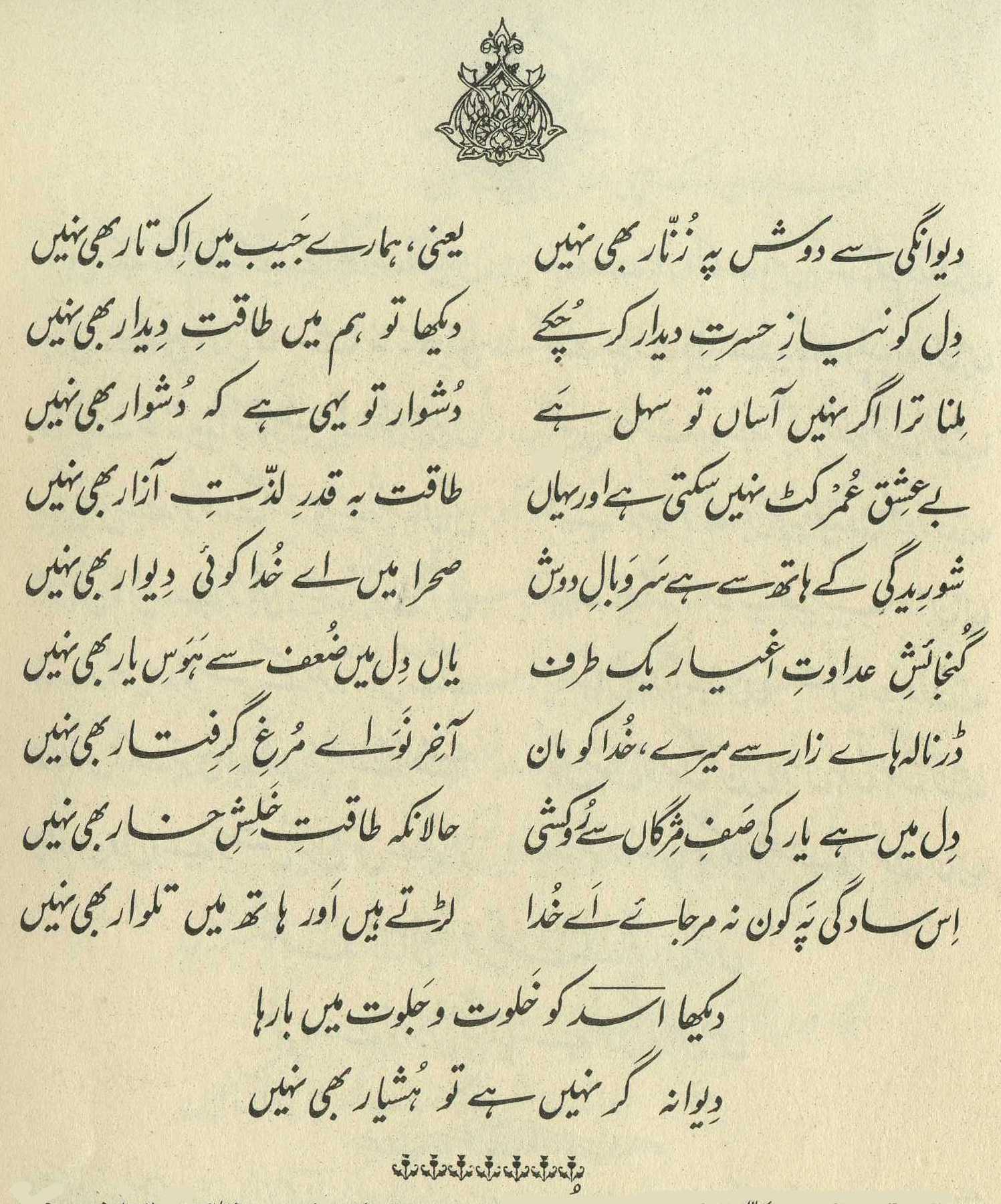
My state is that I don't even have strength for the irritation of a thorn, and still there's enthusiasm in the heart for confronting the rank of eyelashes. (121)
== Nazm page 121

He says, my intention is that I would confront the army of the beloved's eyelashes-- and my state is that in the heart there's not even enough strength to be able to endure the pain of the irritation of a thorn. (171)
That is, the enthusiasm is so lofty, the endurance so small.... If only when I had no strength, I had no enthusiasm! Then this constant spiritual pain would not exist. (227)
What complexities of wordplay swarm inside this simple-looking verse! At the heart of them, wrapping them all up, is , literally 'face-lifting' or 'face-pulling-up'.
When paired with 'in the heart' [], the concealing nuances of 'face-presenting' at once become impossibly strange. What does it mean to 'present a face' within the heart , when the heart is the deepest depth of the inner self? To 'present a face' to one's inner self, so as to fool oneself into a false confidence? To present it to the beloved, who is (or at least, whose rank of eyelashes is) there in the heart too? To imagine, or fantasize about, or long for, such 'face-presenting'? For , Platts's definition itself, 'The being externally one thing and internally another', is fascinating in its own right; perhaps we should think of it as akin to 'putting a good face on it'.
And then, this ambiguous 'face-presenting' is directed toward the beloved's 'rank of eyelashes'. While can mean 'row' in general, it has a particularly military sound, just as 'rank' does in English. It's easy to imagine those exquisitely sharp eyelashes as a row of arrows controlled by an expert archer, or spears in the hands of a line of soldiers. 'Face-presenting' toward them could be purely defensive (making a pretense of invulnerability), or it could be aggressive as well (boldly making a feint of counterattack); it could even be masochistic (seeking to present an inviting target to as to induce them to attack, and thus to procure the pleasure of pain). All these swarms of possible meanings develop in the first line alone.
When we look at the second line, we find a seeming simplicity that in fact is complicated by a crucial . 'Strength for the irritation of a thorn' can mean either 'strength to endure the irritation of a thorn' (as the commentators read it), or 'strength to put a stop to (see the definition above) the irritation of a thorn'. This second possibility works well with the vision of two armies arrayed in the heart, the serried rank of sharp eyelashes on one side, the desperately gallant 'face-presenting' lover on the other, as he attempts hopelessly to 'face down' the foe.
The verse also offers some clever sound effects. in the first line is echoed by in the second. The phrase , with its two raspy initial sounds, also nicely suggests the abrasion or irritation it describes.
The military metaphor is continued in the next verse, 112,9 .
graphics/thorns.jpg