Verse 71826aarbhii nahii;N
G3
1
fear my wailing/groaning laments-- respect the Lord !
2 a
after all, they aren't even/also the voice/melody of a captive Bird
2 b
after all, there's not even/also any voice/melody in a captured Bird
'Complaint, plaint, lamentation, moan, groan; weeping'.
'Groan, plaint, lamentation, wailing'.
'Voice, sound; modulation; song; air;... riches, opulence, wealth, plenty; subsistence; --prosperity; goodness or splendour of circumstance'.
'Taken, seized, arrested, captured; involved (in), entangled; liable; stricken, smitten (with love, &c.), captivated; — one who is taken, &c.; a captive, a prisoner'.
| References | |
|---|---|
| Arshi, Imtiyaz Ali | Ghazal# 100 |
| Raza, Kalidas Gupta | 364-65 |
| Hamid Ali Khan | Open Image |
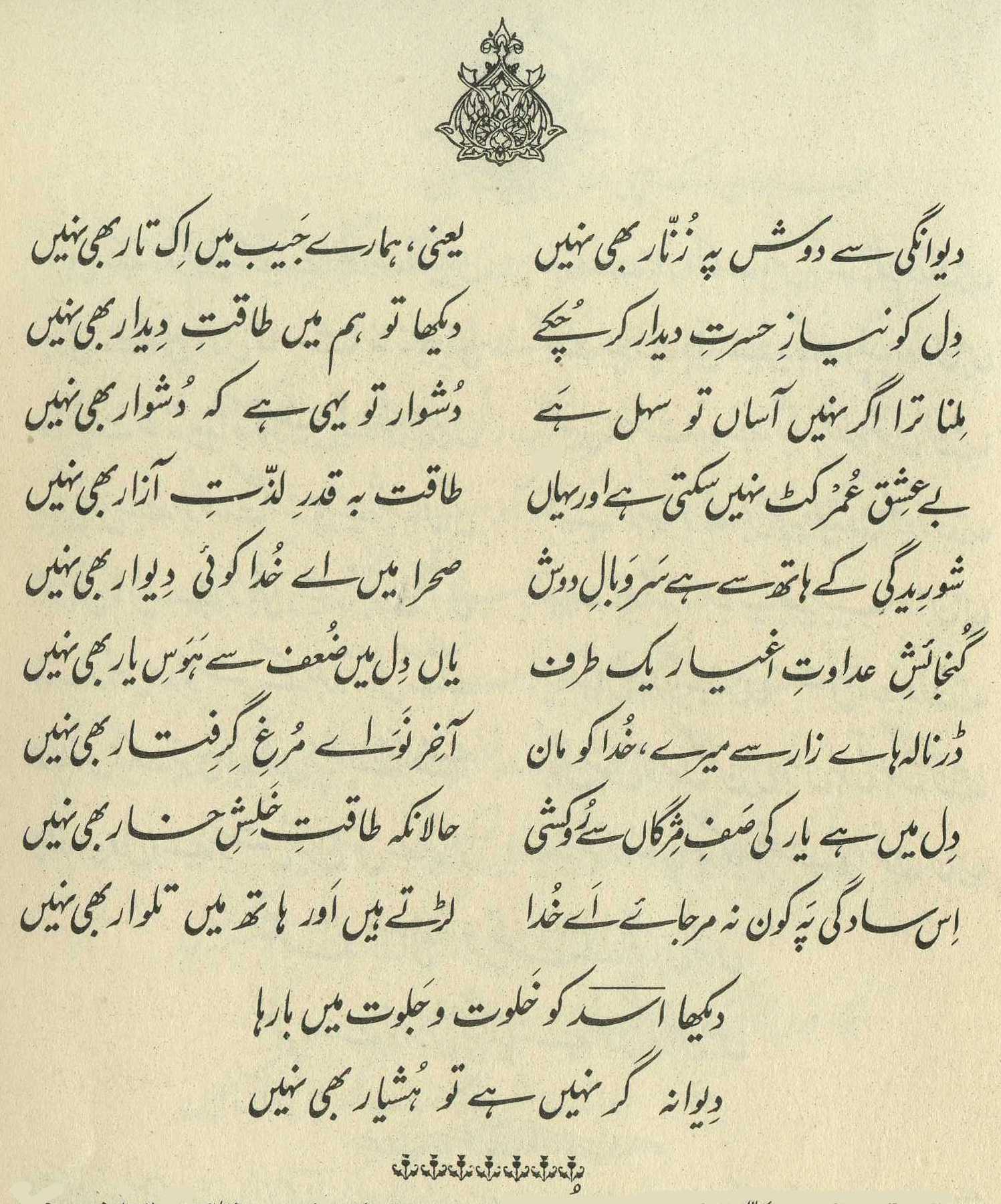
That is, after all, this lament is a lament-- it's hardly the mourning of birds, that it would have no effect! (121)
== Nazm page 121

He says, respect the Lord, and don't cause pain to my heart. Fear my laments; my complaint is not the voice of a captured bird, which will prove to be without effect. The Lord will certainly make it effective. (171)
Oh cruel one, respect the Lord! Fear the laments that emerge from my heart. My laments are not those of a captured bird. That is, they will not remain without effect. Don't become ensnared in difficulties. (226)
The commentators' almost unanimous view suffers from the same problem that Faruqi complained about in 112,5 : it's 'devoid of pleasure'. In addition, it basically ignores the powerful little word . The cure for such limited interpretations is not far to seek: pay closer attention to every word, every nuance, every grammatical possibility of the verse; and ask yourself why Ghalib would have expected a hearer to say .
Here, the central axis of the verse is surely the contrast between a groaning, wailing, suffering cry []; and a beautiful, melodious, fortunate voice []. In the first line, the beloved is enjoined to fear (the moral power of) her tormented lover's lament, and to 'respect the Lord' by fearing divine punishment and therefore treating her lover less harshly. In addition to threatening her with God's justice in the first line, the lover goes on in the second line to take a new tack: he seeks to cajole the beloved and beg her compassion. And here, in true Ghalibian style, we have two rueful, all-too-appropriate readings to choose from.
In (2a), there's an implicit : 'After all, you ought to pity me, because I'm more wretched even than a captive bird. I have only groans and wails and vain cries for justice, while a captive bird has a melodious voice [], and may sing very sweetly and even be loved for its song; it may enjoy a luxurious life in its cage, while I live in constant torment. But still, be warned-- the Lord will hear my laments!'
By contrast, (2b) paints a very different picture of the (newly?) captured bird. 'After all, you ought to pity me and treat me kindly and show compassion. You can't expect me to sing sweetly, just as a newly captured bird has no 'song' to express his misery and suffering. You should pity me for my inarticulate wretchedness.'
Still, there's no denying that that is interpretively awkward.
graphics/cagedbird.jpg