Verse 31826aarbhii nahii;N
G3
1 a
if meeting you is not easy, then ['it'] is simple
1 b
if meeting you is not easy, then [meeting you] is simple
2 a
this then is difficult-- that ['it'] is also not difficult
2 b
this then is difficult, that [meeting you] is also not difficult
| References | |
|---|---|
| Arshi, Imtiyaz Ali | Ghazal# 100 |
| Raza, Kalidas Gupta | 364-65 |
| Hamid Ali Khan | Open Image |
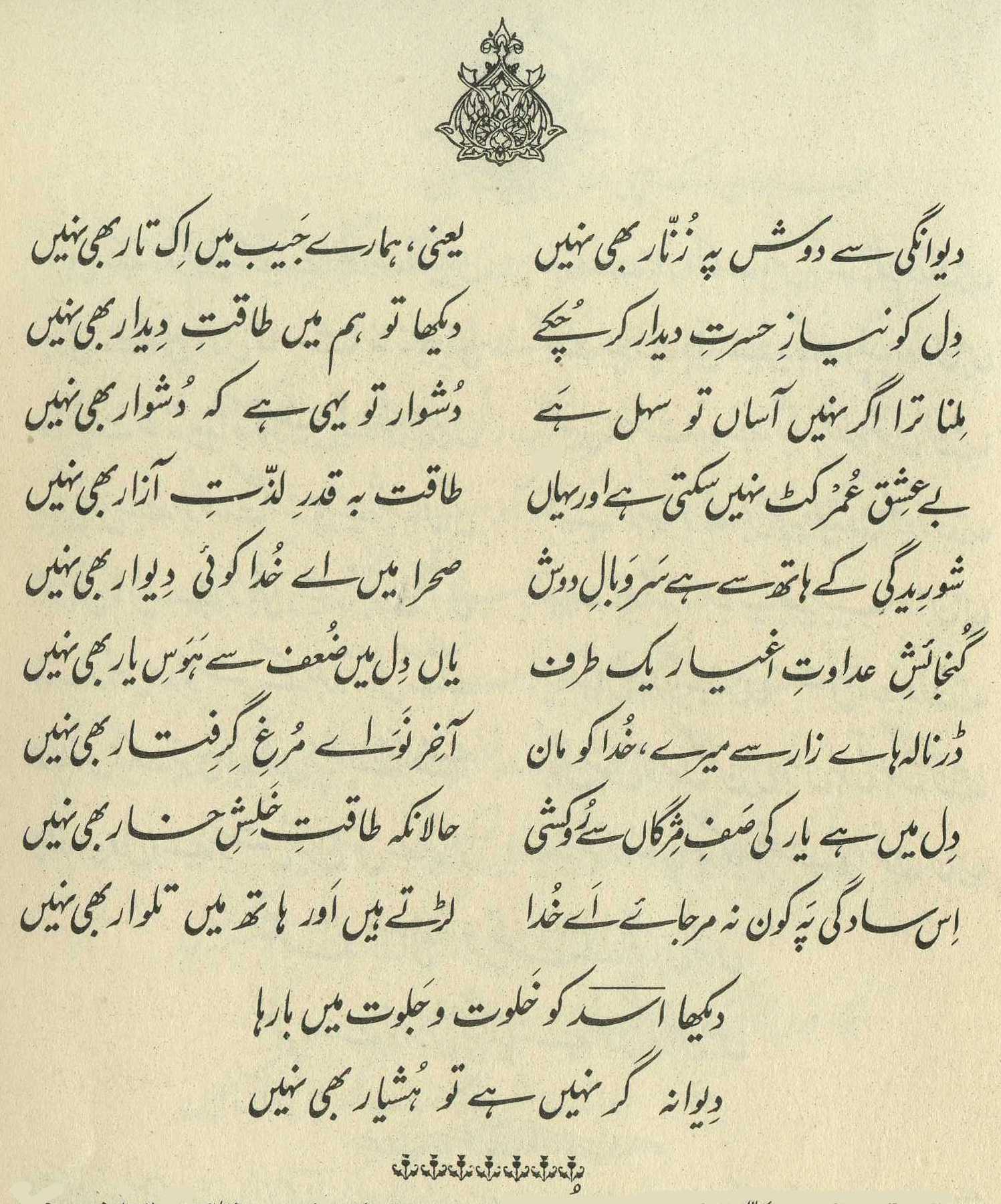
[1864, to Junun Barelvi:] That is to say, if to get to you is not easy, then this task is easy for me. Well, to get to you is not easy: so be it. Neither will we be able to get to you, nor will anyone else be able to get to you. The difficulty then is that that same getting to you is not difficult either. Whomever you want, you can meet with. We had thought separation to be a simple thing, but we can’t make jealousy an easy burden to endure. (Arshi 226)
==Urdu text: Khaliq Anjum vol. 4, p. 1514
==another translation: Russell and Islam , p. 301
==another translation: Daud Rahbar , pp. 267-68
While explaining a fact [], to have such appropriate idioms come to hand is an extraordinary coincidence. Whether one takes this theme toward the divine [], or turns it toward the human [], in both cases the meaning is that if getting to you were not easy, that is if it were dfficult, then there would have been no problem, because I would have lost hope and just sat there, and would have been free of the itching pain of ardor and suffering. But the difficulty is that just as it is not easy, in the same way it is not difficult, and thus there’s no escaping in any way from the itching pain of ardor and suffering.
==Urdu text: Yadgar-e G halib , pp. 124-25
He declares the same thing to be both easy and difficult, which might in fact be possible. But for something to both not be easy and also not be difficult-- that is contradictory and in fact impossible. (120)
== Nazm page 120

If meeting with you were not easy, then it would be difficult. In some way or other, by means of effort, it would be possible. The disaster is that it is impossible. (226)
Here Ghalib is playing with one of his favorite special devices, the creation of paradox . As can be seen, he has certainly confused some of the commentators. Even though he's discussed the verse in one of his letters, access to his letters was not always as easy as it is today, so it's not surprising that interpretations vary. Ghalib's own interpretation is straightforward-- or at least, that's how he made it sound. But he wrote the above letter almost forty years after composing the verse, and he was explaining some of his verses to a confused reader, so that simplicity would have been appropriate to the occasion.
Much the most striking thing about the verse is not any ostensible meaning, but the way it's flagrantly rigged for maximum confusingness and paradoxicalness. Consider the first line: 'If meeting you is not easy, then [X] is simple' (1a). In Urdu, the subject can be colloquially omitted, so that we have a choice of guesses as to what it might be. The grammatically and common-sensically obvious first choice is to guess that the same subject as in in the first clause: 'If meeting you is not easy, then [meeting you] is simple' (1b). But since this results in a mini-paradox of its own, we'll need to wait and look for a subject in, or through, the second line. (Under mushairah performance conditions, of course, there would be definitely be a bit of a wait.)
Then when we look at (or hear) the second line, we find a fresh set of interlocked obscurities. 'This then is difficult, that [X] is also not difficult'. For just as in the first line, the subject of the second clause is (permissibly) omitted. Surely we must guess that X is the same as the subject of the first clause, since we're running out of subject possibilities here. But the subject of the first clause is merely 'this'-- in the emphatic form with an embedded , such that it can be either restrictive ('only this') or emphatic ('this very thing'). In which case we have 'This then is difficult, that [this] is also not difficult' (2a). The other possibility, of course, is 'This then is difficult, which [is] also not difficult', since can be used in place of . Either way, we're absolutely forced to return to the first line for possible interpretations of 'this'. There, the only possible candidate for 'this' is 'meeting you', which yields (2b).
In short, if we work at it, we're eventually able to come up with the rather prosaic meaning that Ghalib himself has provided for his questioner. But the point of the verse, the enjoyableness of it, the thing that would make a hearer say , would surely never be just that prosaic paraphrase. Rather, it would be the flashy pyrotechnics of 'easy' and 'difficult' that surround the alleged 'meaning' and make it a matter of some mental labor to discern-- even after we know what we should (allegedly) be looking for.
The verse, in short, not only describes difficulty, but also enacts it. Its gnomic complexities have been so carefully engineered that the reading provided by Ghalib requires four different subjects: meeting you; [the lover's attitude]; ['this']; and [meeting you], of which all except the first must be interpolated or interpreted or both. Not bad, for a little two-line verse without any obscure words or complex grammar. Verses about 'easy' and 'difficult' seem to bring out Ghalib's taste for abstraction and paradox; see 6,5 for more examples.
graphics/yangyin.jpg