Verse 21826aarbhii nahii;N
G3
1
[we had] already made the heart an offering/supplication to the longing for (a) vision/sight
2 a
when [we] looked, then in us was not even the strength for (the) vision/sight
2 b
when [she] looked, then in us was not even the strength for (the) vision/sight
'Petition, supplication, prayer; —inclination, wish, eager desire, longing; need, necessity; indigence, poverty; —a gift, present; —an offering, a thing dedicated'.
'Sight, vision ... ; look, appearance; face, countenance, cheek; interview'.
| References | |
|---|---|
| Arshi, Imtiyaz Ali | Ghazal# 100 |
| Raza, Kalidas Gupta | 364-65 |
| Hamid Ali Khan | Open Image |
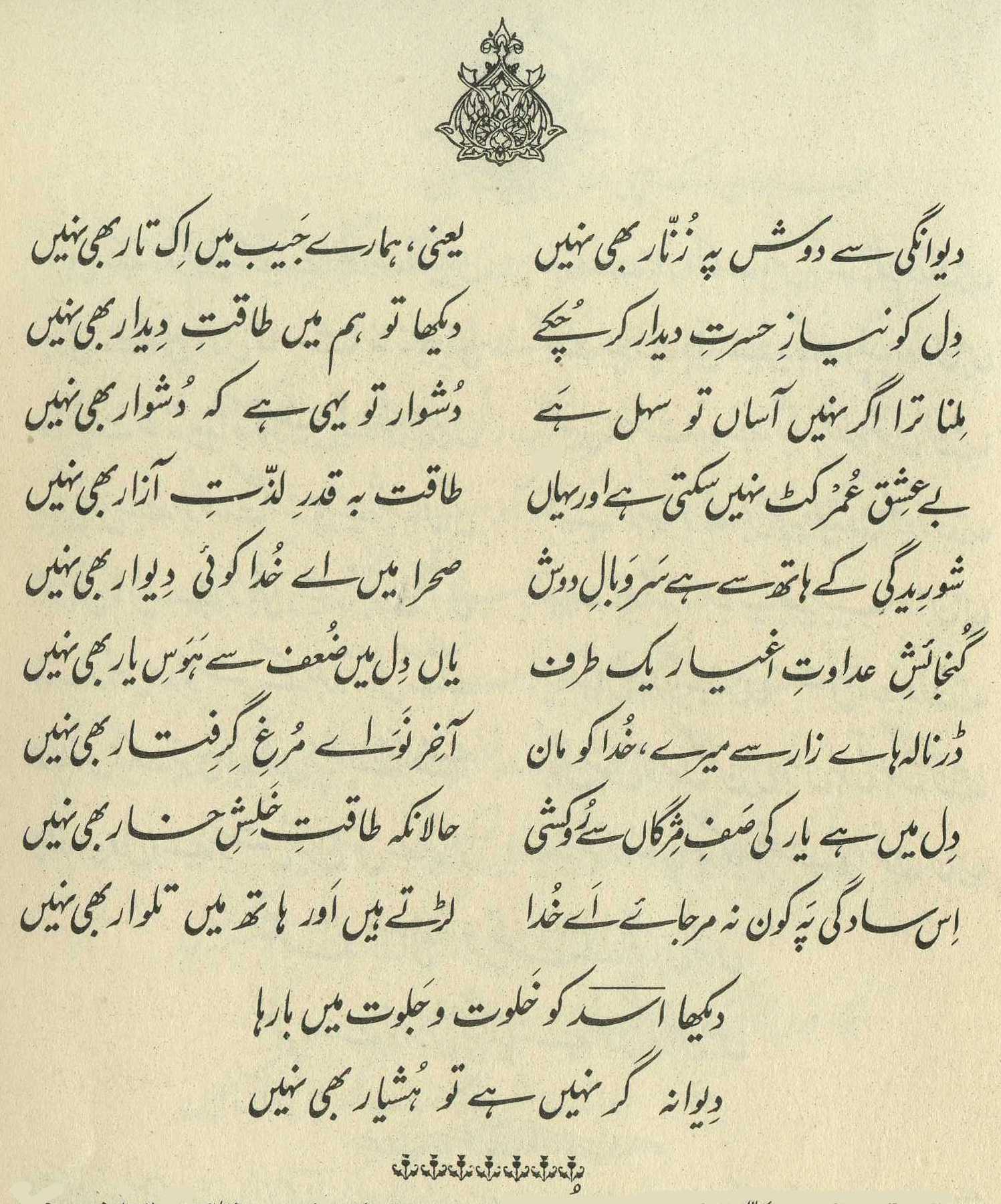
That is, when in pursuit of the longing for sight we'd already erased the heart, after that when we reflected, then we found that the strength and endurance for sight didn't remain in us. [Here the word] is connected with both actions. (120)
== Nazm page 120

He says, when in the longing for sight we'd already mingled the heart with the dust, after that the thought of my test came to me. Reflection showed me that the erasing of the heart had also erased the strength and endurance for sight. Now even if she shows herself, we no longer have the capability for sight, and the strength for endurance. (169-70)
Alas, that the heart's whole strength was finished off in the longing for sight. It's our ill fortune that now if sight is possible, then the heart doesn't even have enough strength left for sight: [consider] 48,3 . (226)
The chief pleasure of the verse is in the wordplay (and meaning-play) with . The semantic range of is even greater than 'to look' in English, since it also includes 'to see'. '[When we] looked' [] thus applies broadly to almost any action like inspection, checking, reviewing, assessing. This use and positioning of is so common that the first time through, it seems thoroughly unremarkable: 'When we looked, the tank was empty', 'When we looked, it wasn't true', etc. In this case, 'When we looked, the lost (offered-up) heart was incapable of vision'. For another use of this structure, see 16,5 .
Only on the second go-round do we realize that the phrase also applies, even more powerfully and effectively, to the primal act of looking itself: 'When we looked-- or rather, tried to look-- we discovered that we no longer had strength enough for (the) sight/vision'.
And only on the third go-round (at least, in my case) do we realize that the person who 'looked' could also be the beloved, since the subject is omitted (and since Urdu offers us the morbid wonders of the ergative construction). In that case, the lover's realization of radical, hopeless weakness comes not upon his inspection, and not upon his (attempt at) looking, but upon the beloved's looking at him-- or at least, her looking in his general direction, her paying some kind of heed to him.
The other enjoyable bit of wordplay comes through , which can mean the act of sight itself; or something that is looked at-- an (irresistibly beautiful) appearance or face (see the definition above). The distinction is more or less that between longing for 'vision', and longing for 'a vision'. Needless to say, both meanings work excellently in this verse.
In its 'catch-22' quality (we sacrifice our heart for a sight; the sacrifice makes us too weak to see) this verse reminds me of 25,4 (we sacrifice our heart in the test itself; the sacrifice leaves us with nothing left to offer after we pass the test). Or there's 210,6 (we complain of her neglect; she gives us one look, and it vaporizes us).
graphics/sight.jpg