Verse 41826aarbhii nahii;N
G3
1
without passion a lifetime can't pass-- and here
2
strength/endurance is not proportional even/also to the delight/relish of trouble/affliction
taaqat>> : 'Ability to accomplish, capability; ability, power, energy, force, strength; ability to endure, power of endurance, endurance, patience'.
'Greatness, dignity, honour, rank, power; importance, consequence; worth, merit; estimation, appreciation, account; value, price; —measure; degree; quantity; magnitude; bulk, size; portion, part; —whatever is fixed or ordained of God, divine providence, fate, destiny'.
'Pleasure, delight, enjoyment; sweetness, deliciousness; taste, flavour, relish, savour'.
'Sickness, disorder, disease, infirmity; trouble, affliction; injury, outrage'.
| References | |
|---|---|
| Arshi, Imtiyaz Ali | Ghazal# 100 |
| Raza, Kalidas Gupta | 364-65 |
| Hamid Ali Khan | Open Image |
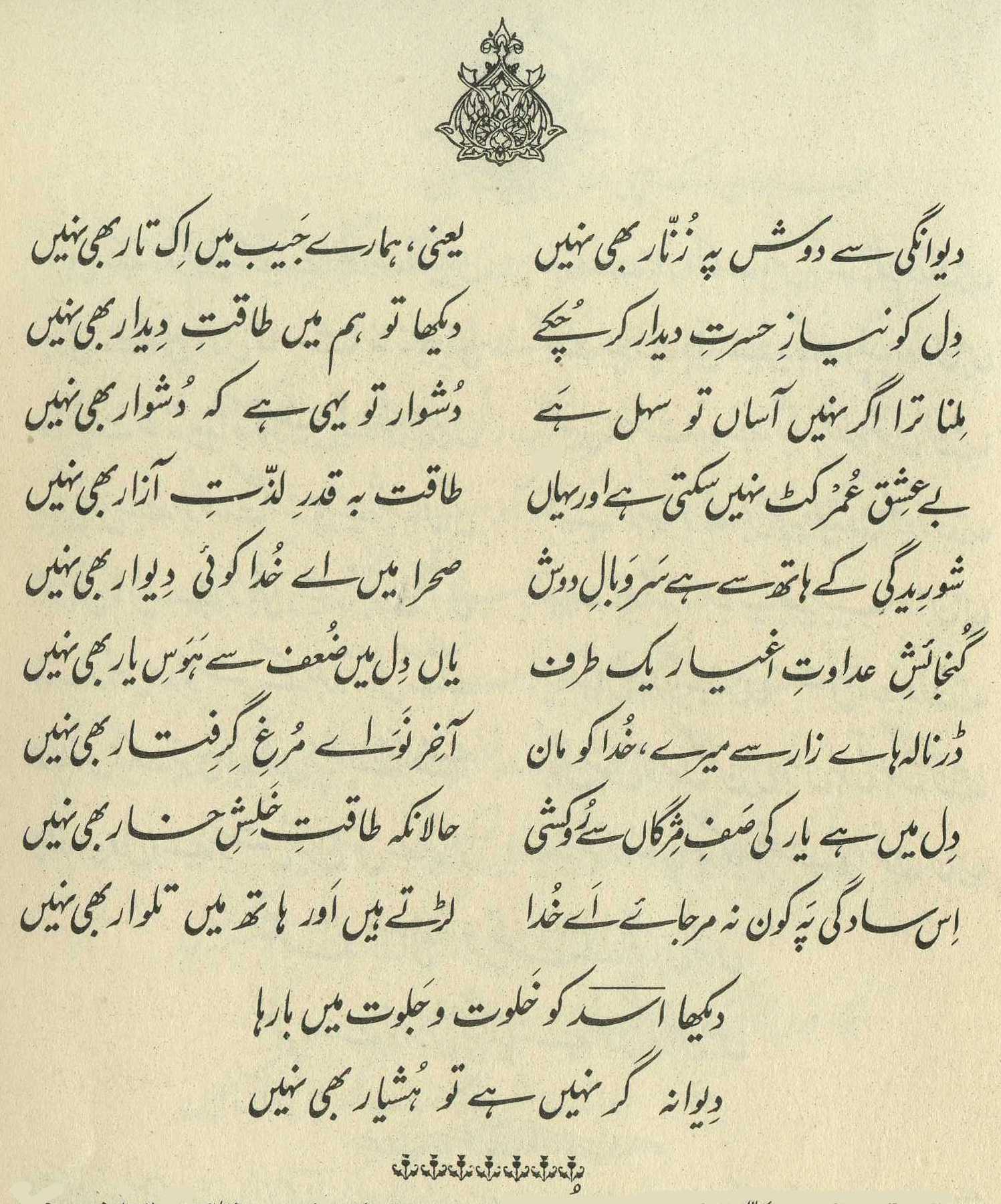
That is, in passion there is certainly torment, and I don't have the strength and power to support the delight of torment. (120)
== Nazm page 120

He says, without passion, life can't even pass-- and for enduring the difficulties of passion, there's not even enough strength in the heart. The meaning is that in order to pass one's life, one is compelled to established relationships with the world as well, and the heart becomes tired of the 'grief of daily life' as well. (170)
I have fallen into a great disaster, for without passion it's difficult to pass one's life, and my state is such that I don't even have the strength needed to support the troubles of passion. (226)
That phrase is not only a piquant yoking of opposites, but also a wonderfully palindrome-like construction, offering us first and then , two sound-sequences that are not only internally symmetrical but also echo each other remarkably. No wonder Ghalib used the phrase again and again. Other verses in which it appears: 53,10 ; 60,6 ; 92,3 .
This one is a real 'damned if you do, damned if you don't' verse. If the lover doesn't have passion, the sheer day-to-day-ness of a lifetime can't be endured. If he does have passion, its torments will kill him. Either way, his goose is cooked.
Another, and even bleaker, statement of such a dilemma appears in 20,7 : although grief is fatal, nobody with a heart can escape it: the difference is only between being killed by either the 'grief of passion', or else by the grief of 'dailiness / livelihood / the world' [].
The effect is to make passion sound like a life-occupying device of great efficiency: it offers the lover everything he could need to keep boredom and the quotidian at bay. He has delight, he has torment-- and long before they have time to pall, he'll be dead, because he's too weak to endure that much pleasure/pain, and so his worries about how to pass his life will become moot. His only regret, as he leaves us a few last thoughts, is that he couldn't hold out a little longer and enjoy a bit more of the before it finally did him in.
graphics/painpleasure.jpg