Verse 101816aar-edost
G1
1
would/should one make a complaint of the kindnesses of the enemy?
2
or would praise be expressed, of the pleasure of the affliction of the friend/beloved?
is an archaic form of ( GRAMMAR )
'Declaration, assertion, affirmation; explanation, exposition, description, relation, disclosure, unfolding, circumstantial indication or evidence'.
'Praise, thanksgiving'.
'Pleasure, delight, enjoyment; sweetness, deliciousness; taste, flavour, relish, savour; --an aphrodisiac; an amorous philter'.
'Sickness, disorder, disease, infirmity; trouble, affliction; injury, outrage'.
| References | |
|---|---|
| Arshi, Imtiyaz Ali | Ghazal# 51 |
| Raza, Kalidas Gupta | 170-171 |
| Nuskhah-e-Hamidiyah | 88-90 |
| Asi, Abdul Bari | 99-100 |
| Gyan Chand | 173-174 |
| Hamid Ali Khan | Open Image |
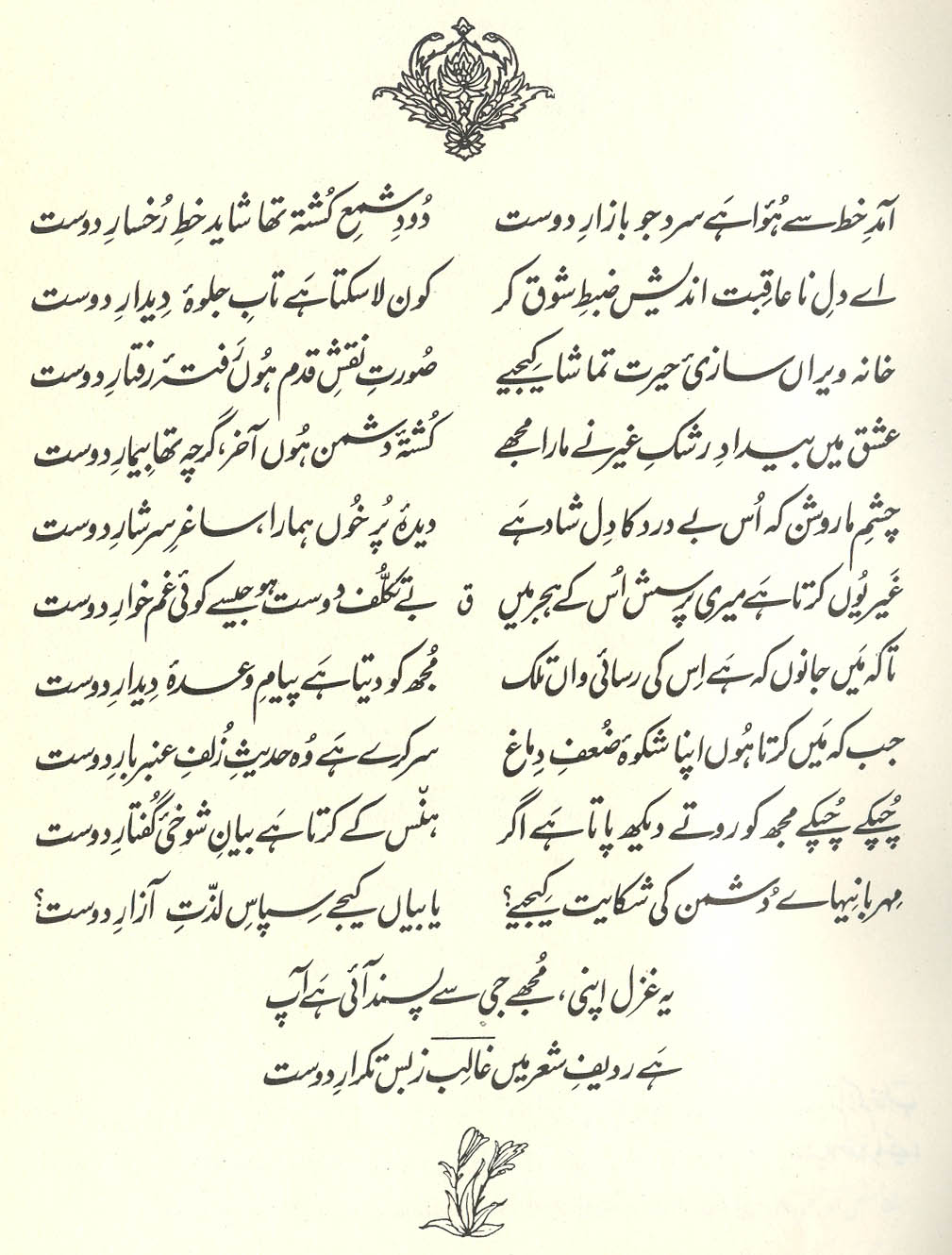
== Nazm page 49

Complaint should be made of the enemy's cruelty-mixed 'kindnesses', or gratitude should be expressed for the beloved's tyranny. (93-94)
This is the fifth and last verse in a five-verse verse-set that begins with 53,6 and is discussed by the commentators there.
This final verse in the verse-set plays on the ambiguous at best (or hypocritical and cruel at worst) 'kindly' behavior of the Other about which we've heard in the earlier verses of the verse-set. Here the speaker has called him the 'enemy', so that it will resonate with 'friend/beloved' in the second line. A complaint is perhaps to be made about his behavior-- but to whom?
The complaint could perhaps be made to the Other himself (about his own 'kindnesses'); or just possibly to the beloved (about the Other's 'kindnesses'). The lover is talking to himself, making plans for future actions-- if indeed he will ever carry them out. The vagueness of , which is often used for generalized suggestions addressed to one or more unspecified persons, leaves the degree of his resolve unclear.
As so often, we're deep into the realm of paradox : complaint about the 'kindnesses' of an enemy, praise for the pleasure of the pain inflicted by the 'friend'. After all, the joy of the torments of passion is at the heart of the ghazal world. On the phrase , see 112,4 .
Note for grammar fans: Here's a very clear juxtaposition of , the polite imperative of , with , an archaic form of the subjunctive , also from . I used to think that was simply a (metrically convenient) shortened form of , since that possibility looks plausible at first glance. But it's not, and I thank Peter Hook for providing the correct explanation. A careless might make the two forms look similar, but a meter-knower can never be fooled: notice that they scan differently (long-short-flexible versus long-flexible); this scansion difference is maintained systematically wherever either one appears.
graphics/opposites.jpg