Verse 21816aar-edost
G1
1
oh heart thoughtless of consequences, control your ardor!
2
who can find the power to bear the glory/appearance of the sight of the friend/beloved?
'End, termination, conclusion; futurity, the future; the future state or life'.
'Thinking, considering, meditating'.
'Heat, warmth; burning, inflaming; pain, affliction, grief; anger, indignation, wrath, rage; light, radiance, lustre, splendour; strength, power, ability, capability; endurance'.
'To muster strength, endurance, or courage, &c. (for); to be able to bear'.
| References | |
|---|---|
| Arshi, Imtiyaz Ali | Ghazal# 51 |
| Raza, Kalidas Gupta | 170-171 |
| Nuskhah-e-Hamidiyah | 88-90 |
| Asi, Abdul Bari | 99-100 |
| Gyan Chand | 173-174 |
| Hamid Ali Khan | Open Image |
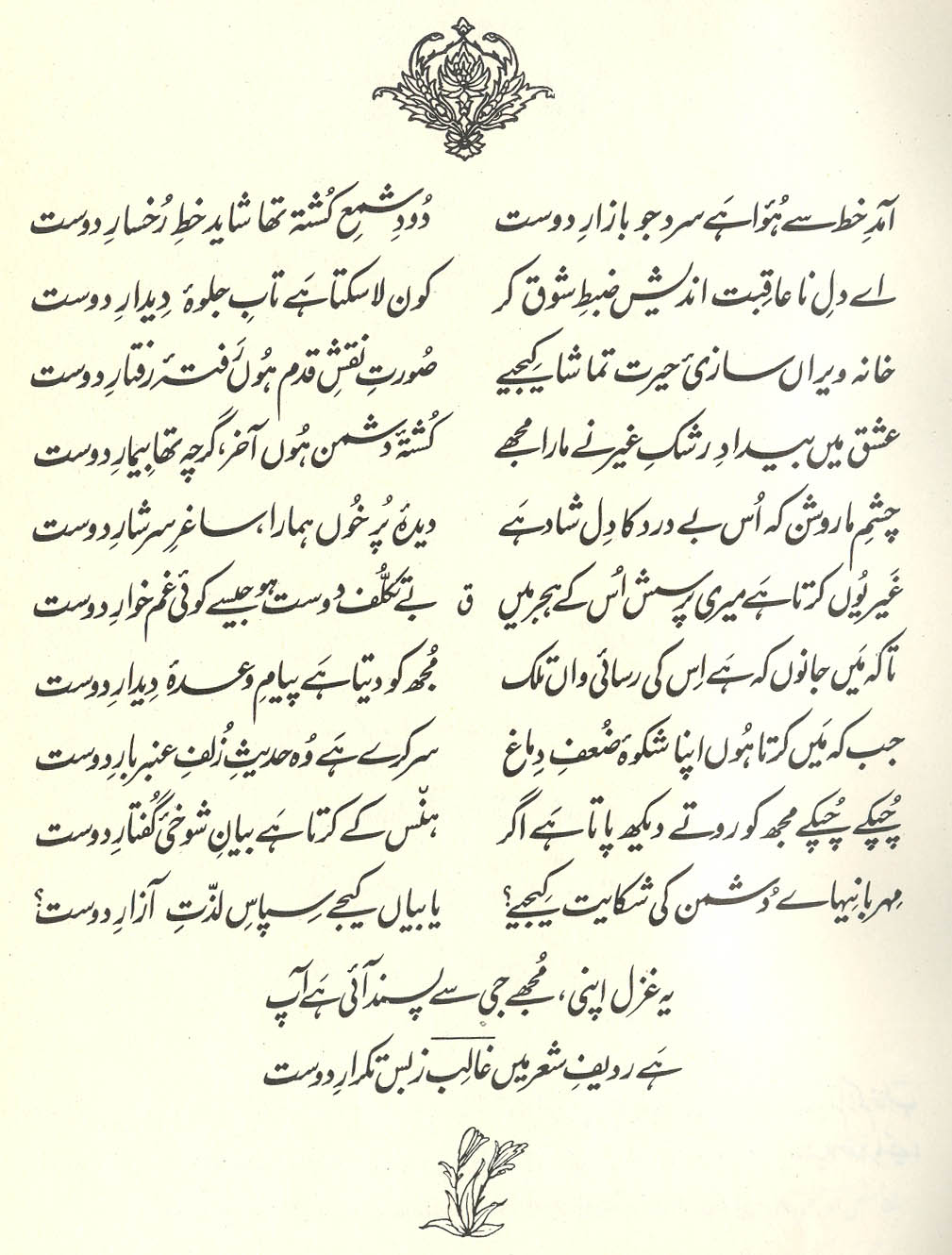
The phrase 'thoughtless of consequences' suggests the events of Mount Tur . (48)
== Nazm page 48

He says, oh heart that does not think of the results of action, control your ardor for the sight. Don't you remember what a state Hazrat Musa got into on Mount Tur, after only a tiny glimpse? (92)
When Janab Musa, compelled by the insistence of his people, went to Mount Tur and petitioned the Lord Most High, 'Oh Lord, show me Your radiance', he received the reply, 'You cannot look upon it'. When he asked again, a stroke of lightning flashed. The bush of Tur burned, the mountain of Tur shuddered in an earthquake. Janab Musa fainted and fell to the ground. (117)
Undoubtedly the commentators are right to place this verse in the context of the experience of Hazrat Musa, the Islamic counterpart of Moses, on Mount Tur. And Arshi sets it within an equally appropriate group of verses that depict the beloved's radiance itself as a form of veil, since it blinds everyone who tries to look; 214,7 is especially apt here. Arshi's chosen verses too can be seen as evoking Hazrat Musa's ordeal, when he rashly aspires to look upon the glory of the Beloved, and is almost destroyed for his foolhardiness. The situation of Hazrat Musa is evoked only by implication -- yet how clearly it emerges in the reader's mind!
But also enjoyable is the celebration of the perfect word, , placed in a perfect setting, right in the conspicuous middle of the second line. Among its meanings are 'endurance' (the quality the lover so desperately needs), and 'radiance' (the quality the beloved so eminently has). Both meanings are well-established and current; it's almost impossible to use one without evoking a ghost of the other. At their common core is the idea of heat as a sign of radiance, glory, passion, strength, power. For more on , see 60,1 .
The idiom means 'to endure', which is clearly the dominant sense. The lover should curb his ardor because its results will be so deadly: if the beloved actually comes, who can bear to look? And what we are reading as a negative rhetorical question ('Who can bear...?') can perfectly well be read also as a straightforward question, to which one answer is 'not Hazrat Musa'. Is there another answer? A verse like 60,11 says so. And think of 231,7 as well.
Ghalib's love of speech is once again on display-- in both lines.
graphics/sunrays.jpg