Verse 61816aar-edost
G1
1
the Other asks how I am, in separation from her, in such a way--
2 a
frankly/'to tell the truth', as though some friend would be a sympathizer of a friend
2 b
familiarly/informally, as though some friend would be a sympathizer of a friend
2 c
as though some familiar/informal friend would be a sympathizer of a friend
'Without ceremony, unceremonious, frank'.
| References | |
|---|---|
| Arshi, Imtiyaz Ali | Ghazal# 51 |
| Raza, Kalidas Gupta | 170-171 |
| Nuskhah-e-Hamidiyah | 88-90 |
| Asi, Abdul Bari | 99-100 |
| Gyan Chand | 173-174 |
| Hamid Ali Khan | Open Image |
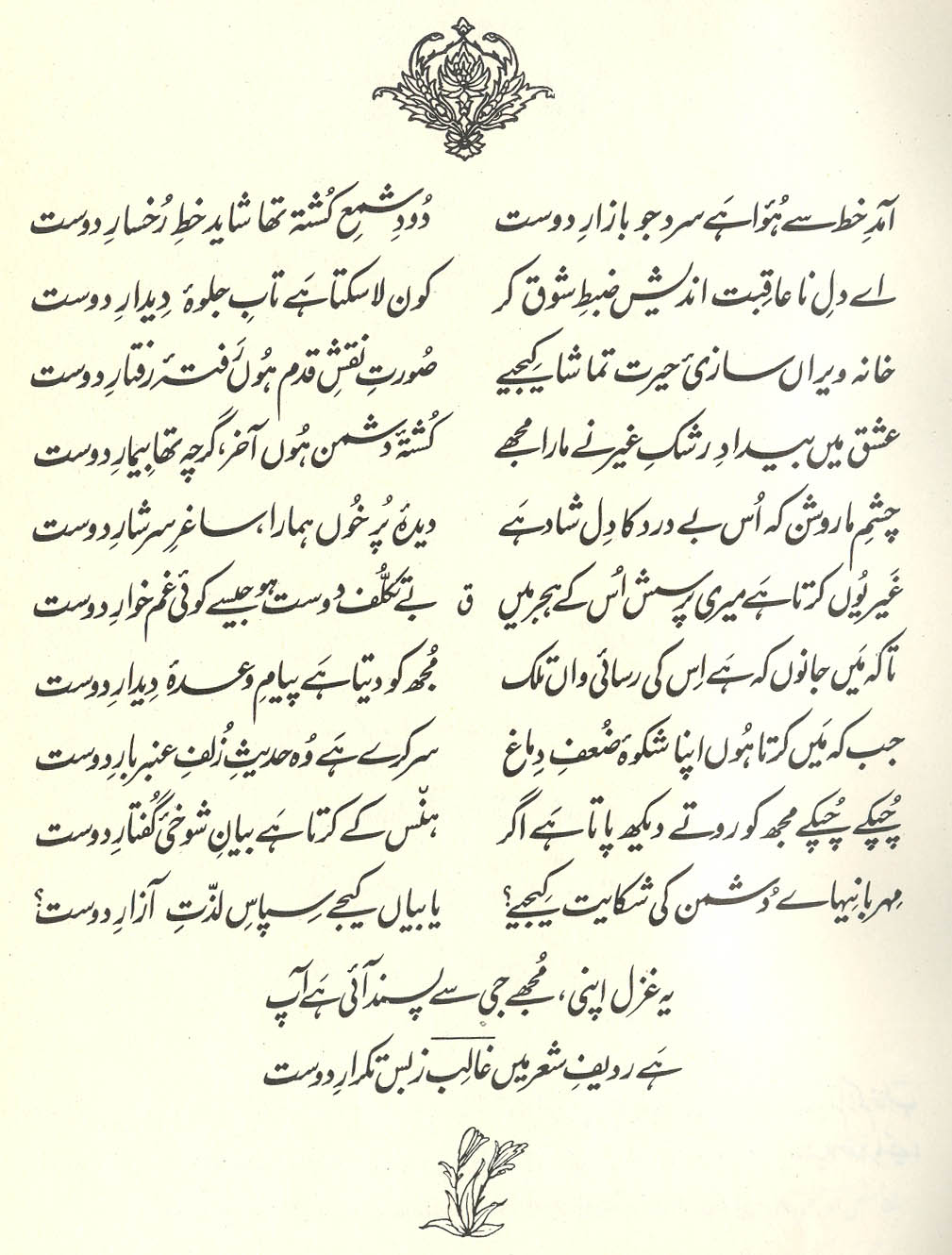
[Speaking of {53,6-10} together as a verse-set : That is, the enemy has become a friend, and by way of graciousness has burnt me up, and fanned the flames of envy. In the whole verse-set this same general idea is developed in detail. (49)
== Nazm page 49

In this verse-set, how excellently Mirza Sahib has painted a picture of the enemy's hypocritical behavior, and at the same time he has also emphasized the way the enemy's expression of affection not only is based on boastfulness, but is also extremely heart-lacerating, or rather is kinding the fire of envy. (93)
[In this verse-set] the Rival , seeing me restless and anxious in separation from the beloved, informally and in the guise of sympathetic friendship comes to inquire about me in all the situations of love, in order to burn me in the fire [of envy]. (118)
As Nazm notes, this verse introduces a verse-set that consists of {53,6-10}. Most of the commentators treat them fully as a set, and offer almost no commentary on any of the individual verses in isolation.
If this verse is taken in isolation, there seem to be two possible readings of it. One reading is the obvious, primary one adopted by the commentators: the ' Other ' is hypocritically pretending to comfort the suffering lover, while actually twisting the knife in the wound. The second reading would suggest that the cruel, fickle beloved is tormenting the lover and the Other alike with her absence and disdain. This possibility arose in 53,4 as well, and is discussed at more length in 42,1 . Perhaps they really are fellow-sufferers. Perhaps the Other is (almost) as miserable as the lover himself, and has in truth come over to express a kind of fellow-feeling based on mutual suffering?
We might well entertain such an idea, since the verse lays it out quite clearly; formally speaking, the possibility of hypocrisy remains only an implication . But of course, when we move on to the rest of the verse-set, we see that the Other seems in fact to be behaving in a truly sleazy fashion-- definitely so in 53,7 , probably so in 53,8 and 53,9 . Perhaps the lover himself might have briefly entertained the possibility of the Other's sincerity, before he was undeceived?
On the excellent complexities of , see 25,1 . This verse is a particularly striking case in point, since all three of the possibilities-- a petrified-phrase truth-claim (2a), an adverb (2b), an adjective (2c)-- are so clearly appropriate, and work so well with the first line.
In this whole ghazal of which the refrain is , here's the only instance in which , which basically means 'friend', actually does mean 'friend'-- not as a synonym for 'beloved', but as opposed to 'beloved'.
graphics/shadows.jpg