Verse 51816aar-edost
G1
1
'our eye [is] radiant' [with joy], since/while that pitiless one's heart is happy
2
our blood-filled eye, the friend/beloved's brimming wine-glass
'Pleased, delighted, exulting, joyful, happy, glad, cheerful'.
| References | |
|---|---|
| Arshi, Imtiyaz Ali | Ghazal# 51 |
| Raza, Kalidas Gupta | 170-171 |
| Nuskhah-e-Hamidiyah | 88-90 |
| Asi, Abdul Bari | 99-100 |
| Gyan Chand | 173-174 |
| Hamid Ali Khan | Open Image |
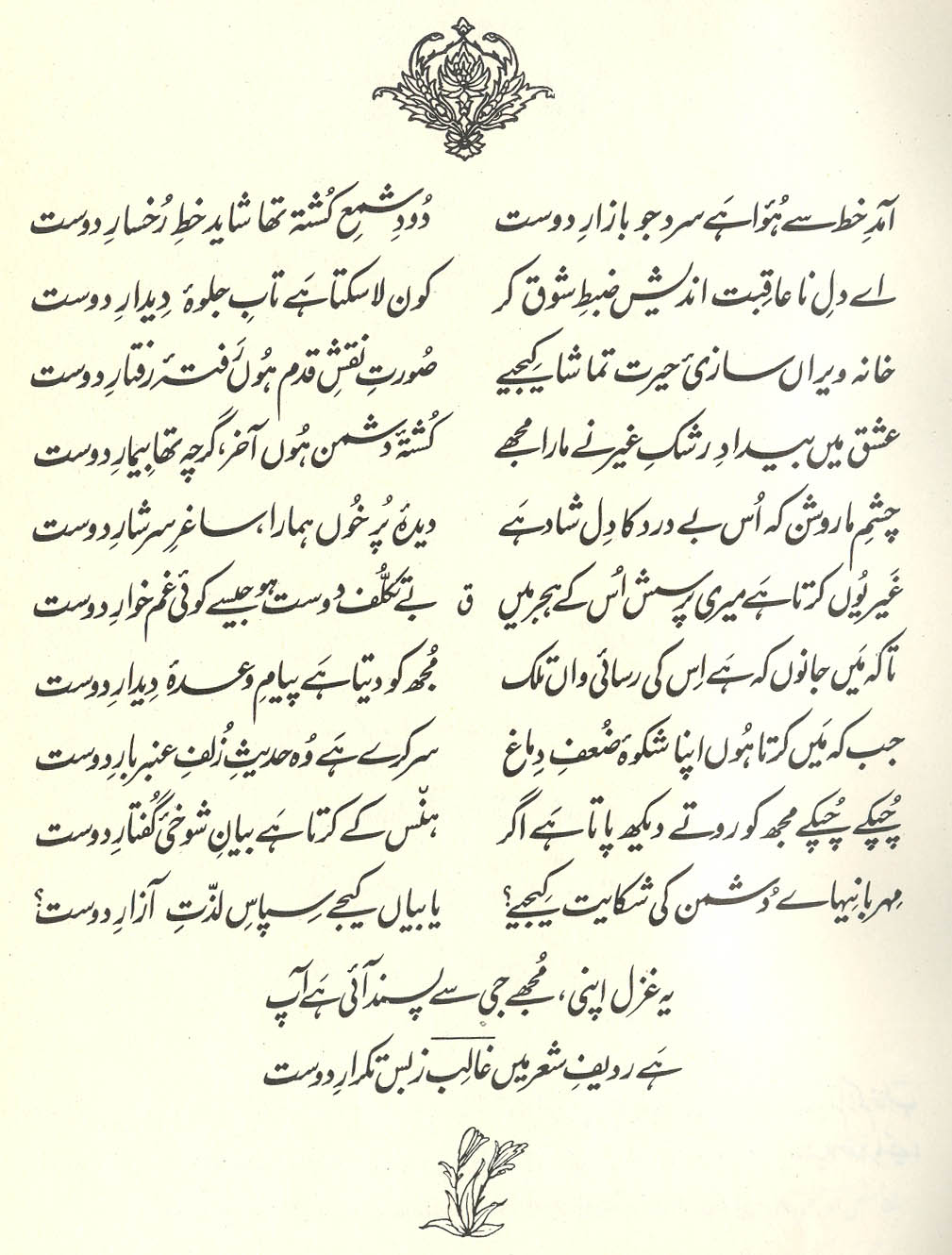
In the second line, 'is' is omitted . has been taken from Persian, but it's so famous that it ought not to be considered a mixing of the two languages. And similarly they also say [our eye is radiant, our heart is joyous]. For this reason the author has said, 'that pitiless one's heart is joyous'. And this too is one of the verbal device s, although people of skill have renounced the use of this verbal device. (48)
== Nazm page 48 ; Nazm page 49


In the second line, the omission of 'is' is extremely displeasing. (51)
He says, although in passion we are weeping tears of blood, it's only because that pitiless one's heart is happy when she sees us weeping tears of blood. Therefore we too say . That is, we too are pleased with our blood-filled eyes, or our blood-filled eyes have become the brimming wine-glass of the beloved. The meaning is that just as one who has drunk wine feels happy, in the same way that cruel one's heart sees us weeping tears of blood and is happy, and at her happiness we too are happy. (92-93)
Nazm is usually the only commentator who complains about words that are ' omitted '-- in this case, he objects to the absence of 'is' in the second line. But this time he has an ally: Hasrat strongly agrees, finding the omission 'extremely displeasing' []. As is habitual for the commentators, they pay far too little heed to Ghalib's determination to create verses that can be read in as many ways as possible.
If the 'is' were there in the second line, it would create a flat statement, A 'is' B. Without the 'is,' that possible reading still exists. We can read the line as a copulative construction in which the 'is' is merely implied; that is how Nazm and Hasrat both read it, with perfect comprehension despite their disapproval.
But this 'A is B' reading is also, if the imagery is taken seriously, a truly grotesque one. Are we really to imagine the beloved's graceful little hand taking up the lover's blood-filled eyeball-- carefully, since it's about to overflow-- and bringing it to her elegant lips, so that she can sip the ruby-red blood? UGH. Of course, it might be argued that we're not meant to take the imagery so literally, so concretely, as actually to visualize that scene; we're only meant to think of the image in a cloudy, generalized, metaphorical way. But without such specificity, don't we radically weaken the verse? After all, our imaginary garden does need to have real toads in it. In the present verse, if we don't have a real blood-filled eyeball and a real wineglass, what do we actually have at all?
The much better course is to have the blood-filled eye and the wineglass, but not to insist on literally equating them. For the absence of the 'is' means that other readings are also opened up to us. 'A, B' is so much more flexible than 'A is B'! As a parallel case consider 4,4 , with its first line consisting of an extremely simple (and thus multivalent) 'A and B, C and D' structure, with not a verb in sight. I discuss {4,4} as a 'list' verse, and the second line of the present verse could also be considered to be the smallest possible 'list', containing just two items.
Thus the second line can be read as, 'We have a blood-filled eye; she has a brimming wine-glass'. Each of them, in short, is showing appropriate signs of delight. The blood-filled eye (from constantly weeping tears of blood) is the proper mark of the lover, blood is red and radiant like fire, thus the lover's eye is radiant. The beloved is made happy by a brimming glass of red wine, and by her lover's suffering; while the lover is made happy by her happiness, and by pride in his own blood-filled eyes. They are both happy-- but how differently! On this reading, the verse would belong with others like 13,3 ('you and X, I and Y') or 15,2 (here X, and there Y).
The Persian idiom cited by Nazm, , 'our eye is radiant, our heart is joyous', suggests another kind of depth as well. By replacing the lover's joyous heart with the beloved's in the second half of the idiom, the verse suggests that the lover so submits himself to the beloved that the moods of the two have become one. Perhaps they both, sharing their joy, are about to offer up a toast to some good fortune (of the beloved's, of course)? The lover proffers his blood-filled eyeball, the beloved raises her glass full of red wine.
graphics/wineglass.jpg