Verse 111816aar-edost
G1
1
this ghazal of mine pleases me deeply/inwardly in itself
2 a
in the refrain of the verse , Ghalib, there is, abundantly/sufficiently, repetition of 'friend/beloved'
2 b
'From the abundance; sufficiently; very, extremely, excessively; notwithstanding, although'.
'Returning to the attack; repeating often; repetition; tautology; burden (of a song); question, dispute, altercation; objection'. (Steingass p.318)
'Repeating often; repetition; tautology; the chorus or burthen of a song; question, dispute; objection, controversy, contention, altercation, wrangling, wrangle, cavil'.
| References | |
|---|---|
| Arshi, Imtiyaz Ali | Ghazal# 51 |
| Raza, Kalidas Gupta | 170-171 |
| Nuskhah-e-Hamidiyah | 88-90 |
| Asi, Abdul Bari | 99-100 |
| Gyan Chand | 173-174 |
| Hamid Ali Khan | Open Image |
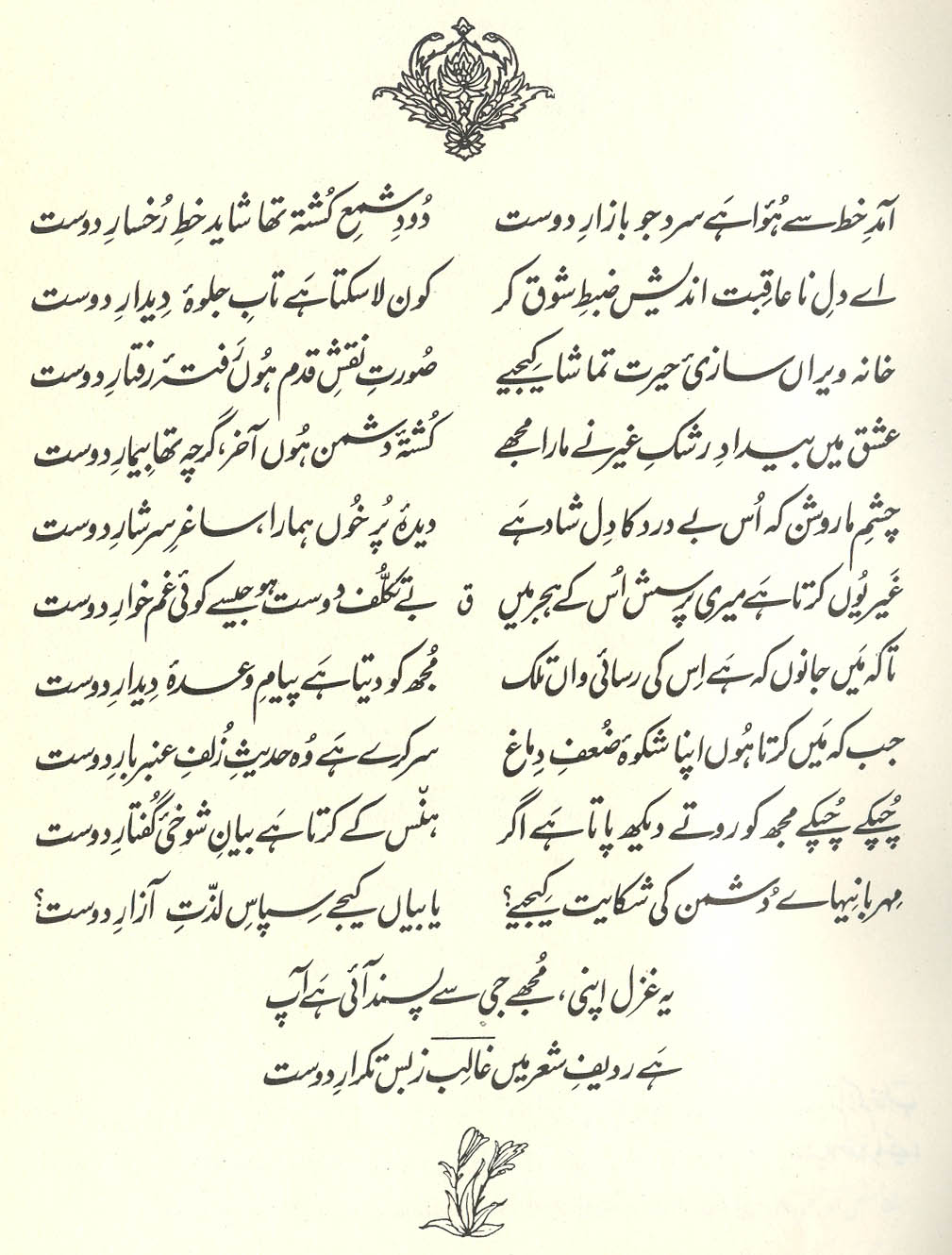
The word that comes after the rhyme and occurs repeatedly is called the refrain . The rhymes share a similarity, and the refrain is repeated. And the rhyme is a pillar of the verse, and the refrain is among its adornments. In Arabia and Persia and Hind poets describe verse as 'metrical rhymed speech', and logicians call verse 'imaginary speech'. (49)
== Nazm page 49

He says, oh Ghalib, this ghazal pleases me from the heart, because in its refrain the word 'beloved/friend' comes a number of times. The word that comes again and again at the end of the verse, after the rhyme, is called the refrain. (94)
I liked this ghazal of mine very much, because in its refrain is the 'beloved/friend'. That is, the word 'beloved/friend' comes in it time after time. (119)
This closing-verse is a lovely, simple, witty wrap-up to the ghazal. Unusually, the verse is full of technical vocabulary (ghazal, verse, refrain, repetition). And that vocabulary isn't there for nothing. In the first line, the poet tells himself that he's quite fond of this verse.
Why? On the popular commentarial reading of the second line, the reason is that it's quite sufficiently or extremely or even excessively [] full of repetition of (the word) , the 'friend' or beloved (2a).
But of course, , short for , is basically identical in meaning to (see the definition above). Which means it has the alternative meaning of 'although, notwithstanding'. For more on , see 1,5 . In this sense, the poet claims to be fond of the ghazal not because of, but despite, its repetition of the word (2b). In ghazal composition, certain kinds of repetition [] definitely constitute literary flaws. For an illustration, see 17,9 , in which several commentators reproach Ghalib for such repetition.
By so pointedly introducing the ghazal's technical terminology ('refrain', 'verse', 'repetition') Ghalib surely invites a technically grounded reading of the second line. Thus we're led to consider the nature of the complaint of 'repetition'. When 'repetition' takes the form of words used in the rhyme , or elsewhere in the verse, it can indeed be a flaw; but when it involves the refrain itself it's not culpable at all, but obviously inevitable. So Ghalib is, with tongue in cheek, refusing to apologize for such a commendable, lover-like case of 'repetition'.
For another expression of the lover's pleasure in even mentioning the beloved, see 180,3 .
graphics/dost.jpg