Verse 91816aar-edost
G1
1 a
if through silence/stealth he manages to see me weeping
1 b
if he manages to see me silently/furtively weeping
2
laughingly he mentions the mischievousness of the friend/beloved's conversation
'Silently, quietly, with little noise; secretly, stealthily, clandestinely, furtively, slyly'.
| References | |
|---|---|
| Arshi, Imtiyaz Ali | Ghazal# 51 |
| Raza, Kalidas Gupta | 170-171 |
| Nuskhah-e-Hamidiyah | 88-90 |
| Asi, Abdul Bari | 99-100 |
| Gyan Chand | 173-174 |
| Hamid Ali Khan | Open Image |
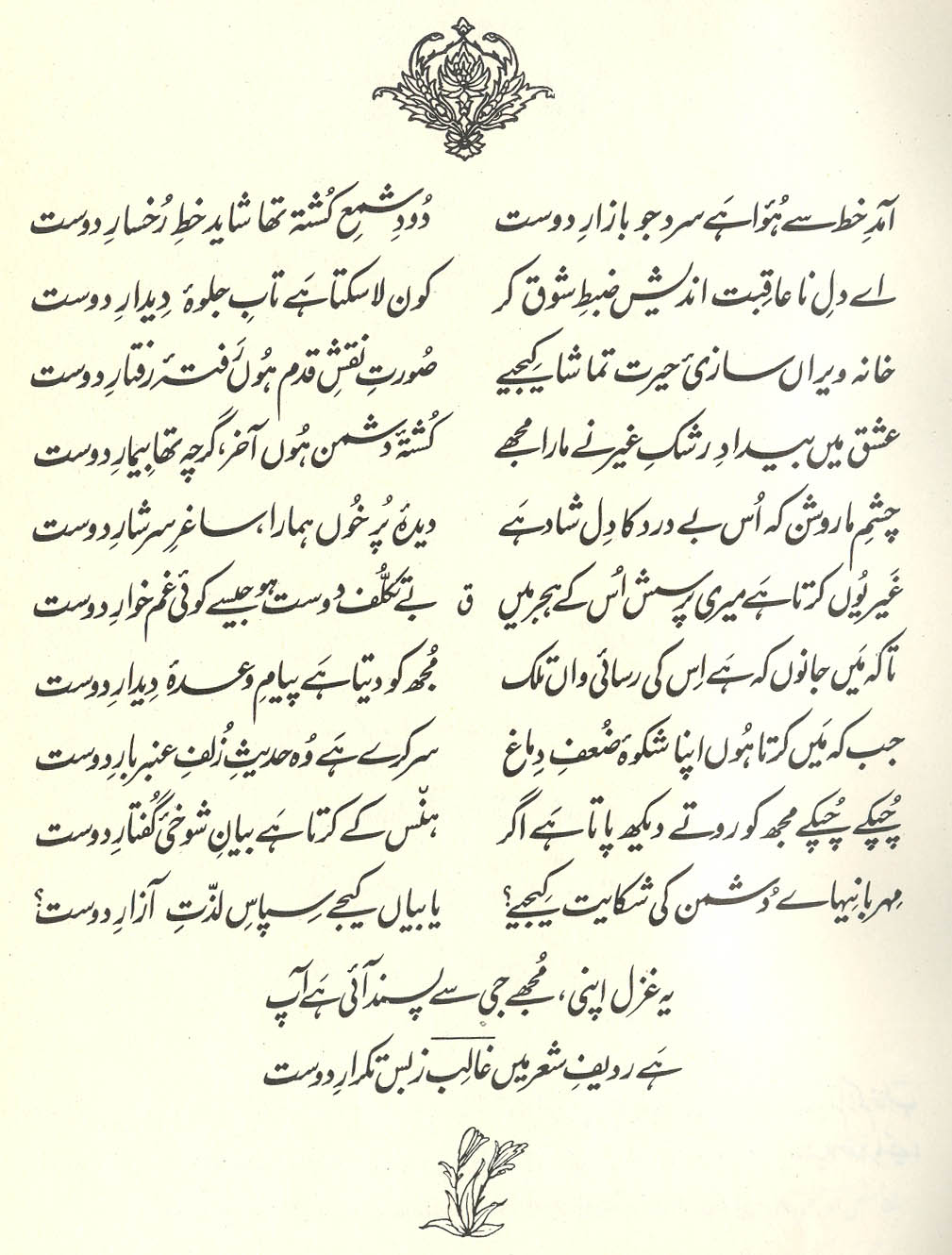
== Nazm page 49

Considering that the cure for my silently/furtively weeping is the mischievousness of the beloved's conversation, he begins to praise the beloved in such terms. (93)
This is the fourth verse in a five-verse verse-set that begins with 53,6 and is discussed by the commentators there.
The 'he' is of course the Other , as we know from 53,6 . Like its predecessor 53,8 , this verse too is built chiefly on wordplay . In the first line, we have both tears and silence []-- whether the silence is that of the lover as he seeks to conceal his tears, or that of the Other as he seeks to spy them out. The adverbial phrase can be read either with the first clause, as in (1a), or with the second clause (1b).
Then in the contrastive second line, we have not silence and tears, but laughter, speaking (by the Other) and conversation (of the beloved).
Probably the Other is once again being malicious. But theoretically he could be trying to cheer up the weeping lover, as Bekhud Dihlavi seems to feel. Telling the weeping lover stories of the beloved's playful conversation-- is that a friendly distraction, or a patronizing parade of access, or a piece of sheer cruelty? (Or perhaps a combination of them all, in some kind of psychological mixture?). And of course, his whole story could be false-- perhaps the Other has no more access to the beloved than the lover does; in which case he's being truly sadistic.
graphics/masks.jpg