Verse 71851uurkii
G3
1 a
is there an assumption/obligation that all would get a similar answer?
1 b
what assumption/obligation is there that all would get a similar answer?
1 c
what an assumption it is-- that all would get a similar answer!
2
come on, won't you? let's even/also us take a stroll around Mount Tur
'Made obligatory or binding (by God); obligatory, incumbent;—a thing or duty made obligatory (by God, for neglecting which one will be punished), a divine command; a moral obligation, an indispensable duty; a statute, an ordinance, injunction, a command or prohibition (of the prophet Mohammad); obligation, onus, responsibility; —supposition, hypothesis, assumption'.
| References | |
|---|---|
| Arshi, Imtiyaz Ali | Ghazal# 223 |
| Raza, Kalidas Gupta | 412 |
| Hamid Ali Khan | Open Image |
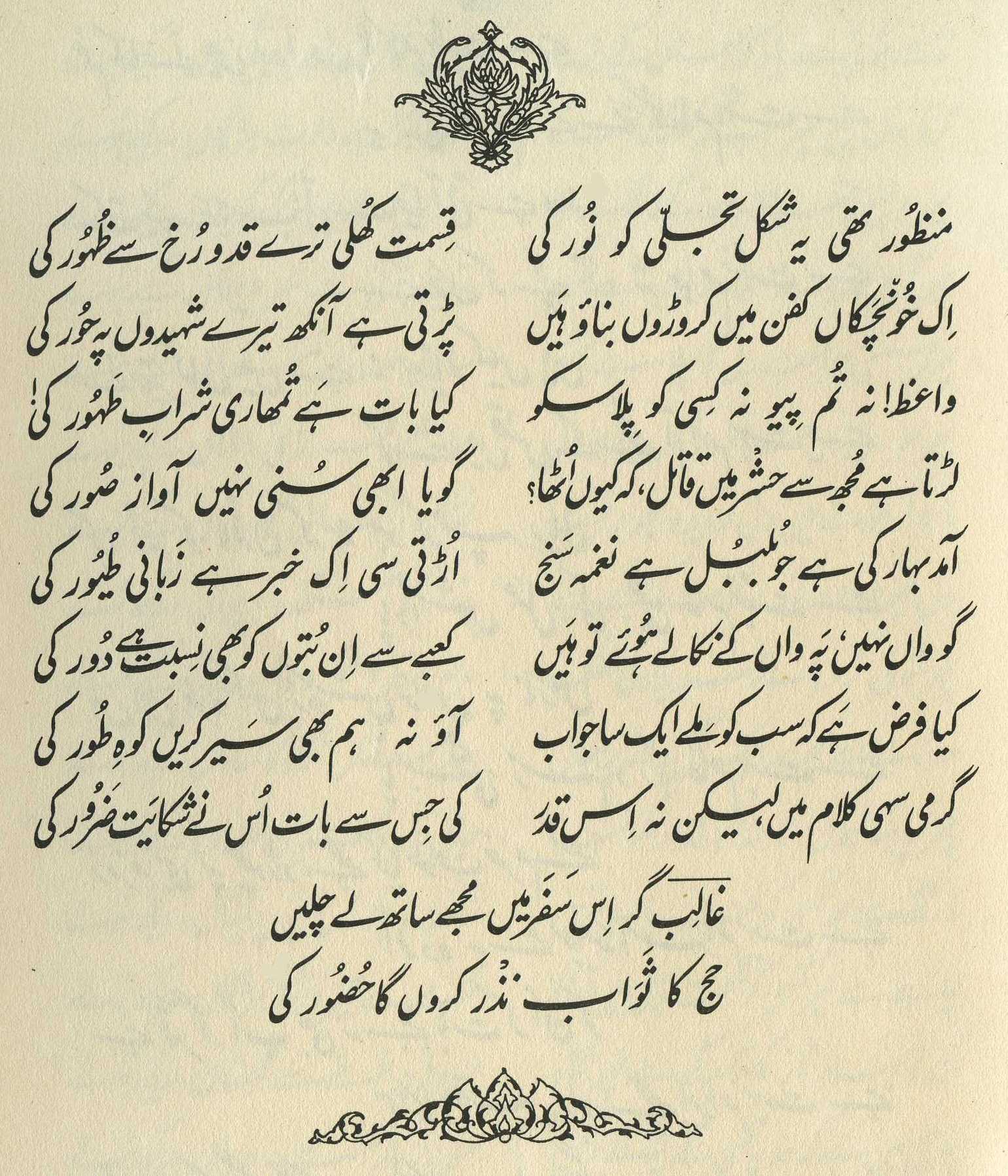
Is there an assumption that the way He gave a flat refusal to Kalim [=Moses], there would be the same refusal to us too? In this verse the author has versified in an extraordinary idiomatic word-- everyone uses it in speech, but nobody has used it in poetry. But what this means-- it's difficult to give an answer. A grammatical guess tells us that and , etc., are contracted forms of and . For without this, no meaning will be able to be assigned to the negative. (262)
== Nazm page 262

What a fine verse he has composed! He says, it's no necessary thing that everybody would receive only a flat refusal like that received by Hazrat Musa. It's possible that our request would be accepted, and the glory/appearance of the Beautiful One would be shown. So why wouldn't we take a stroll around Tur? (319)
The story is that when Hazrat Musa was compelled by the demand of his people, then he went off to Mount Tur and petitioned, 'Protector, these people refuse to accept the faith until they would see You'. And he petitioned, 'Lord and Protector, show me Your beauty'. The answer came, 'You absolutely cannot see Me'. After this, something like lightning flashed. The date-palm of Tur burnt up. In Mount Tur an earthquake came. Hazrat Musa became unconscious. (488)
At the heart of this verse is another brilliant use of . Perfectly available are at least three readings: it signals a yes-or-no question (1a); it works as an adjective ('what kind of?') modifying 'assumption' (1b); or else it introduces an exclamation-- in this case, apparently a negative, scornful one (1c). And of course, from the first line we have no way of knowing just what sort of 'assumption' (on our part?) or 'obligation' (on someone else's part?) the verse is mulling over.
Under mushairah performance conditions, we're of course made to wait as long as conveniently possible for an answer. And even then, the verse withholds its 'punch'-word until the last possible moment. Not until we hear the rhyme -word can we really interpret the rest of the verse at all. Then the pleasure, and the 'mischievousness', strike us all at once.
Another source of enjoyment is the idiomatic casualness of the second line. Nazm has pointed to the colloquial use of to mean something like 'won't you?' or 'will you?' or 'all right?'. But even more amusing is the casual use of , 'to take a stroll'. While Hazrat Musa had his Mount Tur encounter in fear and trembling, the speaker here proposes a casual little afternoon stroll-- no big deal, he implies, but why shouldn't we saunter over and try our luck? He might be thinking aloud to himself, or suggesting to some close companion a small, mildly entertaining excursion-- in which he still half-expects to get better results than Hazrat Musa did! When it comes to 'mischievousness' (and what I call 'grandiosity'), how much more wickedly enjoyable can it get?
Compare 163,7 , with its equally casual reference to 'stopping by' the Ka'bah as a backup plan, to pass the time. And of course there's the delightfully arrogant 60,11 , which also uses the image of Mount Tur.
Mount Tur is traditionally equated with Mount Sinai (Arabic names: or ). The story of how upon that mountain Moses asked to see the Lord, but swooned away when the Lord's glory split the mountain, is briefly told in the Qur'an, Sura 7, v. 143.
graphics/mountsinai.jpg
graphics/mountsinai3.jpg
