Verse 41851uurkii
G3
1
the murderer quarrels with me in a Doomsday/tumult: 'Why did you arise?!'
2
speaking/'so to speak', she had not yet heard the sound/voice of the trumpet
'Gathering, meeting, congregation, concourse; the resurrection; --commotion, tumult, noise (such as that of the resurrection); wailing, lamentation'.
'A horn (musical); a trumpet; the trumpet of Isrāfīl (the angel of death)'.
| References | |
|---|---|
| Arshi, Imtiyaz Ali | Ghazal# 223 |
| Raza, Kalidas Gupta | 412 |
| Hamid Ali Khan | Open Image |
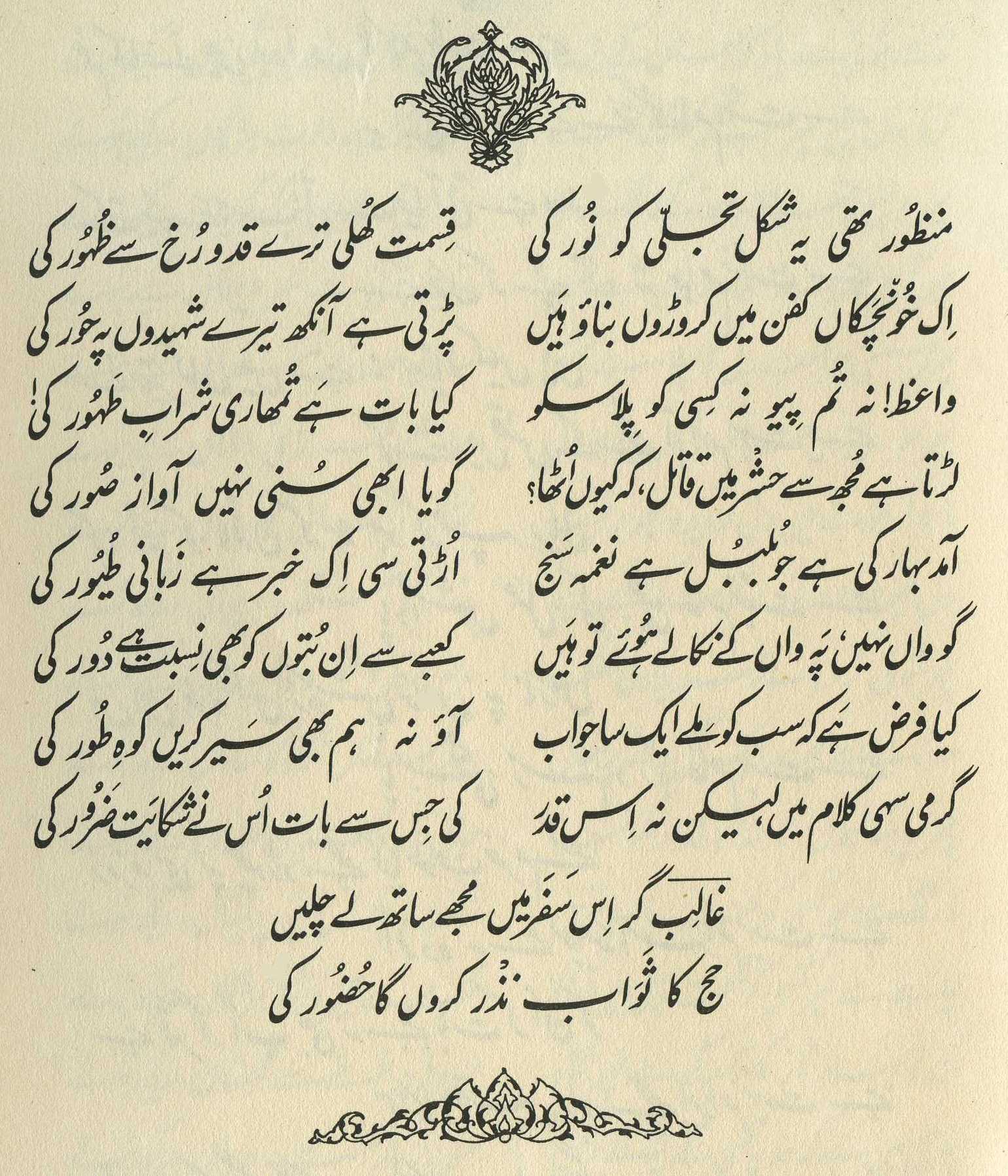
That is, in her temperament is so much heedlessness that the trumpet has sounded, and she doesn't know it. (261)
== Nazm page 261

He says, my murderer quarrels with me in Doomsday/turmoil: 'Why did you come to life without my command? That is, I had murdered you-- if I got you up, then you would get up!' And her degree of security is such that it's as if as yet she hadn't even heard the trumpet sound. (318)
The [religious] belief is that on the day of Doomsday [] when the trumpet will be blown, then all the dead will become alive. He says, my murderer is heedless and unaware to such a degree that the trumpet of Doomsday has been blown; so to speak [], the dead have received the order to rise up. But she has absolutely no awareness-- when I arise at the sound of the trumpet, then she quarrels with me: 'Why did you arise?'. In this verse, besides the beloved's practice of heedlessness, another aspect is that she quarrels with me about this: 'You're my murdered one-- you should have risen up at my command! Why did you arise when you heard the sound of the trumpet?' (544-45)
When we hear the first line, we're not sure how to take , which can refer to various sorts of 'gathering' or 'commotion' (see the definition above). The beloved is called a 'murderer', but that's one of her common epithets anyway; and she might be angry with the speaker for getting up from his seat at some party without permission. Or might just describe the turmoil and commotion created by the beloved's anger itself.
Only when we hear the second line-- which mean, in proper mushairah performance style, after a suitably tantalizing delay-- do we begin to realize what's going on. And even then, the punch-word, 'trumpet', is withheld till the last possible moment. Only when we hear it do we perceive the eschatological situation. For when Resurrection Day [] and Doomsday [] come, a trumpet summons the dead to rise up and meet their Lord. The dead lover obediently rises up.
But then the beloved scolds him, asking him why he has arisen without her permission. The commentators point out some of the amusing possibilities here:
=The beloved is so busy 'speaking' loudly and scolding the lover that she actually hasn't heard the divine trumpet call.
=The beloved is so arrogant and heedless that she disdains to notice the divine trumpet call, so nobody knows whether she has heard it or not.
=The beloved has heard the divine trumpet call, but she chooses to ignore it and act as if she hasn't heard it.
Even then, the verse isn't any kind of a putdown of the beloved. The outcome is left entirely unrevealed. It seems possible that the beloved might even be right, and her claim tor absolute power and authority over the lover might be backed up by some divine license.
But the most enjoyable part of the verse is the perfect placing and use of . In its literal meaning of 'speaking', it describes the reason that the beloved might not have heard the trumpet sound. (Alternatively, though less enjoyably, the 'speaking' might refer to the summons issued by the 'voice' of the trumpet.) And in its extended meaning of 'so to speak', creates both a speculation about the beloved's behavior (she actually might not have heard the trumpet), and a description of it (she acts as if she hasn't heard the trumpet). For more on the double meaning of , see 5,1 .
graphics/doomsday.jpg