Verse 31851uurkii
G3
1
Preacher , you neither would drink yourself, nor would you be able to give anybody a drink!
2 a
what is it with your 'nectar/wine of Paradise'?
2 b
what an extraordinary thing it is, your 'nectar/wine of Paradise'!
2 c
as if it's anything special, your 'nectar/wine of Paradise'!
tahuur>> : 'A purifying, or a pure, draught,' the water of Paradise, nectar'.
| References | |
|---|---|
| Arshi, Imtiyaz Ali | Ghazal# 223 |
| Raza, Kalidas Gupta | 412 |
| Hamid Ali Khan | Open Image |
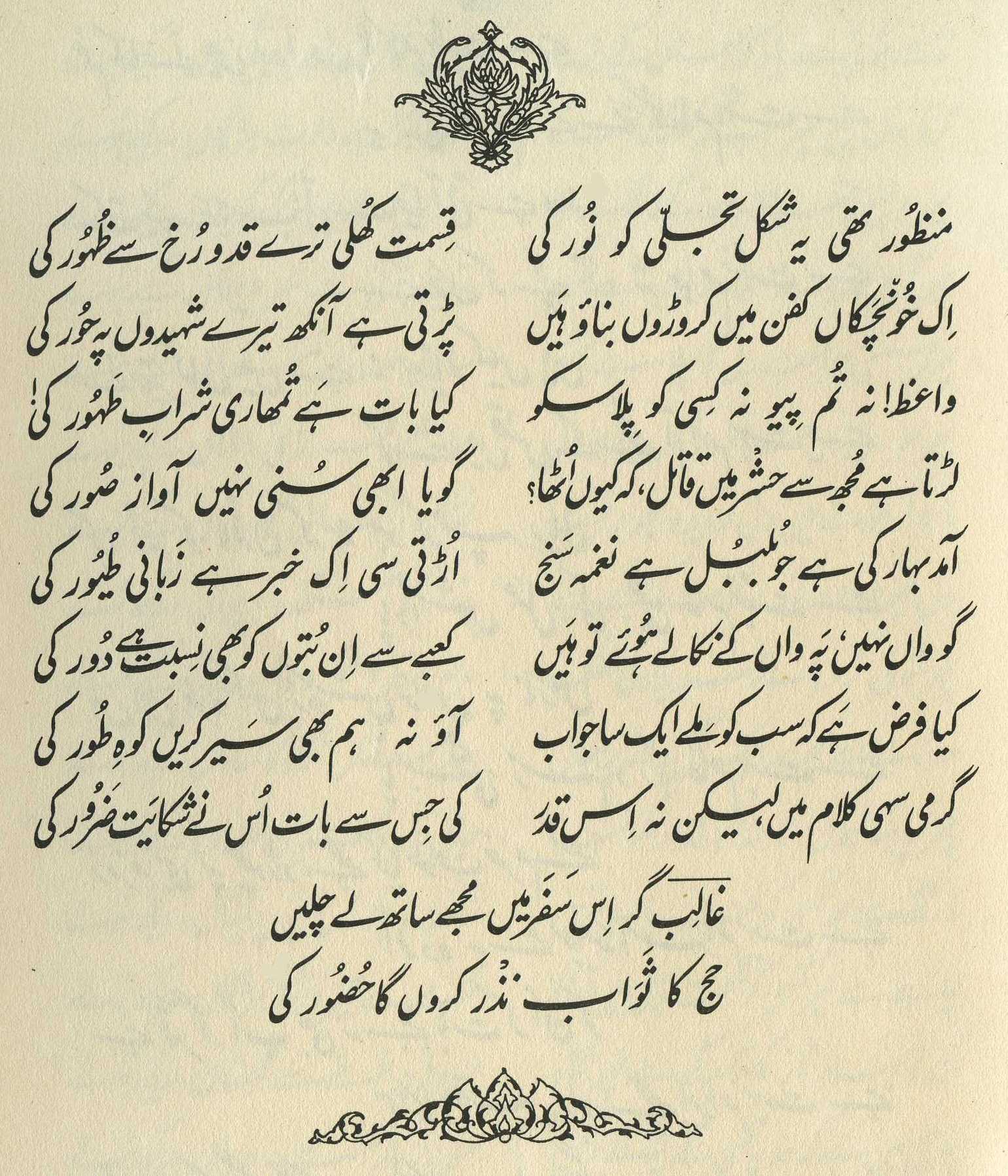
[1861, to Siyah:] Sir! The verse that you asked about is this one: {231,3}. Two more verses of this ghazal have come to mind, I write them on another page: 231,7 , 231,6 . Notice that [in {231,6}] is short for , with the meaning of 'but'. (Arshi p.324)
==Urdu text: Khaliq Anjum vol. 2, p. 552
Having addressed one person, to at once shift over toward the group-- this is a new aspect of refinement, and gives extreme pleasure. (261)
== Nazm page 261

He says, oh Preacher, neither can you yourself drink, nor can you give anybody a drink, and you praise it so extravagantly! Thus we've learned that your 'nectar of Paradise' is only an imaginary wine [], with the mention of which you please your heart. He uses a new kind of mischievousness, and has composed a very greatly enjoyable verse. (318)
'Nectar of Paradise' is pure wine of Heaven. This verse has been made, in a rakish [] taste, extremely refined/enjoyable. Eloquence takes lessons from it. (485-86)
The first line cleverly doesn't specify what beverage the Preacher wouldn't drink or be able to serve. So we naturally take it as applying to normal wine. On this reading, the speaker is astonished (and scandalized?) that the Preacher is such a drag, and even so useless, in the wine-house: it's not only that he won't himself drink, but he won't even help pass the decanter around to others! How strange, how sad, how ill-bred! It naturally causes the speaker to question what weird thing the Preacher has on his mind instead, that gives rise to such boorish social behavior. The idea of such a reproach is doubly amusing: why would the Preacher be hanging around in a wine-house to begin with, and who in any case could be naive (and rakish) enough to level such reproaches against him?
But the verse's best effects are reserved for the second line (for which, under mushairah performance conditions, we're made to wait as long as conveniently possible). The well-established complexities of , which can be used colloquially to generate either a genuine question, as in (2a); or an admiring exclamation, as in (2b); or a sneering dismissal, as in (2c), are excellently deployed. Moreover, the presence of the full idiomatic expression intensifies the pleasure of such casual everyday speech; compare the very similar use of this versatile colloquialism in 163,9 , and see also the more general discussion in 59,2 .
And then, of course, the kicker, the 'punch'-word, is reserved for the last possible moment: only with the rhyme -word do we learn that the real subject of the verse is the nectar or 'pure wine' of Paradise, the . It turns out that the verse has really been sneering not at the bad social manners of the Preacher, but, more daringly, at the nectar of Paradise itself. This verse thus belongs to the 'snide remarks about Paradise' set; for the full list, see 35,9 .
graphics/wineglass.jpg