Verse 11851uurkii
G3
1 a
this shape/form of light was admired/chosen/'seen' by Glory/Radiance
1 b
this shape/form was admired/chosen/'seen' by the Glory/Radiance of Light
2
the fortune of Manifestation improved/'opened' through your stature and face
zuur>> : 'Seen, looked at; visible; admired; --chosen; approved of, admitted, accepted; sanctioned, granted; --agreeable; acceptable; admissible; --designed, intended'.
'Manifestation; clearness, lustre, brightness, brilliancy, splendour, glory'.
'(One's) fortune to take a favourable turn, to be or become fortunate or prosperous'.
zuhuur>> : 'Appearing, arising, springing up; appearance, manifestation, visibility; coming to pass'.
| References | |
|---|---|
| Arshi, Imtiyaz Ali | Ghazal# 223 |
| Raza, Kalidas Gupta | 412 |
| Hamid Ali Khan | Open Image |
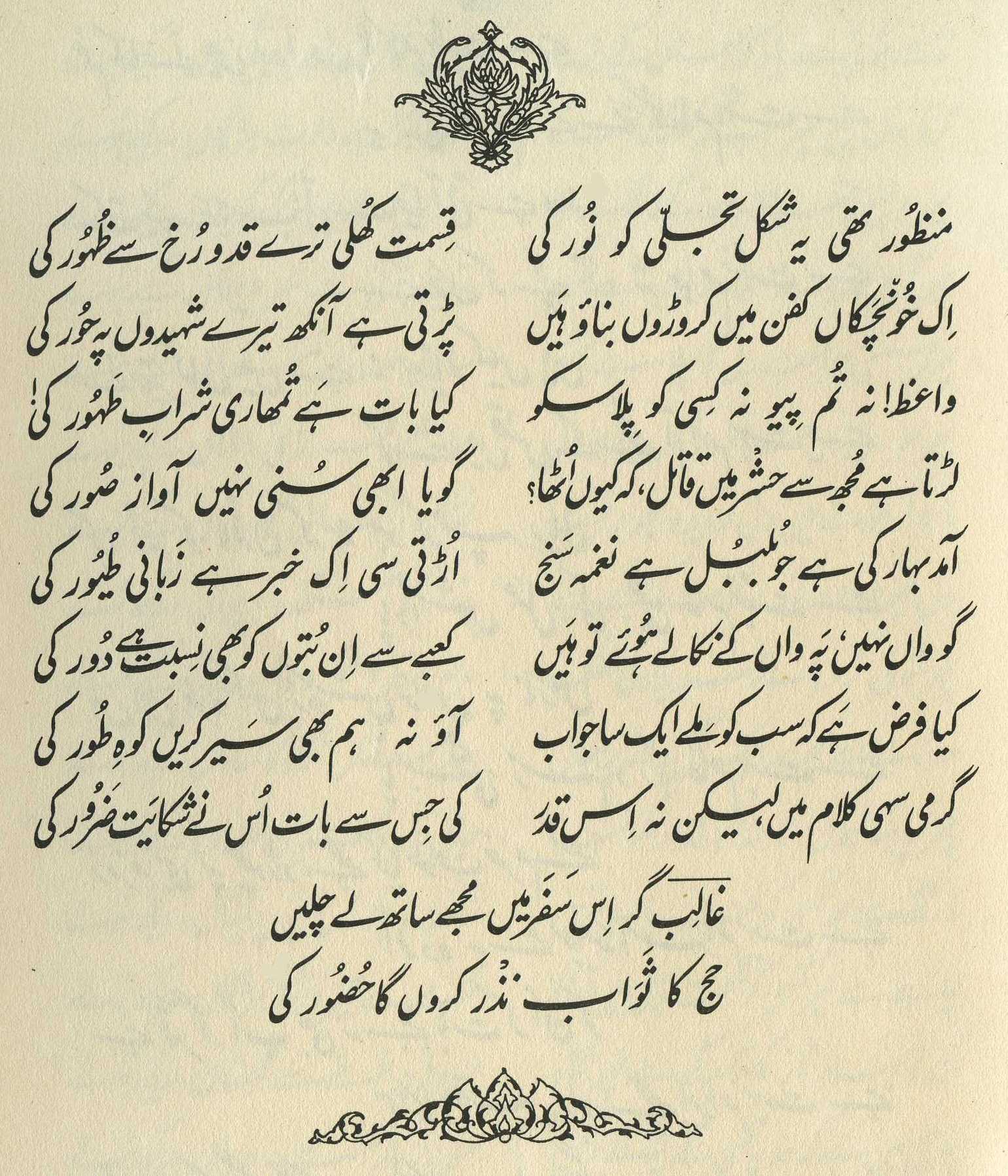
That is, Glory was waiting for your stature and face: 'If such a form would be available, then in it I would manifest myself'. (261)
== Nazm page 261

He says, the Divine Glory wished to manifest itself in your radiant [] aspect. As if the fortune of Manifestation had opened up through the heart-attracting beauty of your stature and face. (318)
The Lord's Glory wanted to manifest itself-- that is, Eternal Beauty had an ardor for self-display and a relish for dispensing glory/appearance. But it considered it contrary to its dignity to manifest its glory in [just] any shape. Thus when your radiant shape had been made, then it manifested itself. (486)
It's impossible to decide for sure what the 'midpoint' phrase 'of light' [] modifies. Right there in the line itself-- in fact, right next to each other-- are the two feminine nouns and . To choose the former would be to attribute to the addressee-- who is surely the beloved-- a brilliance or quality 'of light' that seems semi-divine (1a). To choose the latter would link the quality 'of light' to the (apparently) divine Glory (1b).
The commentators generally go for (1a), and for once I agree with them. Mostly because it's piquant to attribute a shape or form of pure light to a human, while it's humdrum to attribute it to God. But of course, the choice is more interesting than either alternative in isolation, since it opens up a wider range of interpretive possibilities.
The verse is full of wordplay based on sight and seeing, and at the heart of it is , literally 'seen', which by extension means 'desired, admired, chosen' (see the definition above); this one word in itself connects the 'seeing' imagery to the 'choosing' theme of the verse.
It's also a fine mushairah verse. The first line sets us up for how fortunate someone-- the beloved, we of course assume-- is, to have a form uniquely chosen by God. Then the second line seems to continue in this vein, almost all the way through: we get 'the fortune opened up'; then we get 'your stature and face'-- only at the end do we get the postposition 'through', followed at once at the last possible moment by the punch-word, .
Only then do we realize that we're congratulating-- not the beloved for being singled out in this way, but 'Manifestation' itself, for the increase in dignity and auspicious fortune it receives by having God and the beloved somehow ineffably joined through its own good offices. In short, we don't congratulate the chosen beloved for the manifestation of her radiance, we congratulate 'Manifestation' for the chosen beloved's radiance. In the ghazal, the human and/or transcendant trumps the natural world every time. And in this wildly abstract verse, 'Manifestation' is the nearest we get to the natural world.
Compare 40,6x .
graphics/lightform.jpg