Verse 51851uurkii
G3
1
it's the coming of spring, {since / in that / so that} the Nightingale is a melody-singer
2
it/there is a single/particular/excellent/unique 'flying-ish news' from the tongue of the birds
'Flying report; rumour'.
'Of or by or from the tongue, traditional, oral, verbal, viva voce; nominal, mere'.
| References | |
|---|---|
| Arshi, Imtiyaz Ali | Ghazal# 223 |
| Raza, Kalidas Gupta | 412 |
| Hamid Ali Khan | Open Image |
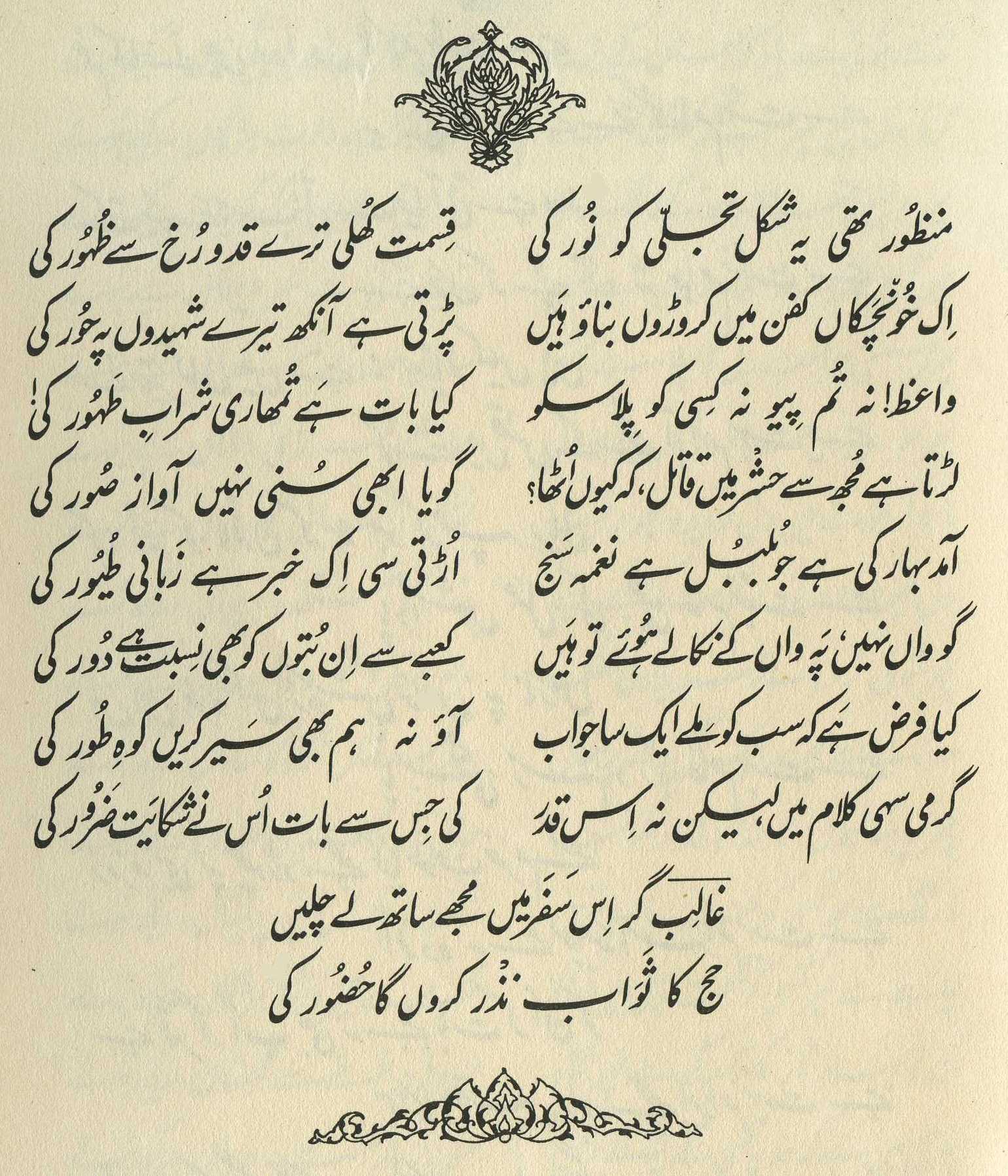
That is, the Nightingale's melody is the 'flying news' of the spring. This simile is extremely eloquent []; and to do it justice, it is new. (261)
== Nazm page 261

He says, the Nightingale's melody-singing is not without cause. It seems that now the spring is about to come. Although perfect confidence cannot be claimed, because a 'flying-ish news' has been heard-- and that too not through the words of some trusted one, but through the words of birds. (318)
From the Nightingale's melody-singing it seems that spring is about to come. But since this news is being heard from the tongue of a bird, one doesn't understand whether to have confidence in it or not. Although from outward circumstances and moods, it appears that spring is coming. (487)
Zauq too has made fine use of the theme of 'flying news':
[your restless prisoner would pick up the cage and fly away with it
if from the spring breeze he would hear a 'flying-ish news' of the rose]....
Since they also call a melody a 'voice or sound from the breath' [], and itself has the meaning of 'breath', or 'air', to call a melody a 'flying news' is an even more refined thing. But there's one more aspect as well: that the whole first line may be taken as 'flying-ish news'. That is, some birds have brought the news that now spring is about to come, and for this reason the Nightingale sings. In the whole verse the pearls of affinities are glimmering: 'coming', 'Nightingale', 'flying', 'news', 'from the tongue of', 'birds'; thus the verse seems even more beautiful.
The invention of a simile is itself a form of ' meaning-creation ', because in this way new meanings are bestowed on the object. Thus the verse has two meanings, as was mentioned above. And because of the affinities all the words of the verse provide support for each other's meanings. In this way the verse is an excellent example of 'meaning-creation'. It's possible that Ghalib might have taken the 'flying news' theme from Zauq, but because of supremacy of the simile and richness of meaning, Ghalib's verse has become a 'royal pearl'....
The tone of the verse too is an innate gift; that is, its flourishing fresh-imaginingness is very conspicuous. This style has remained very popular among Indian and Persian poets. Among Urdu ones, in Ghalib, and before him in Mir, this quality can be seen.
The below-mentioned verse of Sauda 's might have been in Ghalib's mind, but still, Ghalib's simile remains untouched:
[he hears the lament of the garden bird, oh Cupbearer
spring comes, the Nightingale has begun to tell the news]
== (1989: 369-70) 2006: 397-98
../apparatus/txt_sets.html On this multivalent use of , see 12,2 . Thanks to its versatility, we can read the relationship between the two clauses in a variety of ways:
=Because spring is coming, therefore the Nightingale sings.
=Because the Nightingale sings, therefore spring comes.
=Because the Nightingale sings, therefore we know that spring is coming.
=Spring is coming, naturally accompanied by the Nightingale's singing.
=What the Nightingale sings is 'Spring is coming'.
As usual, we have no way of resolving these multiple possibilities, and we look to the second line for any hope of clarification. But of course the second line starts afresh and offers us new complexities. If we read the second line as 'it is a single/special flying-ish news from the tongue of the birds', then we have to ask what the 'it' is. Presumably something in the first line, but what exactly? That the spring is coming? That the Nightingale is singing? And do the 'birds' include the Nightingale, or is he to be taken as a separate (superior) singer and harbinger of spring?
And if we read the second line as 'there is a single (special, etc.) flying-ish news from the tongue of the birds', we have even more possible ways to connect it to the first line. Is the 'flying-ish news' news that the spring has come, and/or that the Nightingale is singing, or is it something else entirely? Might the rumor from the ordinary birds be different from what the Nightingale is singing? After all, their report is just a rumor, a 'flying-ish news', while his might be something else entirely. And it's also just 'one' or 'a single' [] such rumor (though possibly special, etc.). Might that mean it's just one story or rumor among many that we hear, or one among many that they tell? Or might it refer to unanimity, with all the birds spreading the same bit of gossip? And how trustworthy are the birds as reporters-- even reporters of gossip?
In other words, it's not clear how reliable is the word that spring has come, and who is spreading the word, and why. Yet it's a funny thing to be suspicious about! Spring does come, and why would anyone lie about it? What would anyone have to gain? Perhaps because the spring is so desperately longed for and so eagerly awaited-- perhaps observers are prone to jump the gun and spread the good word prematurely.
Ultimately, all the grammatical complexities and possibilities fall away; it's the idiomatic expression 'flying news' [] that is at the heart of the verse, as Nazm observes. And the association with birds is so perfect that surely nobody could fail to enjoy it; it creates such a fresh and vivid springtime mood . In his usual style, Ghalib has contrived to use the expression both idiomatically and in its literal sense.
graphics/flyingbirds.jpg