Verse 91851oaa))e
G13
1 a
that gathering of coquetry-- what a [grand] thing it is, Ghalib!
1 b
what is it about that gathering of coquetry, Ghalib?
1 c
that gathering of coquetry-- what is it [worth], Ghalib?!
2
even/also we went there-- and came back having bewailed your fate!
'Measuring; apportioning (subsistence or daily bread); ordering, ordaining, decreeing; — thinking, considering, supposing; the ordaining of Providence; the Divine decree; predestination; fate, destiny, lot'.
| References | |
|---|---|
| Arshi, Imtiyaz Ali | Ghazal# 216 |
| Raza, Kalidas Gupta | 413 |
| Hamid Ali Khan | Open Image |
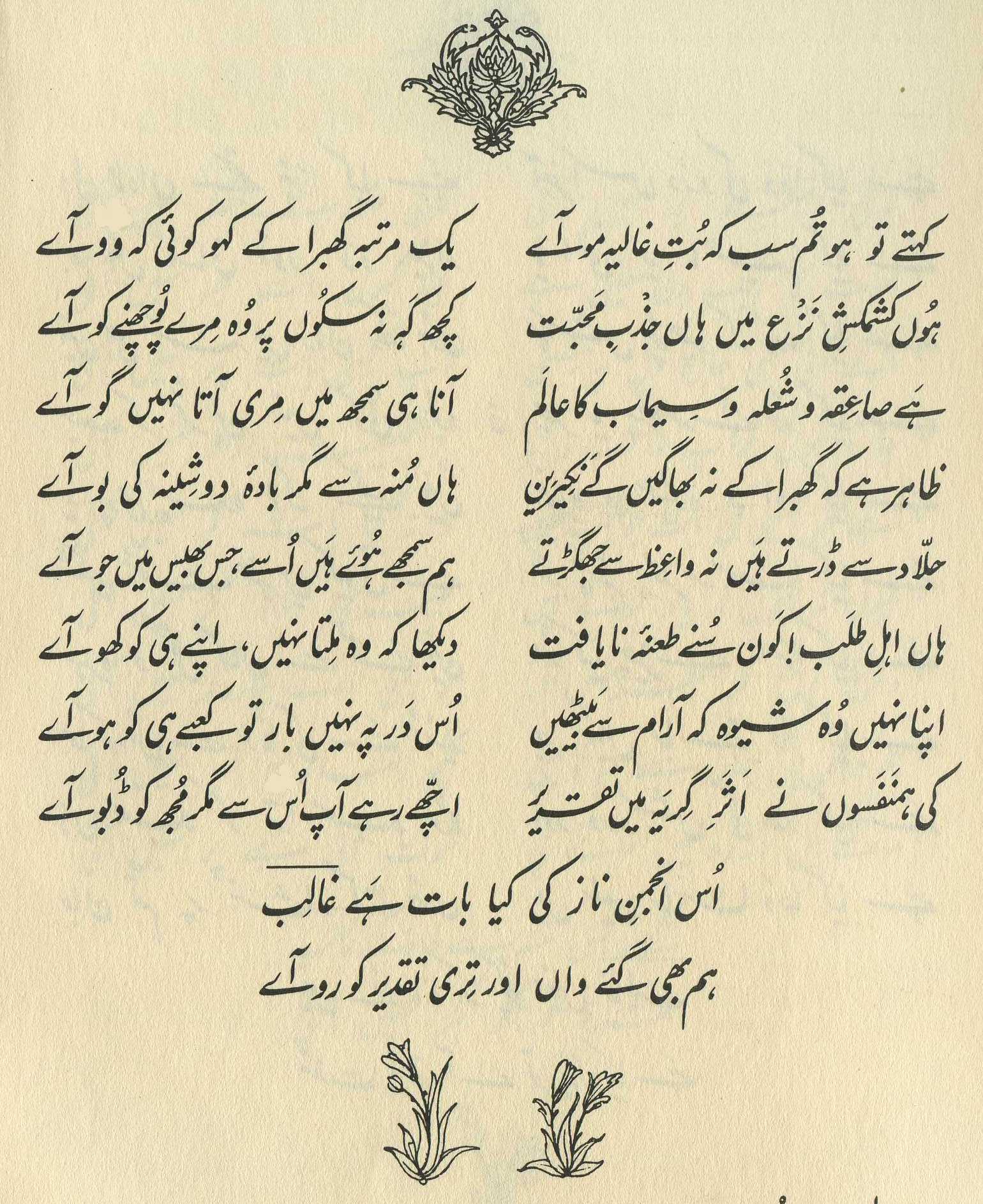
That is, having gone there and described to her your stricken and wretched condition, we came back. Zafar too has used well:
[how can there be happiness, when weeping is in one's fate?
like a candle we, even in the gathering of joy, wept and came away] (177)
== Nazm page 177

He says, that gathering of coquetry-- that is, your beloved's gathering-- oh Ghalib, is worthy of praise. Nobody is prevented from going there, friends and enemies and everybody gather there. There is laughter and joking-- in short, they enjoy the pleasures of companionship. It's your misfortune that you are deprived of going there, and can be prevented from access. (236)
The beloved's gathering-- how can it be described []! We too went there, and to the extent that our tongue aided us, we left no stone unturned to recommend you. But alas-- she wouldn't hear of it.
-- from this phrase, it is clear that the speaker has himself been affected by the flourishingness, splendor, ornamentation, and so on of this gathering, and now he understands even better that if Ghalib dies in the attempt to enter it, it's no cause for surprise.
From it is clear that other people too have previously gone with such a recommendation, and returned. But his fault was not forgiven, or permission for his coming was not granted. Thus even in a worldly respect, the conditions of lover and beloved are as different as earth and sky, for in no way does she agree to his coming into the gathering. (318)
The calm assurance of the commentators in singling out exactly one meaning for a verse is something that still surprises me. As they describe this effortlessly luxuriant garden of a verse, one that sprouts not little tendrils but giant thick banyan-trunks of meaning all over the place, you'd think they were talking about a telephone pole.
The idiomatic expression is as common as 'That's really something!', and is even more versatile (since it can also be a question). At a minimum, both expressions convey nothing more than sheer astonishment, sheer exclamatory force. Is it something remarkably good, remarkably bad, or simply remarkably strange and thus indescribable? From the expression itself, nobody can possibly tell. Bekhud Mohani echoes it with -- another common idiomatic phrase of almost equal multivalence. For another, similarly complex example of , see 231,3 ; and see also the more general discussion in 59,2 .
Thanks not only to the idiomatic expression, but also to the wonderfully handy triple possibilities of itself, the first line can be an exclamation of pleasure and admiration (1a), a genuine question (1b), or an exclamation of rejection or disdain (1c). Since we can't tell in what tone to read the first line, we hope for guidance from the second line-- for which, under mushairah performance conditions, we're made to wait as long as is conveniently possible. And then what do we get? A line that is itself multivalent, and that can (by no coincidence) resonate in more than one way with each of the three readings of the first line.
'Even/also we went' means that the speaker went in addition to one or more others-- but who are the others? Well, they could be Rival s, miscellaneous members of the gathering, other friends of the lover, and/or the lover himself. For, commentators to the contrary, it's quite possible that the speaker went to check out where the lover had been spending his evenings, and in the verse is reporting his impressions.
And finally, why did the speaker bewail the lover's fate, and then come away from the gathering? Here are some obvious possibilities:
=He saw that the gathering was so irresistible that the lover's being excluded from it was truly tragic; he bewails the lover's sad loss (this is the commentators' reading).
=He saw that the gathering was so irresistible that the lover was doomed to slavery to the beloved for the rest of his life, and would end up sacrificing his life for her; he laments this unavoidable doom.
=He saw that the gathering was so full of Rivals, and the beloved so fickle, that the lover had no possible hope of success in his mad passion; he laments the lover's desperate folly.
=He saw that in the gathering the lover was treated so humiliatingly, that he berates the lover for enduring it (see 97,5 for a classic example of this kind of humiliation).
=He saw that the gathering was of an ambiguous, perplexing, and perhaps ominous nature, and now inquires about the lover's dangerous fixation on it.
=He saw that the gathering was a disgusting show of meretricious gaudiness and vulgar and cruel behavior; he laments the lover's lack of insight into its real nature.
Here in less than twenty words is a kind of encyclopedic overview of the lover's whole destiny.
graphics/partylights.jpg