Verse 81851oaa))e
G13
1
companions/'breath-sharers' discoursed/speechified on the effect of weeping
2
they were fine/'good' with it-- but they came back having exhausted/'drowned' me
'To speak, discourse (of); to relate, recite, declare, assert, &c.'
'To speak; to relate; to affirm; to reason, argue, dispute'.
[of which is a variant]: 'To submerge, drown, flood; to lose, waste, exhaust, sacrifice, ruin, destroy'.
| References | |
|---|---|
| Arshi, Imtiyaz Ali | Ghazal# 216 |
| Raza, Kalidas Gupta | 413 |
| Hamid Ali Khan | Open Image |
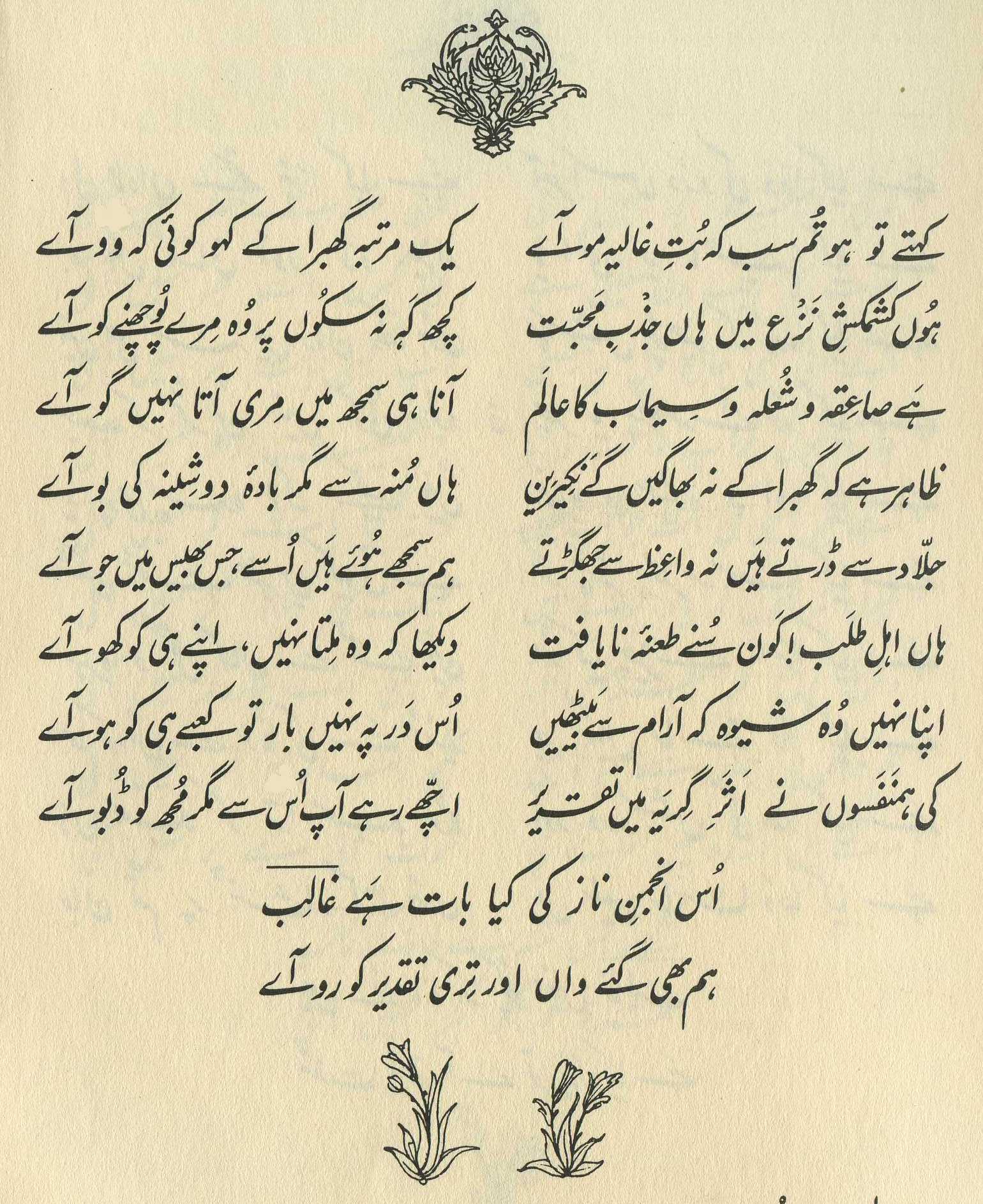
The idiom is , that is, 'we don't believe it'. The author has used it in such a way that in place of he has said ; and from using the idiom in this way, no meaning remains. (176)
== Nazm page 176

He says, my companions made a speech to the beloved about the effect of weeping-- that is, they argued that weeping had an effect; but they were not able to prove it. And on this basis when the beloved said, 'If weeping had an effect, and what you are making this argument for were true-- that is, that he keeps weeping night and day over me, and that this weeping will have an effect on me, will influence my life-- this is absolutely mistaken, it is not so at all. For if letting tears fall had an effect, then at this moment I would be in the presence of the weeper.'
Having heard this, my companions were convinced of the ineffectiveness of weeping, and having lost hope, came back. After having become convinced, these people had the advantage of having conversed with her, but they 'drowned' me-- that is, their becoming convinced of the ineffectiveness of my weeping was a cause of shame for me. A second aspect in this is that they told the beloved the state of my weeping, which I had always kept hidden. Now after its becoming apparent, in her eyes I will become contemptible. (236)
That is, when the beloved said to her companions, 'If weeping is from the heart, there's no reason it wouldn't have an effect', then the companions agreed with her. The lover says, you people have agreed with everything she said and thus pleased her, and have left me in an awful position. That is, previously the beloved perhaps thought that the lover couldn't endure much from her, and thus showed mercy. But now she considers that his weeping isn't from the heart, and will treat him even more disdainfully, and will even be free of blame for her disdain.
[In refutation of Nazm's criticism:] When that meaning [of mine] has been presented, then he didn't use the idiom at all. If he had used , then it would have become difficult to express the meaning of the verse. In order to avoid the well-known idiom, Mirza didn't say , but . In addition, to use an idiom in the Lord knows how many forms-- those Ustads have held this permissible, who were the bearers of the Urdu language and Urdu poetry. (317)
An opening-verse of the late Hijr Shajahanpuri comes to mind. In it too, the use of 'to drown' is enjoyable:
[from tear-shedding that heart-stealer became even more irritated
our wet eyes took and 'drowned' us even more] (284)
Nazm believes that Ghalib means to say that the companions disputed or cast doubt upon the effect of weeping. Thus he accuses Ghalib of having misused a common idiom in an obscure, almost incomprehensible way, because such a negative meaning could easily and colloquially have been achieved through , but can't be achieved through with anything like the same strength or legitimacy.
Bekhud Mohani (supported by Bekhud Dihlavi) is convinced that Ghalib means to say that the companions defended or affirmed the effect of weeping. Thus he finds Nazm's whole approach wrongheaded: the reason the poet didn't say was that he didn't mean , in its idiomatic negative sense; why should he be reproached for tampering with an idiom that he never meant to use in the first place?
But what the companions really did was converse, discuss, or speechify 'about' or 'on'-- literally 'in' []-- the subject of the effect of weeping. Surely it's not by accident that Ghalib hasn't specified exactly what they said about it. All we know is that they enjoyed their discussion (they were 'fine with' it-- or it was 'very well for them')-- while the lover himself was 'drowned' by it. Nothing in the verse invites Bekhud Dihlavi's and Bekhud Mohani's elaborate scenarios about the companions scoring (or not scoring) debating points in the presence of the beloved (although there's nothing against those scenarios either).
All we are really sure of is the fact of the discussion itself, and its effect on the lover. Perhaps some of the companions maintained that weeping is ineffective and vain-- and the lover's heart sank at the futility and uselessness of his one means of winning the beloved's attention. Others of them argued that weeping can't fail to have an effect-- and the lover's heart sank at the realization that he alone is cursed with uniquely ineffective tears, and that no one understands the true wretchedness of his plight. Or perhaps it was merely the discussion itself-- the light-hearted treatment of a topic so dire, the outflow of casual words going on and on, people laughing and scoring points-- while the lover himself was in the grip of mortal suffering.
In any case, the result is the same: the discussion, so enjoyable for everybody else, has ultimately ruined or exhausted or, in an elegant bit of wordplay that is surely the origin of the verse, 'drowned' the lover. The lover is 'drowned' by mere discussion of tears-- how vulnerable he must be to the tears themselves! Adding to the wordplay is the reference to the companions as 'breath-sharers' [] and the fact that the root of is , 'to pour' (Platts p.330) (though I don't know whether this derivation would have sprung readily to mind). The flow or torrent of speech, with its expenditure of 'breath' ('Don't waste your breath!'), is a source of lively pleasure and a sign of vitality to others. But it's something that can 'drown' the lover-- and deprive him of the small amount of 'breath' that he still has left.
graphics/tearflood.jpg