Verse 21851oaa))e
G13
1
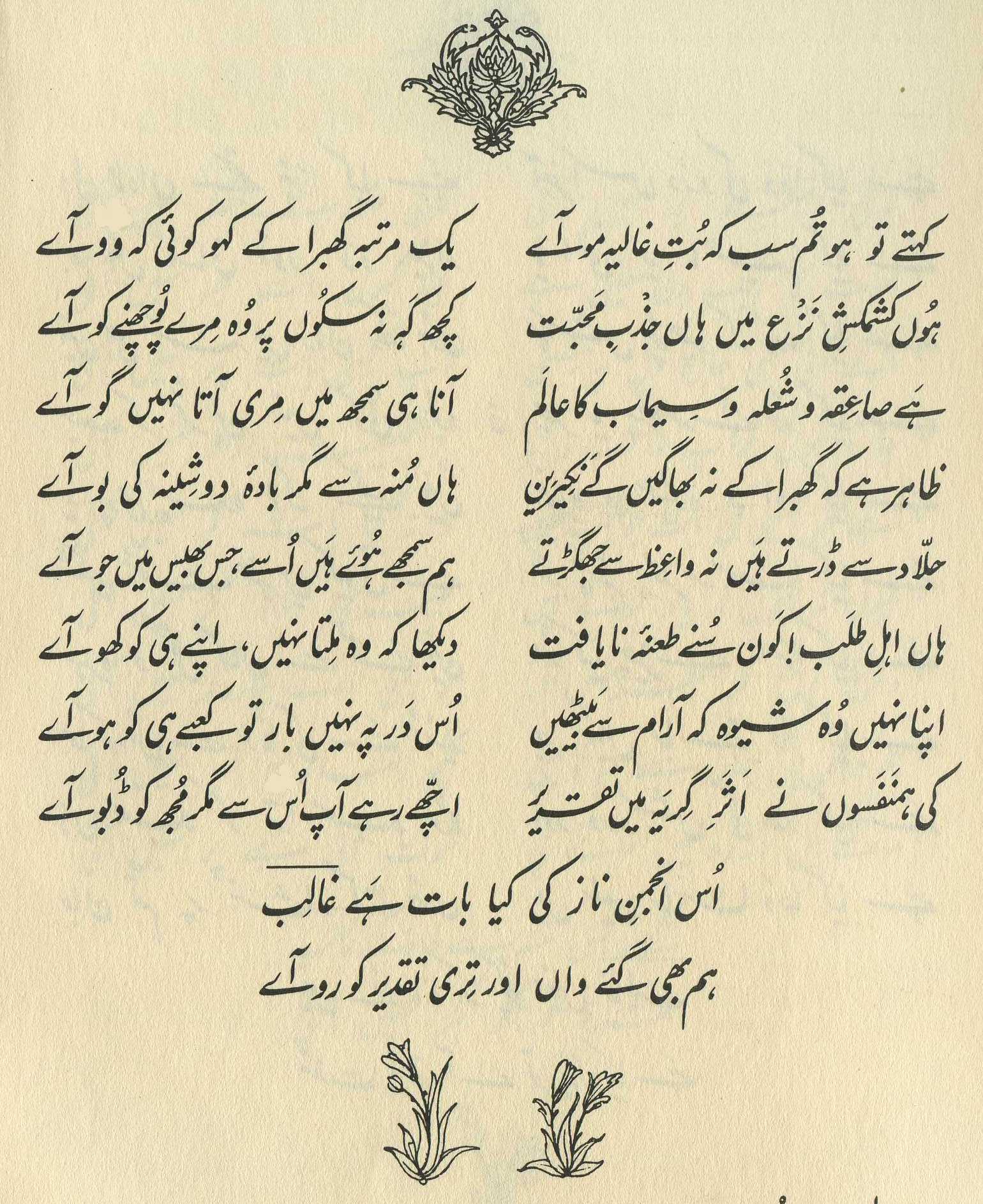
I'm in the struggle/'tug-of-war' of the death agony-- indeed, attraction of love--
2
I might/would not be able to say anything-- but may she come to ask after me!
'Repeated pulling; pulling backwards and forwards, or to and fro; ... struggle, contention, wrangle, squabble; attraction, allurement'.
'Drawing, attraction; allurement; absorption'.
| References | |
|---|---|
| Arshi, Imtiyaz Ali | Ghazal# 216 |
| Raza, Kalidas Gupta | 413 |
| Hamid Ali Khan | Open Image |
This rhyme -word too Zafar has composed well:
[even if she would come, the moment she came she would begin to draw her face away
she wouldn't 'come'-- she would come to draw a knife over my throat] (163,2)
== Nazm page 175

At this time I am absorbed in the struggle of the death agony, but indeed, oh attraction of love-- gradually you too please show me an attractive power []! It's obvious that I have no strength left to talk, but let her come to ask about me. So what if I can't answer-- so be it. (234-35)
Even now, when I am in the death agony, I feel the wound that she has never even asked about me-- may this wound not remain! In addition, even in the death agony, the beloved is remembered.
[Zafar's verse] is very clear, and the flowingness of a river would be ashamed before it. But there's no doubt of the staleness of the theme . Some Ustad says:
[turning aside her gaze, she excuses herself from union
she slaughters us with a reversed knife-blade] (314-15)
Here is a verse of wordplay (and meaning-play too of course) between different kinds of 'pulling', 'tension', 'drawing' (in the sense of 'attraction', not picture-creation). The struggles of the death agony are a tug-of-war, as the sufferer is pulled back and forth on the borderline between death and life. Even in this desperate and hopeless condition, the lover is 'pulled' by the longing for the beloved. And in his longing he hopes that the drawing power of love can somehow 'pull' her toward him, so that she'll (perhaps only politely?) come to inquire about his condition.
Moreover, the relation between the two lines has been carefully rendered complex by the clever phrase , 'indeed, attraction of love'. Is the phrase a vocative, an address to a quasi-personified entity called 'Attraction of Love'? Or is it a shorthand for something like, 'just look at the attraction, the drawing-power, of love!' or 'what attraction, what drawing-power, love has!'? The ambiguities open up several possible relationships between the lines:
=Lines 1 and 2 both straightforwardly describe the same situation: the lover is dying, and he desperately longs for the beloved to come to him.
=Line 1 describes the lover as dying of passion itself, as the 'drawing-power of love' wracks him with a death-agony. Line 2 then illustrates the full, paradoxical agony of his situation: desire for her is killing him, and even as he dies of it he still vainly craves for more of it.
=Line 1 describes the lover as a classic medical (or psychological) case of the 'attraction of love'; Line 2 illustrates the diagnosis by showing the symptoms: even as he's dying, so that her coming will be useless, he still longs for her to come to him.
=Line 1 is a pathetic exclamation addressed to 'Attraction of Love', inviting this entity to notice, or sympathize with, or feel proud or ashamed of, the dying lover's sufferings, as described in Line 2.
=Line 1 is a specific appeal to 'Drawing-power of Love' to help out a dying lover; Line 2 is a request for this entity to 'draw' the beloved to the lover's bedside.
Then there's the secondary ambiguity of 'I might not be able to say anything' [], which can have two senses:
=Because the lover is in his death-agony he can't speak, and thus can't express his longing for her to come, but the longing is still there.
=If she comes, he might not be able to speak to her, but he still longs for her to come.
Really the cleverest word is the colloquial and exclamatory little , which opens so many imaginative possibilities. It implies that the verse is enmeshed in some larger discussion-- while leaving us to decide for ourselves what form that context might take.
graphics/deathbed.jpg
